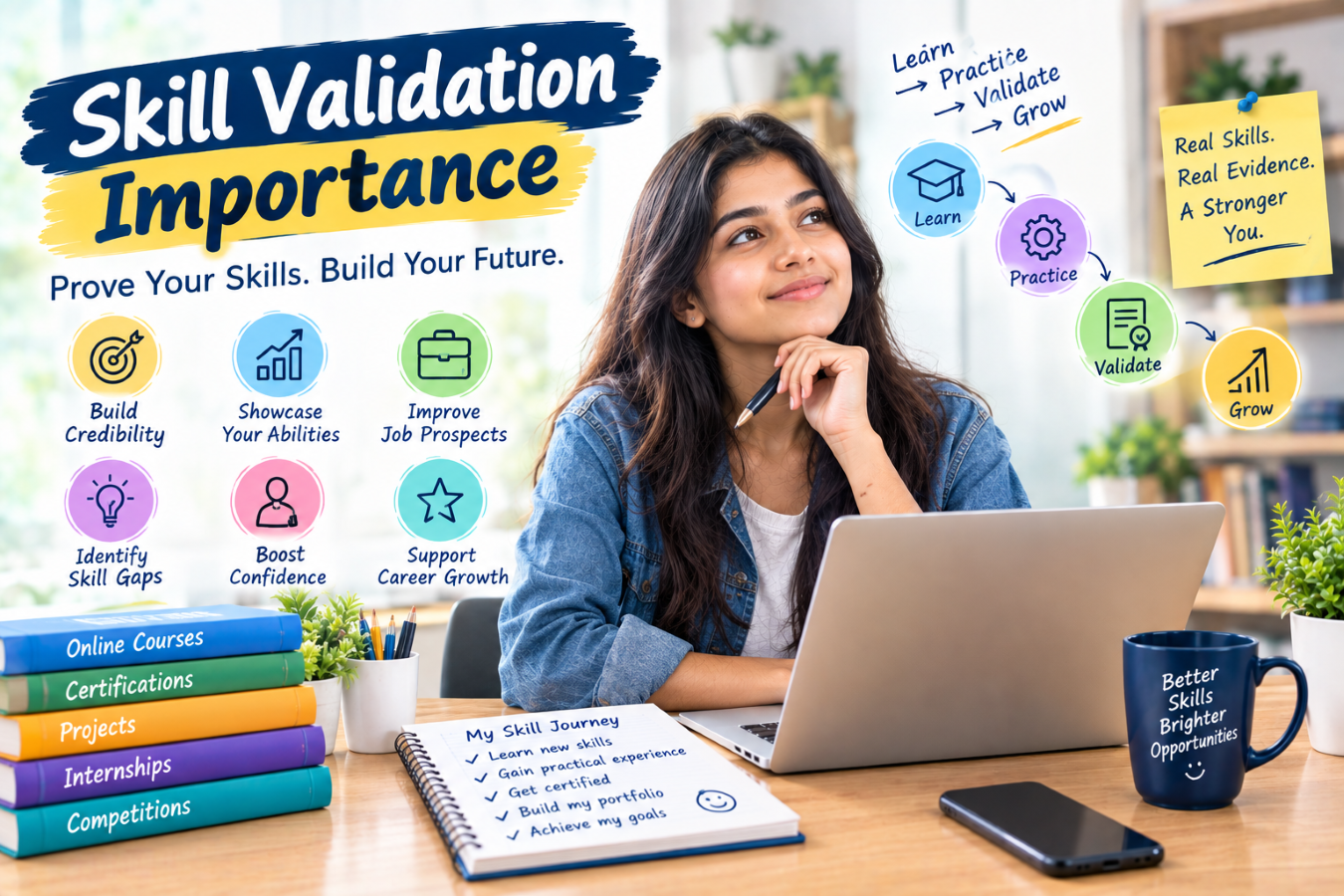
In today’s competitive education and employment environment, having knowledge is important, but being able to demonstrate what you can actually do is equally valuable. Students may complete courses, attend workshops, earn certifications, or study subjects extensively, but employers and organizations often need evidence that a candidate can apply that knowledge in practical situations. This is where skill validation becomes important.
Skill validation is the process of confirming that a person genuinely possesses a particular skill through assessments, projects, practical demonstrations, certifications, portfolios, internships, competitions, or other forms of evidence. For students, it can help transform an abstract claim such as “I know data analysis” into something more meaningful: “I have applied data analysis to real projects and can demonstrate the results.”
At cvDragon, we believe students should focus not only on learning skills but also on creating credible evidence of those skills. Skill validation can help students understand their capabilities, identify gaps, build professional confidence, and communicate their strengths more effectively when applying for internships, jobs, and other opportunities.
What Is Skill Validation?
Skill validation means providing evidence that demonstrates a person’s ability to perform a specific task or use particular knowledge effectively. The evidence can take many forms depending on the skill.
For example, a programming student can validate their skills through applications, GitHub projects, coding challenges, or technical assessments. A marketing student can demonstrate their abilities through campaign projects, content portfolios, market research, or analytics work.
Similarly, communication skills can be demonstrated through presentations, public speaking activities, interviews, or leadership experiences.
The important distinction is between claiming a skill and demonstrating a skill. A resume may say that someone has excellent problem-solving abilities, but a completed project or competition experience can provide supporting evidence.
Why Skill Validation Matters for Students
Students often face a challenge when entering the professional world: they may have limited formal work experience.
This does not necessarily mean they lack valuable abilities. Academic projects, internships, competitions, certifications, volunteer activities, personal projects, and extracurricular experiences can all provide evidence of skill development.
Skill validation helps students turn these experiences into recognizable proof.
It can help them:
- Demonstrate practical abilities.
- Build stronger resumes.
- Prepare for interviews.
- Identify skill gaps.
- Improve career confidence.
- Build professional portfolios.
- Support internship applications.
- Communicate skills more clearly.
- Make learning more purposeful.
Instead of simply saying they are prepared for a role, students can show how they have prepared.
Learning and Validation Are Different
Learning a skill and validating a skill are related, but they are not the same.
A student might watch several tutorials about Python and understand the basic concepts. That represents learning. Building a Python application or successfully completing a coding assessment provides evidence that the student can apply that knowledge.
This creates an important progression:
Learn → Practice → Apply → Validate → Improve
Students should therefore think beyond completing a course. They should ask how they can demonstrate what they learned.
Validate Skills Through Practical Projects
Projects are one of the most effective ways for students to validate their abilities.
A project requires students to apply knowledge to a specific objective. Along the way, they may need to research, plan, troubleshoot, make decisions, and complete a final outcome.
For example:
A student learning web development could build a responsive website.
A student learning data analytics could analyze a public dataset and create a dashboard.
A student studying marketing could develop a sample digital campaign.
A student interested in finance could create a financial analysis project using publicly available information.
Projects provide tangible evidence that can be discussed during interviews and included in a portfolio.
Use Skill Assessments
Formal or informal assessments can also validate skills.
Students can take assessments that test:
- Technical knowledge.
- Coding ability.
- Language proficiency.
- Data analysis.
- Business knowledge.
- Digital tools.
- Industry-specific competencies.
A good assessment should measure something relevant and provide useful information about performance.
Students should not focus only on achieving a high score. Assessment results can also reveal areas that need further development.
Certifications as Skill Evidence
Certifications can provide another form of skill validation.
A certification may demonstrate that a student completed a structured learning program or successfully passed an assessment related to a particular subject.
However, students should understand that not all certifications serve the same purpose. Some demonstrate course completion, while others involve formal examinations or practical assessments.
Students should therefore research what a credential actually represents before using it as evidence of expertise.
A certification becomes even more useful when combined with practical projects or experience that demonstrate application.
Internships Provide Real-World Validation
Internships can offer particularly valuable evidence because students have the opportunity to apply their skills in a professional environment.
During an internship, a student may use software, contribute to projects, analyze information, communicate with colleagues, or solve practical problems.
These experiences can provide evidence that goes beyond classroom learning.
Students should keep track of the responsibilities they handle during an internship so that they can later describe their experience accurately on their resumes and portfolios.
Competitions Can Demonstrate Skills Under Pressure
Competitions provide another useful way to validate skills.
Hackathons, case competitions, coding contests, business challenges, design competitions, and research contests require students to apply their knowledge within specific constraints.
For example, a case competition can demonstrate problem-solving, research, teamwork, presentation, and decision-making.
A hackathon can demonstrate technical skills, creativity, collaboration, and time management.
The competitive environment can also show how students apply skills when they have limited time and resources.
Build a Portfolio of Evidence
A skills portfolio can bring different forms of validation together.
Students can include:
- Projects.
- Certifications.
- Internship experiences.
- Competition achievements.
- Presentations.
- Research work.
- Design samples.
- Technical demonstrations.
- Volunteer projects.
The portfolio should focus on meaningful evidence rather than simply collecting as many items as possible.
For every project, students can explain:
What was the objective?
What was my role?
Which skills did I use?
What challenges did I face?
What was the outcome?
This makes the portfolio easier for others to understand.
Use Feedback to Strengthen Validation
Feedback can add another layer of credibility to skill development.
Students can seek feedback from:
- Teachers.
- Mentors.
- Internship supervisors.
- Project teammates.
- Industry professionals.
- Competition judges.
For example, a student may complete a presentation and receive feedback about structure, clarity, and delivery. Applying that feedback and improving future presentations demonstrates continued development.
Validation should therefore not be treated as a one-time event.
Skill Validation Helps Identify Skill Gaps
One of the most useful benefits of validation is discovering what you still need to learn.
A student may believe they have strong programming skills until they attempt a complex project and discover difficulties with debugging or system design.
That discovery is valuable.
It gives the student a clear direction for future learning.
A useful process is:
Assess → Identify Gap → Practice → Reassess
This prevents students from assuming that completing one course means they have mastered an entire subject.
Connect Skills With Career Requirements
Skill validation becomes more useful when students connect it with their career goals.
Suppose a student wants to pursue data analytics. They may identify relevant skills such as:
- Excel.
- SQL.
- Statistics.
- Data visualization.
- Business communication.
They can then develop and validate these skills through courses, assessments, projects, internships, and competitions.
This creates a clear connection between career planning and skill development.
Skill Validation Can Strengthen a Resume
A resume becomes more convincing when skills are supported by evidence.
Compare:
Skills: Leadership, Communication, Problem-Solving
with:
Experience: Led a four-member team during a case competition, coordinated research activities, developed recommendations, and presented the final solution to a judging panel.
The second example provides evidence for several skills.
At cvDragon, we encourage students to connect their skills with real experiences whenever possible. A resume should communicate not only what students claim to know but also how they have used those abilities.
Prepare Better for Interviews
Skill validation can also make interview preparation easier.
Recruiters may ask candidates to explain a project, describe a challenge, or provide an example of how they used a particular skill.
Students who have documented and reflected on their experiences can answer these questions more naturally.
For example, instead of simply saying:
“I am good at teamwork.”
a student can explain a specific group project, describe their responsibility, discuss a challenge, and explain how the team reached its outcome.
Specific experiences provide stronger material for interview conversations.
Avoid False or Unsupported Skill Claims
Students should be careful not to exaggerate their abilities.
Claiming expertise without sufficient evidence can create problems during assessments or interviews.
Instead, students can accurately describe their level of experience.
For example:
- Basic knowledge of Python.
- Working knowledge of Excel.
- Experience using SQL in academic projects.
- Familiarity with digital marketing analytics.
- Practiced presentation skills through competitions.
Honest skill descriptions build credibility and give students a clear foundation for further development.
Validate Soft Skills Through Experience
Technical skills are often easier to test, but soft skills can also be validated.
For example:
Leadership: Coordinating a student event.
Communication: Delivering presentations.
Teamwork: Completing a group project.
Problem-solving: Participating in a case competition.
Time management: Completing a project under a fixed deadline.
The key is to provide examples that demonstrate behavior rather than simply listing the skill.
Create a Personal Skill Evidence Tracker
Students can make skill development easier by maintaining a simple record.
For each skill, they can track:
Skill: What ability am I developing?
Evidence: What have I done using this skill?
Feedback: What did others say about my performance?
Next Step: What should I improve?
For example:
Skill: Public speaking
Evidence: Three college presentations
Feedback: Strong content, improve delivery speed
Next Step: Practice slower and clearer speaking
This creates a practical record that students can use when updating their resumes or preparing for interviews.
Keep Validating Skills Over Time
Skills change with practice.
A student who is a beginner today may become proficient after several months of focused work. Conversely, a skill that is not used for a long period may become less familiar.
Continuous validation helps students monitor their progress.
Students can periodically reassess their skills through new projects, advanced assessments, internships, competitions, or professional experiences.
This turns skill development into an ongoing process rather than a one-time achievement.
The Role of Skill Validation in Career Readiness
Career readiness is not simply about having a degree. It involves understanding relevant knowledge, developing practical abilities, communicating effectively, adapting to new situations, and demonstrating what you can contribute.
Skill validation supports this process by connecting learning with evidence.
Students who consistently build and document evidence of their skills can develop a clearer professional identity.
They can answer important questions such as:
What am I good at?
What have I actually accomplished?
Which skills do I need to improve?
What evidence can I provide to an employer?
These questions can make career planning more focused.
Conclusion
Skill validation is an important part of student career development because it connects learning with evidence. Courses and academic education can provide knowledge, but projects, assessments, internships, certifications, competitions, portfolios, and feedback can help students demonstrate how they apply that knowledge.
At cvDragon, we believe students should focus on developing genuine skills and building credible evidence around them. A strong career profile is not created simply by listing qualifications. It develops through continuous learning, practical application, reflection, and improvement.
Students can follow a simple cycle:
Learn → Practice → Apply → Validate → Improve → Repeat
By following this approach, students can better understand their strengths, identify skill gaps, prepare for interviews, strengthen their resumes, and build confidence in their abilities.
The goal of skill validation is not to prove that a student knows everything. It is to demonstrate what they can do today while creating a clear path for what they can learn and accomplish tomorrow.
Leave a Reply