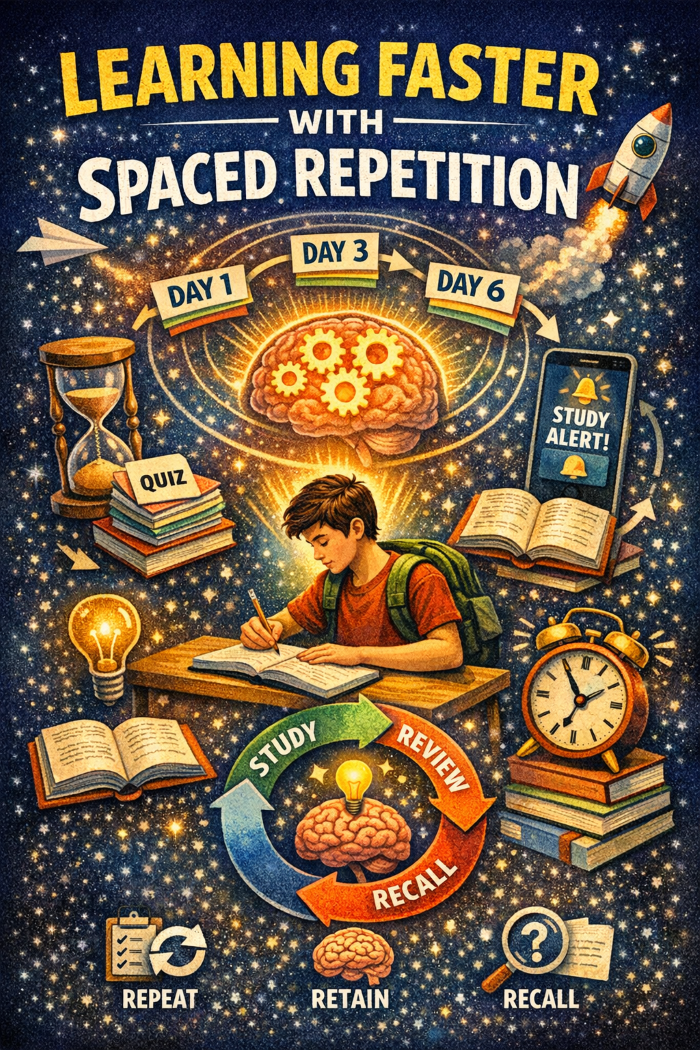
In today’s competitive academic environment, students are constantly searching for smarter ways to learn faster and remember information for longer. One of the most scientifically proven learning techniques is spaced repetition. Unlike traditional cramming, spaced repetition helps the brain store information in long-term memory by reviewing it at carefully timed intervals.
For students preparing for exams, competitive tests, or daily coursework, this method can significantly improve retention, reduce stress, and make learning more efficient. At CvDragon, we believe that smart learning strategies can transform academic performance, and spaced repetition is one of the most effective among them.
What Is Spaced Repetition?
Spaced repetition is a learning technique where information is reviewed multiple times over increasing intervals of time.
Instead of reading the same chapter repeatedly in one sitting, students revisit the material after a few hours, then a day later, then after several days, and later after a week or more.
This method works because the brain tends to forget information over time unless it is reinforced. By reviewing content just before you are about to forget it, you strengthen memory and improve long-term recall.
For example, if you learn a concept today, you might revise it:
- After 1 day
- After 3 days
- After 7 days
- After 15 days
- After 30 days
Each review helps the brain retain the information more deeply.
The Science Behind Spaced Repetition
Spaced repetition is based on the psychological concept known as the forgetting curve, introduced by German psychologist Hermann Ebbinghaus.
The forgetting curve shows that people forget newly learned information rapidly if they do not review it. In fact, a large portion of new knowledge can fade within a day.
However, every time the information is reviewed, the forgetting curve becomes flatter. This means the brain remembers it for longer periods.
In simple terms, spaced repetition trains your memory to hold information permanently.
Why Cramming Doesn’t Work
Many students rely on last-minute cramming before exams. While this may help with short-term recall, it is often ineffective for long-term understanding.
Cramming overloads the brain with too much information at once. The result is mental fatigue and poor retention.
Spaced repetition, on the other hand, breaks learning into smaller, manageable sessions spread over time.
This improves:
- Memory retention
- Understanding
- Recall speed
- Confidence during exams
Instead of learning more, students learn smarter.
How Spaced Repetition Helps Students Learn Faster
At first, spaced repetition may seem slower than cramming because it requires multiple review sessions. However, in the long run, it actually saves time.
Here’s how:
Better Long-Term Retention
Students spend less time relearning forgotten concepts.
When information stays in memory longer, revision becomes quicker and easier.
Faster Recall During Exams
Repeated reviews strengthen neural pathways in the brain.
This makes recalling formulas, definitions, and concepts much faster during tests.
Reduced Study Stress
Because learning happens gradually, students avoid the pressure of studying everything at the last moment.
This leads to calmer and more productive exam preparation.
Improved Concept Clarity
Frequent revision helps identify weak areas early, giving students time to improve.
Best Subjects for Spaced Repetition
Spaced repetition works exceptionally well for subjects that require memory and recall.
These include:
- Vocabulary and language learning
- History dates and facts
- Science definitions
- Legal terms and concepts
- Business theories
- Mathematics formulas
- Competitive exam preparation
It is especially useful for students preparing for entrance exams, board exams, or professional certifications.
How to Use Spaced Repetition Effectively
Students can follow a simple review schedule to make this technique work.
First Learning Session
Study the concept thoroughly and understand it well.
Focus on clarity, not memorization alone.
First Revision: Within 24 Hours
Review the material the next day.
This helps prevent rapid forgetting.
Second Revision: After 3 Days
Go through notes, flashcards, or practice questions.
Third Revision: After 7 Days
Test yourself without looking at the answers.
Fourth Revision: After 15 Days
Focus on weak areas and difficult concepts.
Final Revision: After 30 Days
Quick recap to strengthen long-term memory.
This cycle can be adjusted depending on exam timelines.
Use Flashcards for Better Results
Flashcards are one of the best tools for spaced repetition.
Each card contains:
- A question, term, or concept on one side
- The answer or explanation on the other side
Students can review flashcards regularly and separate them into groups:
- Easy
- Medium
- Difficult
Difficult cards should be reviewed more frequently, while easy ones can be reviewed after longer intervals.
This makes revision highly targeted and efficient.
Digital Tools for Spaced Repetition
Technology has made spaced repetition even more effective.
Several apps are designed specifically for this method.
Popular options include:
- Anki
- Quizlet
- RemNote
These platforms automatically schedule review sessions based on how well you remember each item.
This saves time and ensures optimal revision intervals.
Active Recall + Spaced Repetition
For maximum learning speed, combine spaced repetition with active recall.
Active recall means testing yourself instead of passively reading.
For example:
- Close the book and explain the concept
- Solve questions from memory
- Recite definitions aloud
- Write summaries without notes
When paired with spaced repetition, this method dramatically improves learning efficiency.
Students not only remember faster but also understand better.
Common Mistakes to Avoid
While spaced repetition is powerful, some students make mistakes that reduce its effectiveness.
Reviewing Too Late
Waiting too long between revisions may lead to forgetting.
Stick to regular intervals.
Passive Reading
Simply rereading notes is less effective than self-testing.
Too Much Content at Once
Break study material into smaller chunks.
Avoid overwhelming yourself.
Inconsistency
The success of spaced repetition depends on regular practice.
Missing multiple review sessions weakens retention.
Building a Daily Study Habit Around It
Students can easily integrate spaced repetition into their daily routine.
For example:
- Learn new topics in the morning
- Review yesterday’s content in the evening
- Revise older topics on weekends
This creates a balanced study system that keeps all subjects fresh.
Consistency is the key.
Final Thoughts
Spaced repetition is one of the most effective ways to learn faster and remember longer. Instead of depending on stressful last-minute study sessions, students can build stronger memory through planned and repeated revision.
At CvDragon, we encourage students to focus on smart study strategies that improve both performance and confidence. Spaced repetition is not just a study method—it is a science-backed system for long-term academic success.
Remember, learning faster does not mean rushing. It means using the right technique at the right time. With spaced repetition, every revision session brings you closer to mastery.
Leave a Reply