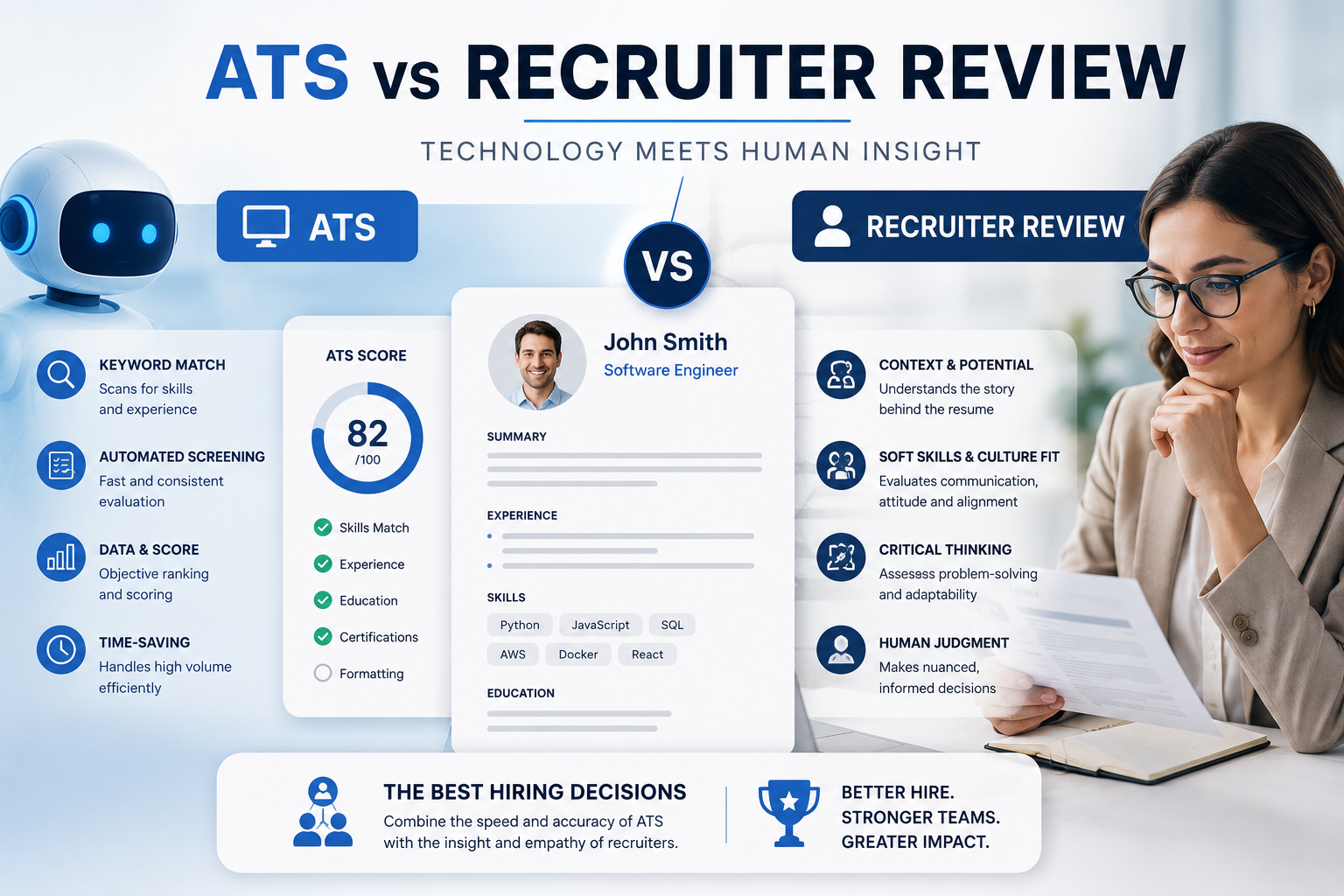
When applying for jobs online, your resume usually goes through two important stages before you get shortlisted: the Applicant Tracking System (ATS) and the recruiter review. Many job seekers focus only on one side of the process, but success depends on optimizing your resume for both.
Understanding the difference between ATS vs recruiter review can help you create a resume that passes automated screening while still impressing human recruiters.
At CvDragon, we guide candidates in building resumes that balance technology and human readability effectively.
What Is ATS?
An Applicant Tracking System (ATS) is software used by companies to collect, organize, filter, and rank job applications.
Popular ATS platforms include:
- Workday
- Greenhouse
- Lever
ATS acts as the first screening layer before a recruiter sees your resume.
What Does ATS Do?
ATS systems:
- Scan resumes for keywords
- Parse resume content
- Rank applications
- Filter unqualified candidates
- Organize applicant data
The software checks whether your resume matches the job description.
If your resume performs well, it moves to the next stage.
What Is Recruiter Review?
After passing ATS, your resume is reviewed by a human recruiter or hiring manager.
Unlike ATS, recruiters focus on:
- Overall impression
- Achievements
- Experience quality
- Career progression
- Communication clarity
- Professional presentation
Recruiters evaluate whether you are genuinely suitable for the role.
Key Difference Between ATS and Recruiter Review
ATS Focuses on Technical Matching
ATS looks for:
- Keywords
- Skills
- Job titles
- Formatting compatibility
It uses algorithms and automated screening.
Recruiters Focus on Human Value
Recruiters assess:
- Impact and achievements
- Communication quality
- Relevance of experience
- Career potential
- Personality indicators
They evaluate the story behind the resume.
How ATS Reads Your Resume
ATS systems scan resumes section by section.
They identify:
- Contact details
- Skills
- Education
- Work experience
The system compares your resume with the job description.
For example:
If the role requires:
- SEO
- Data Analysis
- Project Management
ATS searches for these terms in your resume.
Missing keywords can reduce your ranking.
How Recruiters Read Your Resume
Recruiters usually scan resumes quickly—often within a few seconds initially.
They focus on:
- Resume summary
- Key achievements
- Recent experience
- Measurable results
- Overall readability
Recruiters want clear evidence that you can solve problems and add value.
ATS-Friendly vs Recruiter-Friendly Resume
A strong resume should satisfy both systems.
ATS-Friendly Features
✔ Standard headings
✔ Relevant keywords
✔ Simple formatting
✔ Bullet points
✔ Single-column layout
Recruiter-Friendly Features
✔ Clear achievements
✔ Professional appearance
✔ Strong summary
✔ Easy readability
✔ Quantified results
The best resumes combine both approaches.
Common ATS Mistakes
Many resumes fail ATS screening due to:
- Missing keywords
- Complex formatting
- Tables and graphics
- Unusual section headings
- Keyword stuffing
Even strong candidates can get rejected if the ATS cannot read the resume properly.
Common Recruiter Rejection Reasons
Even after passing ATS, recruiters may reject resumes because of:
- Weak achievements
- Poor grammar
- Generic content
- Lack of relevance
- Long paragraphs
- Unclear career direction
Passing ATS does not guarantee interviews.
Example of ATS vs Recruiter Perspective
ATS Perspective
The system checks:
✔ Does the resume contain required keywords?
✔ Is the format readable?
✔ Does the candidate meet minimum criteria?
Recruiter Perspective
The recruiter asks:
✔ Has the candidate shown impact?
✔ Are achievements measurable?
✔ Is the experience relevant?
✔ Does the profile stand out?
Both perspectives are important.
How to Optimize for ATS and Recruiters
Use Relevant Keywords Naturally
Include terms from the job description, but use them meaningfully.
Focus on Achievements
Instead of:
“Responsible for managing social media”
Write:
“Increased social media engagement by 35% in 4 months”
Keep Formatting Simple
Avoid graphics, icons, and complicated designs.
Write a Strong Summary
Your summary should quickly explain your strengths and value.
Use Bullet Points
Bullet points improve readability for both ATS and recruiters.
Tailor Your Resume
Customize your resume for every role.
Generic resumes perform poorly in both ATS and recruiter reviews.
Which Is More Important?
Both are equally important.
Without ATS optimization, recruiters may never see your resume.
Without strong content, recruiters may reject it after viewing.
A successful resume must:
- Pass the system
- Impress the human reviewer
Final Thoughts
Understanding the difference between ATS and recruiter review is essential in today’s hiring process. ATS focuses on technical compatibility, while recruiters focus on real-world value and potential.
At CvDragon, we recommend creating resumes that are keyword-optimized, professionally structured, and achievement-focused. The goal is not just to pass software screening—but to convince recruiters that you are the right candidate.
Remember, a great resume speaks effectively to both machines and humans.
Leave a Reply