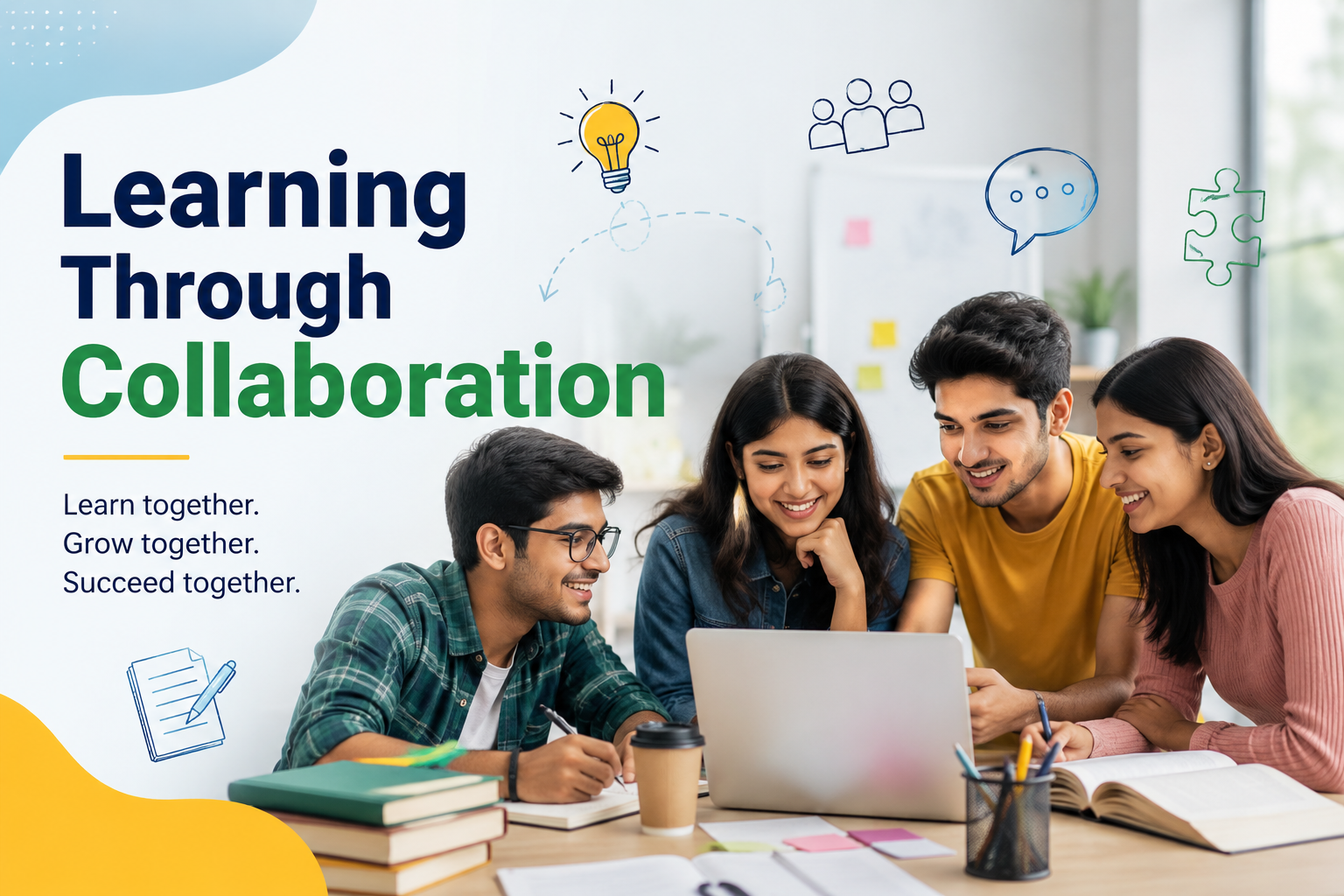
Learning Through Collaboration: How Students Can Learn Better Together and Build Career-Ready Skills
Learning does not always have to happen with a textbook, lecture, or a quiet study desk. Some of the most valuable learning experiences happen when students work with others, exchange ideas, solve problems together, and learn from different perspectives. This is the power of learning through collaboration.
Whether students are working on a college project, participating in a group discussion, preparing for an internship, or completing a practical assignment, collaboration can help them develop knowledge as well as skills that employers value. It teaches students how to communicate, contribute, listen, manage disagreements, and work toward a shared goal.
For students and freshers preparing for their careers, these experiences can be especially useful. Academic achievements may show what someone has studied, but collaborative experiences can demonstrate how they work with people—a quality that matters in almost every workplace.
What Is Learning Through Collaboration?
Learning through collaboration is a learning approach in which two or more people work together to understand a topic, solve a problem, complete a task, or achieve a common objective.
Instead of depending entirely on one person’s knowledge, collaborative learning encourages everyone involved to contribute. One student may explain a concept, another may find an example, and someone else may organize the information into a presentation.
For example, imagine four students preparing a presentation about digital marketing. One researches social media marketing, another studies SEO, a third prepares the presentation design, and the fourth coordinates the final content. While completing the project, each student learns from the others.
The result is more than a completed assignment. Students also practise communication, teamwork, problem-solving, time management, leadership, and accountability.
Why Is Collaboration Important for Students?
Students will eventually enter environments where they need to work with classmates, colleagues, managers, clients, or project teams. Learning to collaborate early can make this transition easier.
1. It Exposes Students to Different Perspectives
Two people can look at the same problem and arrive at completely different solutions. Working with others helps students understand that there may be more than one reasonable way to approach a task.
For example, during a group project, one student might focus on technical accuracy while another considers how the information will be understood by the audience. Combining both perspectives can produce a stronger result.
2. It Improves Communication Skills
Collaboration requires students to explain their ideas clearly and listen carefully to others.
Students learn to:
- Explain complicated ideas in simple language
- Ask questions when something is unclear
- Give constructive feedback
- Listen without immediately dismissing another opinion
- Present their ideas confidently
These communication skills can later help during interviews, presentations, meetings, and workplace discussions.
3. It Encourages Active Learning
When students explain something to another person, they often discover gaps in their own understanding.
Instead of simply memorizing information, they have to think about why something works and how to explain it. This makes learning more active and practical.
4. It Develops Teamwork and Responsibility
Group work teaches students that their contribution affects other people. If one member misses a deadline, the entire team may be affected.
This encourages students to become more responsible about deadlines, communication, and the quality of their work.
Key Benefits of Learning Through Collaboration
Better Problem-Solving Skills
Collaborative learning gives students opportunities to approach problems from different angles. A group can brainstorm possible solutions, compare their advantages and disadvantages, and decide which approach is most practical.
This is particularly valuable for students because employers often look for people who can do more than follow instructions—they want individuals who can think through problems.
Greater Confidence
Students who are uncomfortable speaking in front of others can gradually become more confident through regular collaboration.
A small group discussion can provide a less intimidating environment to practise expressing opinions before students move on to formal presentations or interviews.
Stronger Leadership Skills
Leadership does not always mean being the person in charge. A student can demonstrate leadership by taking initiative, organizing tasks, helping teammates, or making sure everyone has an opportunity to contribute.
For instance, a student who volunteers to create a project timeline and coordinates the team’s progress is already practising leadership.
Better Adaptability
Not every team member will think or work in the same way. Students may need to adjust their communication style, divide responsibilities differently, or reconsider an idea after receiving feedback.
Learning to adapt is an important part of becoming workplace-ready.
How Students Can Apply Collaborative Learning
Collaboration becomes more useful when students approach it intentionally rather than treating group work as simply dividing an assignment into sections.
Create Study Groups With a Clear Purpose
A study group works best when everyone knows what they are trying to achieve.
Instead of meeting simply to “study,” students could decide to:
- Solve a set of difficult problems
- Discuss a specific chapter
- Practise interview questions
- Review each other’s presentations
- Teach one another important concepts
A clear objective keeps the group focused.
Take Turns Teaching Each Other
One effective collaborative learning technique is peer teaching.
Suppose five students are preparing for an examination. Each student chooses one topic, studies it carefully, and explains it to the others.
The person teaching benefits by strengthening their understanding, while the rest of the group gets another explanation of the topic.
Work on Real-World Projects
Students can develop collaboration skills through practical projects outside regular coursework.
For example, a group of students interested in entrepreneurship could create a simple business idea, conduct basic market research, develop a presentation, and pitch it to their classmates.
This combines learning with teamwork, communication, planning, and presentation skills.
Practise Giving and Receiving Feedback
Feedback should not be limited to teachers or supervisors.
Students can ask teammates questions such as:
- Was my explanation clear?
- Which part of the presentation was strongest?
- What could I improve?
- Did I communicate my idea effectively?
Learning to accept feedback without taking it personally is an important professional skill.
Use Collaboration Tools Responsibly
Digital tools can make teamwork easier, particularly when students cannot meet physically. Shared documents, project-management platforms, messaging tools, and video meetings can help teams coordinate their work.
However, technology should support collaboration rather than replace individual thinking. Each student should understand and contribute to the final work.
Common Challenges in Collaborative Learning
Collaboration is useful, but it is not always easy. Students may encounter unequal participation, disagreements, missed deadlines, or communication problems.
Unequal Participation
Sometimes one or two students end up doing most of the work.
A practical solution is to divide responsibilities clearly and establish individual deadlines. Teams can also use a simple task list showing who is responsible for each activity.
Differences of Opinion
Disagreement is not necessarily a problem. In fact, constructive disagreement can lead to better ideas.
The key is to focus on the idea rather than the person. Instead of saying, “Your idea is wrong,” students can explain their concerns and suggest alternatives.
Poor Communication
A team can struggle even when every member is capable if expectations are unclear.
Students should communicate early when they face difficulties rather than waiting until the deadline is close.
Depending Too Much on Others
Collaboration should not become an excuse for avoiding individual learning.
Every student should understand the final project and be able to explain their own contribution. This becomes especially important when the project is discussed during an interview.
How Collaboration Can Strengthen a Student’s CV and Career Profile
Collaborative experiences can become valuable evidence of employability when students know how to present them.
Simply writing “Good teamwork skills” on a CV is not particularly convincing. A stronger approach is to demonstrate the skill through an experience.
For example:
Weak CV statement:
“Excellent teamwork and communication skills.”
Stronger CV statement:
“Collaborated with a four-member student team to develop and present a research project, coordinating responsibilities and meeting weekly submission deadlines.”
The second version gives context and shows how the student actually used the skill.
Students can highlight collaborative experiences from:
- Academic projects
- Internships
- Student clubs
- Competitions
- Volunteer activities
- Hackathons
- Case-study competitions
- Research projects
- College events
During interviews, students can also use these experiences to answer questions such as “Tell me about a time you worked in a team” or “How do you handle disagreements within a team?”
A good answer should explain the situation, the student’s specific contribution, the challenge they faced, and the outcome.
Building a Collaboration Mindset
Effective collaboration is more than dividing tasks. It requires a mindset of shared responsibility.
Students can develop this mindset by practising a few simple habits:
- Listen before responding.
- Respect different opinions.
- Complete assigned tasks on time.
- Ask for help when necessary.
- Offer help when teammates are struggling.
- Give useful, respectful feedback.
- Take responsibility for mistakes.
- Give credit to others for their contributions.
These habits may seem small, but they can gradually shape how students behave in professional environments.
Conclusion
Learning through collaboration gives students an opportunity to develop knowledge and career-ready skills at the same time. By working with others, students learn to communicate ideas, solve problems, manage responsibilities, accept feedback, and adapt to different perspectives.
The most valuable part of collaborative learning is that its benefits extend beyond the classroom. A well-managed group project can become evidence of teamwork on a CV. A challenging team discussion can become an interview example. A leadership role in a student project can demonstrate initiative to a future employer.
Students do not need to wait until their first job to start becoming effective team members. Every group project, study session, competition, or shared learning experience is an opportunity to practise.
Learn with others, contribute meaningfully, and turn every collaboration into a step toward becoming more confident, capable, and career-ready.
Leave a Reply