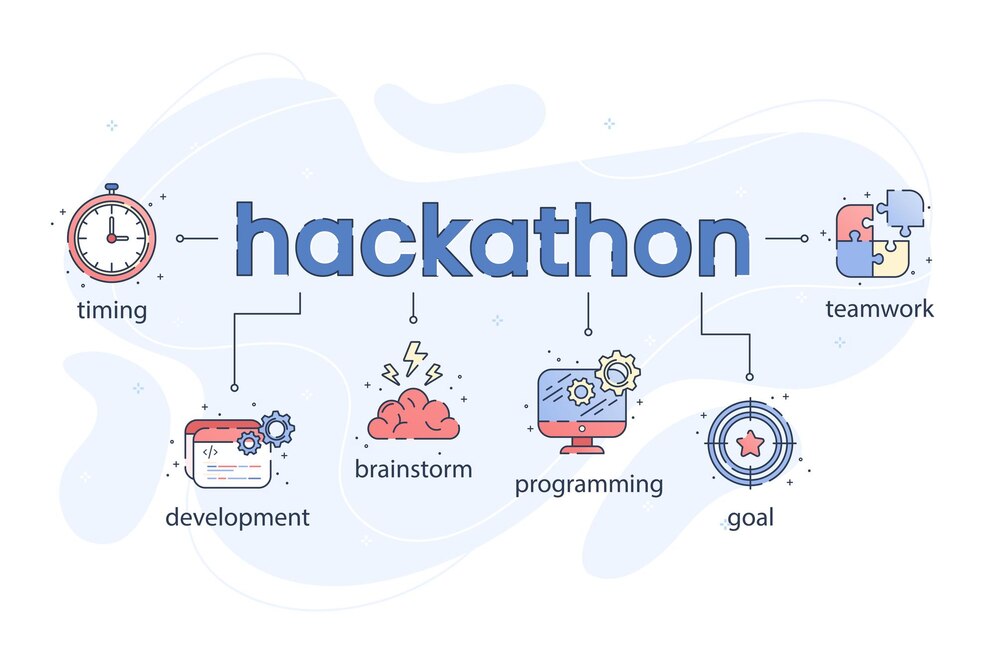
In today’s competitive job market, academic qualifications are only one part of a student’s career profile. Employers increasingly want candidates who can apply knowledge, solve unfamiliar problems, collaborate with others, communicate ideas, and adapt to changing technologies. This is why practical learning experiences have become so important for students preparing for their careers.
One of the most effective ways to gain this kind of experience is through hackathons. A hackathon gives students a limited amount of time to understand a problem, develop an idea, build a solution, work with a team, and present their results. Although hackathons are commonly associated with programming and technology, modern hackathons can cover areas such as business, healthcare, sustainability, education, design, artificial intelligence, entrepreneurship, and social innovation.
Research on educational hackathons has found that participants can develop skills including ideation, product development, leadership, resilience, teamwork, and interdisciplinary collaboration. For students, this makes hackathons much more than competitions. They can become practical learning environments where classroom knowledge is transformed into something useful.
What Is a Hackathon?
A hackathon is an intensive event where individuals or teams work on a specific problem or challenge and attempt to develop a solution within a defined period. Depending on the event, participants might have several hours, a full day, a weekend, or even several weeks to complete their projects.
The word “hackathon” is often connected with coding, but students from many educational backgrounds can participate. A technology student might build an AI-powered application, while a business student could develop a digital business model. A design student might create a user interface, and an engineering student could develop a prototype.
The central idea is simple: identify a problem, think creatively, build a solution, test it, and explain its value.
Why Hackathons Are Valuable for Student Skill Development
Traditional classroom learning is important because it provides theoretical knowledge and foundational concepts. However, students also need opportunities to apply what they learn.
Hackathons create that opportunity.
Instead of being given a textbook problem with a predetermined answer, participants often need to understand an unfamiliar challenge and decide how to approach it. This requires initiative, research, experimentation, and decision-making.
A study of extracurricular hackathons found that participants reported stronger appreciation for skills such as ideation, leadership, resilience, teamwork, and interdisciplinary collaboration.
For students, this means a hackathon can provide a practical environment for developing both technical and soft skills at the same time.
1. Hackathons Strengthen Problem-Solving Skills
Problem-solving is at the heart of every successful hackathon.
Participants usually begin with a problem statement rather than a step-by-step solution. They must understand the problem, identify the users or stakeholders involved, research possible approaches, and determine what solution is realistic within the available time.
This process teaches students to break large problems into manageable parts.
They may need to ask:
- What is the actual problem?
- Who experiences it?
- What causes it?
- What solutions already exist?
- What can we improve?
- What can realistically be built within the deadline?
These questions encourage analytical thinking and help students become more comfortable with problems that do not have obvious answers.
2. Students Learn by Building
One of the biggest advantages of hackathons is that students move from learning about something to actually doing something with it.
For example, a student may learn about machine learning in a classroom but struggle to understand how it works in a real project. During a hackathon, that student might use a machine-learning model to solve a specific problem.
The practical experience can make abstract concepts easier to understand.
Hackathons also encourage experimentation. Students may try a technology, discover that it does not work as expected, modify their approach, and test another solution.
This process develops a valuable mindset: failure during experimentation is part of learning.
3. Develop Technical Skills
Hackathons can be particularly useful for students who want careers in technology.
Depending on the project, participants may gain experience with:
- Programming languages.
- Artificial intelligence and machine learning.
- Data analysis.
- Cloud technologies.
- APIs.
- Databases.
- Cybersecurity.
- Internet of Things.
- Web and mobile development.
- UI/UX design.
- Version control and collaboration tools.
The important point is that students are not simply learning these technologies theoretically. They are using them to create something.
A GitHub survey of students participating in hackathons found that 80% reported exploring a new technology or service while working on their projects, while more than 90% said they learned new skills or ideas that were not covered in their coursework.
4. Improve Teamwork and Collaboration
Many hackathons are team-based, which makes collaboration an essential part of the experience.
A successful team may include people with completely different strengths. One student may be good at coding, another at research, another at design, and another at presenting.
Students therefore learn that they do not have to do everything themselves.
They need to communicate responsibilities, share ideas, listen to others, solve disagreements, and keep the project moving toward the deadline.
These are highly transferable workplace skills. Modern organizations often depend on teams made up of people from different departments and professional backgrounds.
5. Build Communication and Presentation Skills
Creating a good project is only part of a hackathon. Participants also need to explain their solution.
Teams may have to present their prototype to judges, mentors, industry professionals, teachers, or other participants. They need to communicate the problem, explain their solution, demonstrate the product, and answer questions.
This can significantly improve students’ presentation abilities.
A technically strong project may not succeed if the team cannot explain its purpose and value clearly. Hackathons therefore teach students to think about not only what they built, but also why it matters.
This experience can later help during interviews, college presentations, internships, client meetings, and professional discussions.
6. Learn Time Management Under Pressure
Hackathons are usually time-bound, and this creates a realistic challenge for participants.
Students may begin with an ambitious idea but quickly discover that they cannot build everything within the available time. They must decide which features are essential and which can be postponed.
This teaches prioritization.
Instead of spending hours trying to perfect one small feature, students learn to focus on the elements that have the greatest impact on the final solution.
This ability to prioritize is extremely useful in professional environments, where projects frequently involve competing deadlines and limited resources.
7. Encourage Creativity and Innovation
Hackathons encourage students to think beyond conventional answers.
Participants are often given a problem but allowed to decide how they want to solve it. This freedom creates room for experimentation and innovation.
Students may discover that the first idea is not the best one. They may brainstorm several possibilities before selecting an approach.
This develops creative confidence and encourages students to ask:
“What else could we do?”
That mindset can be valuable in careers where innovation and continuous improvement are important.
8. Develop Leadership and Ownership
Hackathons can also help students develop leadership skills.
Someone has to coordinate the team, monitor progress, make decisions, manage responsibilities, and ensure that the final presentation is ready.
Students can take these responsibilities even if they have never considered themselves leaders.
Leadership in a hackathon is not about controlling the team. It is about helping people work effectively toward a common goal.
Students learn to take ownership of decisions, support teammates, manage challenges, and remain accountable for the final result.
9. Learn How to Handle Failure
Not every hackathon project will work perfectly.
A prototype may fail. A technical approach may not work. The team may run out of time. Another team may present a stronger solution.
These experiences can be frustrating, but they are also valuable.
Students learn that failure does not necessarily mean they lack ability. Instead, it can reveal what needs improvement.
A failed project can teach students about technical limitations, planning mistakes, communication problems, or unrealistic expectations.
Learning how to respond constructively to failure can build resilience—an important quality for both academic and professional growth.
10. Create Projects for Your Portfolio
One of the strongest career benefits of hackathons is the opportunity to create tangible work.
Instead of writing only “proficient in Python” or “interested in AI” on a resume, students can showcase a project they actually built.
A hackathon project could become:
- A GitHub repository.
- A portfolio case study.
- A demo video.
- A website or application.
- A prototype.
- A research concept.
- A presentation.
- A project description on LinkedIn.
This gives students something concrete to discuss during interviews.
Research on experiential learning and competitive programming has also linked these activities with practical capabilities such as problem-solving, coding, teamwork, innovation, and creativity.
11. Strengthen a Student’s Resume
Hackathon participation can make a resume more meaningful when the experience is described properly.
Simply writing:
“Participated in a hackathon.”
does not tell a recruiter much.
Instead, students should explain what they contributed and what they achieved.
For example:
“Collaborated with a four-member team to develop an AI-based solution for a real-world problem, contributing to research, prototype development, testing, and final presentation within a fixed deadline.”
If the student won a prize, reached the finals, received recognition, or solved a particularly challenging problem, that achievement should also be mentioned.
At cvDragon, we encourage students to focus on demonstrating skills through meaningful experiences rather than simply listing activities. A well-documented hackathon project can help show employers what a student can actually build, solve, and contribute.
12. Expand Professional Networks
Hackathons can introduce students to people outside their usual academic circles.
Participants may interact with:
- Industry professionals.
- Startup founders.
- Mentors.
- Recruiters.
- Professors.
- Developers.
- Designers.
- Entrepreneurs.
- Students from other colleges.
These connections can become valuable over time. A mentor met during a hackathon might provide career advice, while another participant could become a future collaborator.
The experience can also help students become more comfortable communicating with professionals.
How Students Can Get the Most from a Hackathon
Students do not need to wait until they are experts before joining a hackathon. Beginners can also gain significant value from participation.
Before the event, students should understand the theme, research relevant technologies, review the rules, and identify areas where they can contribute.
During the event, they should focus on building a realistic solution rather than trying to create an unnecessarily complicated product.
After the hackathon, students should document what they built, collect feedback, update their portfolio, and reflect on what they learned.
A useful reflection could include three questions:
What did I learn?
What did I contribute?
What would I improve next time?
This simple habit can turn one hackathon into a long-term skill-development experience.
Hackathons and Career Readiness
The value of hackathons goes beyond winning prizes. They give students a chance to experience a simplified version of professional project work.
Students need to understand requirements, work with others, manage deadlines, make decisions, solve unexpected problems, and present results.
These experiences can make the transition from education to employment smoother.
Hackathons are also increasingly visible in India’s skills-focused technology ecosystem. Recent reporting has highlighted how some companies and organizations are using hackathons as opportunities to identify and assess early-career talent based on practical execution, collaboration, problem-solving, and communication.
However, students should not participate only because they believe a hackathon will directly lead to a job. The bigger value is the combination of learning, building, networking, and demonstrating capability.
Common Mistakes Students Should Avoid
Students can get more from hackathons by avoiding a few common mistakes.
Participating without preparation can make the experience unnecessarily stressful. Trying to build too many features can cause teams to miss deadlines. Focusing only on winning can also make students overlook valuable feedback.
Another mistake is failing to document the project afterward.
Even if a team does not win, the project can still become a useful portfolio piece if students record the problem, their approach, technology used, individual contributions, challenges, and final outcome.
Conclusion
Hackathons provide students with an exciting way to develop practical skills beyond traditional classroom learning. They combine problem-solving, technical development, creativity, teamwork, communication, leadership, time management, and resilience in a single learning experience.
The most important lesson is that students do not need to wait until they graduate to start building professional experience. Every hackathon can become an opportunity to experiment, create something meaningful, meet new people, and discover personal strengths.
At cvDragon, we believe that career preparation should begin with building real skills and gaining experiences that demonstrate those skills. Hackathons can play an important role in that journey because they encourage students to move from simply knowing something to actually applying it.
Winning a hackathon is certainly rewarding, but the deeper achievement is what students take away from the experience—the ability to solve problems, work with others, handle pressure, learn unfamiliar tools, communicate ideas, and keep improving.
For students preparing for competitive careers, a hackathon is not just a competition. It is a chance to learn by doing, build proof of skills, and take another practical step toward becoming career-ready.
Leave a Reply