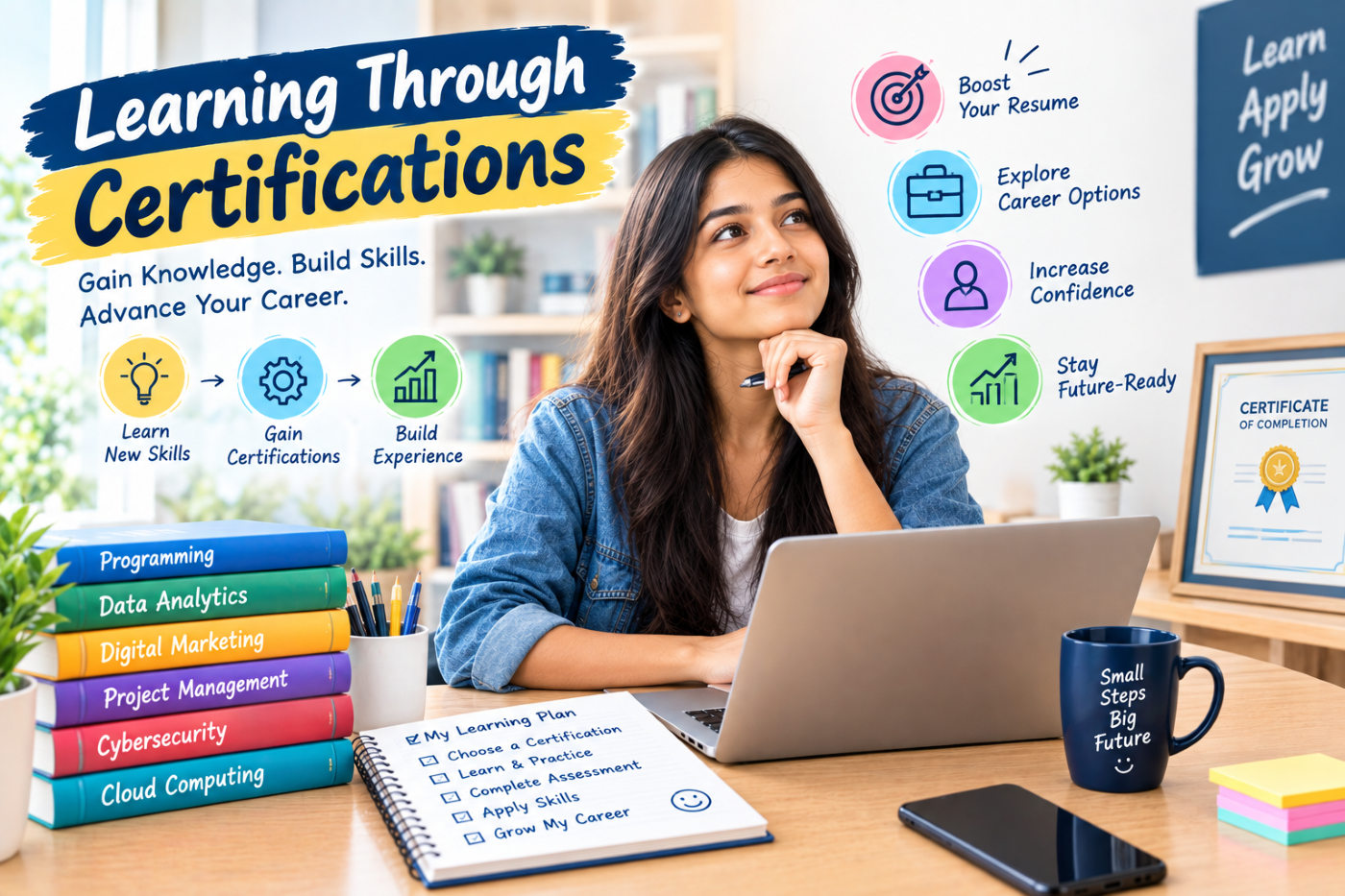
Students today have access to more learning opportunities than ever before. Along with traditional classroom education, they can learn through online courses, workshops, projects, internships, competitions, communities, and professional certifications. Among these options, certifications can provide a structured way for students to learn a specific subject, develop relevant skills, and demonstrate their commitment to continuous learning.
However, the value of a certification goes beyond simply adding another document to a resume. A meaningful certification journey should involve learning, practice, assessment, and application. When students choose certifications carefully and use the knowledge they gain in practical situations, certifications can become part of a broader skill development strategy.
At cvDragon, we believe students should focus on building genuine skills and experiences rather than collecting credentials without understanding them. A well-chosen certification can complement academic education, strengthen practical knowledge, and give students an opportunity to explore areas related to their career interests.
What Is Learning Through Certifications?
Learning through certifications refers to developing knowledge and skills through structured certification programs that typically include learning materials, assessments, practical activities, or examinations.
Certifications can cover a wide range of subjects, including:
- Programming and software development.
- Data analysis.
- Digital marketing.
- Project management.
- Cloud technologies.
- Cybersecurity.
- Finance and accounting.
- Business management.
- Design.
- Communication.
- Industry-specific technologies.
The structure of certification programs varies. Some focus primarily on theoretical knowledge, while others include practical assignments, projects, or skill-based assessments.
Students should therefore evaluate what a certification actually teaches before deciding whether it is relevant to their goals.
Why Certifications Can Be Valuable for Students
Certifications can give students a structured learning path outside their regular academic curriculum.
A student may be interested in a particular technology or career field but not know where to begin. A well-designed certification program can provide a sequence of topics that helps organize the learning process.
Certifications can also encourage students to set learning goals and complete assessments. Successfully completing a structured program can provide a sense of progress and encourage students to continue learning.
However, students should remember that a certification alone does not guarantee professional success. Its value depends on the quality of the learning, relevance to the career goal, and the student’s ability to apply what they have learned.
Choose Certifications Based on Career Goals
One of the most important steps is choosing the right certification.
Students should avoid selecting certifications simply because they appear popular or because other students are taking them.
Instead, they can ask:
What career am I exploring?
Which skills are relevant to that career?
Does this certification teach those skills?
Will I have an opportunity to apply what I learn?
For example, a student interested in data analytics may benefit from learning data analysis tools, statistics, databases, and visualization. A student interested in digital marketing might explore certifications related to SEO, analytics, content, advertising, or marketing strategy.
Career goals can change, so students do not need to have their entire career mapped out before beginning. Certifications can also be used as a way to explore different fields.
Use Certifications to Explore New Career Areas
Certifications can help students experiment with subjects outside their academic specialization.
A student studying commerce may explore data analytics. A computer science student might explore project management or digital marketing. A business student might experiment with basic programming.
This exploration can help students discover interests they may not have encountered in their regular curriculum.
However, students should approach introductory certifications as opportunities to learn rather than assuming that completing one program makes them experts in a field.
Develop Technical Skills
Many certifications focus on technical and industry-specific skills.
Students can use these programs to learn tools and technologies that complement their academic education.
For example, students may learn:
- Programming languages.
- Database systems.
- Spreadsheet analysis.
- Data visualization.
- Cloud platforms.
- Design software.
- Project management tools.
- Cybersecurity concepts.
Technical certifications can be particularly useful when students also practice the associated skills through projects.
Learning a tool without using it can make it difficult to retain knowledge. Applying it to a practical problem makes the learning experience more meaningful.
Build Soft Skills Alongside Technical Skills
Certifications often focus on technical knowledge, but students should not overlook soft skills.
Career readiness also involves:
- Communication.
- Teamwork.
- Problem-solving.
- Time management.
- Presentation.
- Adaptability.
- Critical thinking.
Students can develop these skills alongside certification learning by participating in projects, group activities, presentations, competitions, or discussions.
For example, after completing a project-based certification, a student could present the project to classmates or mentors. This combines technical learning with communication practice.
Turn Certification Knowledge Into Projects
One of the best ways to make certification learning useful is to apply the knowledge to a project.
Suppose a student completes a certification in data analytics. Instead of simply adding the certification to a resume, the student could analyze a public dataset and create a dashboard.
A student learning web development could build a website. Someone studying digital marketing could create a sample campaign strategy.
Projects demonstrate application.
The learning cycle becomes:
Learn → Practice → Build → Review → Improve
This can produce stronger evidence of skills than certification completion alone.
Use Certifications to Identify Skill Gaps
Certification learning can also reveal what students do not yet know.
While studying, students may encounter concepts that are difficult to understand or tools they have never used.
Instead of viewing these difficulties negatively, students can use them to identify skill gaps.
For example, a student may discover that they understand basic data analysis but struggle with statistics. That insight can help them choose their next learning activity.
This makes certification part of a continuous learning process.
Learn Through Assessments and Practice
Many certification programs include quizzes, examinations, assignments, or practical assessments.
Students should treat these assessments as learning opportunities rather than simply hurdles to complete.
When students get an answer wrong, they can review the underlying concept and try again.
A useful approach is:
Attempt → Identify Mistake → Review → Practice → Reattempt
This encourages deeper understanding and reduces the temptation to focus only on passing an examination.
Avoid Collecting Certifications Without Learning
One common mistake students make is collecting certifications simply to make their resumes look impressive.
A long list of unrelated credentials may not necessarily demonstrate strong skills.
Students should instead prioritize certifications that are:
- Relevant to their career interests.
- Appropriate to their current skill level.
- Connected to practical learning.
- Recognized or useful within their target field.
- Supported by meaningful projects or experience.
One certification that genuinely develops a useful skill can be more meaningful than several credentials that the student cannot explain during an interview.
Research the Certification Before Enrolling
Students should research a certification before committing time and money to it.
They can investigate:
- Course content.
- Learning objectives.
- Assessment format.
- Practical components.
- Prerequisites.
- Time commitment.
- Renewal requirements, where applicable.
- Reputation within the relevant field.
Students should also understand what the credential actually represents. A certificate of course completion, a skills assessment credential, and an industry certification may have different purposes.
Understanding these differences can help students make informed choices.
Manage Time While Studying
Students often balance certification learning with college assignments, examinations, projects, and other responsibilities.
Creating a realistic study schedule can make certification learning more manageable.
Students can divide the program into smaller milestones.
For example:
Week 1: Complete introductory modules.
Week 2: Practice core concepts.
Week 3: Work on practical exercises.
Week 4: Complete revision and assessment preparation.
A consistent schedule is generally easier to maintain than trying to complete everything shortly before an examination.
Learn From Mistakes During Certification Preparation
Difficult topics and failed practice assessments can be valuable learning experiences.
Students should not treat mistakes as evidence that they are incapable of learning a subject.
Instead, they can identify the specific problem.
For example:
“I don’t understand this topic” is less useful than:
“I understand the basic concept but need more practice applying it to practical problems.”
This more specific understanding makes it easier to choose the next learning activity.
Combine Certifications With Internships
Certifications and internships can complement each other.
A certification can provide structured knowledge, while an internship can provide workplace exposure.
For example, a student might learn a data analysis tool through a certification and then use that knowledge during an internship.
This creates a stronger connection between learning and professional application.
The combination can help students understand how theoretical concepts and technical skills are used in actual work environments.
Add Certifications to Your Resume Strategically
Students should include relevant certifications on their resumes, but they should present them clearly.
A certification section might include:
Certification Name — Issuing Organization
Completed: Month, Year
Students can also mention relevant skills developed through the certification in their skills or project sections.
At cvDragon, we encourage students to avoid treating the certification list as the entire story. A strong resume should connect credentials with projects, experiences, skills, and achievements.
For example, if a student has completed a certification in data analysis and also created two data projects, the projects can provide evidence of how the certification knowledge was applied.
Build a Learning Portfolio
Students can maintain a digital record of their learning journey.
A portfolio might include:
- Certifications.
- Projects.
- Assignments.
- Presentations.
- Research work.
- Competition experiences.
- Skills developed.
- Reflections.
This creates a broader picture of development.
Instead of presenting only a list of credentials, students can demonstrate the journey from learning to application.
Use Certifications for Continuous Learning
Learning should not stop after receiving a certificate.
Students can use each certification as a starting point for deeper exploration.
After completing a program, they can ask:
What should I practice next?
Which project can I build?
What advanced concept should I learn?
Can I use this skill during an internship?
How does this skill relate to my career goals?
This mindset turns certification from an endpoint into one stage of continuous development.
Certifications and Career Confidence
Learning a new skill and successfully completing an assessment can increase a student’s confidence in their ability to learn.
However, confidence should be based on practical understanding rather than the credential itself.
Students can strengthen this confidence by applying what they learned through projects, presentations, competitions, internships, and personal challenges.
The more opportunities students have to use their knowledge, the better they can understand their capabilities.
Common Mistakes Students Should Avoid
Students can make their certification journey more effective by avoiding common mistakes.
These include:
- Choosing certifications without a clear reason.
- Collecting credentials without developing practical skills.
- Studying only to pass an examination.
- Ignoring hands-on practice.
- Failing to research the certification.
- Adding every certificate to every resume.
- Forgetting what was learned after completion.
- Not connecting certification learning with career goals.
The objective should always be skill development first and credential documentation second.
Conclusion
Learning through certifications can provide students with structured opportunities to develop knowledge, explore career areas, and build relevant skills. When combined with practical projects, internships, competitions, feedback, and continuous practice, certifications can become a useful part of a student’s career development journey.
At cvDragon, we believe students should focus on the skills behind the certificate. A credential can show that a student completed a learning program or assessment, but practical experience demonstrates how that knowledge can be applied.
Students should therefore choose certifications thoughtfully, study actively, practice what they learn, and document meaningful outcomes. Rather than collecting certificates simply to fill a resume, they can build a learning portfolio that connects education, skills, projects, and career goals.
The most valuable certification is not necessarily the one that adds another line to a resume. It is the one that helps a student learn something relevant, apply it successfully, identify the next skill to develop, and move one step closer to their career objectives.
By following a continuous cycle of Learn → Practice → Apply → Assess → Improve, students can turn certification learning into a practical and purposeful part of their long-term skill development.
Leave a Reply