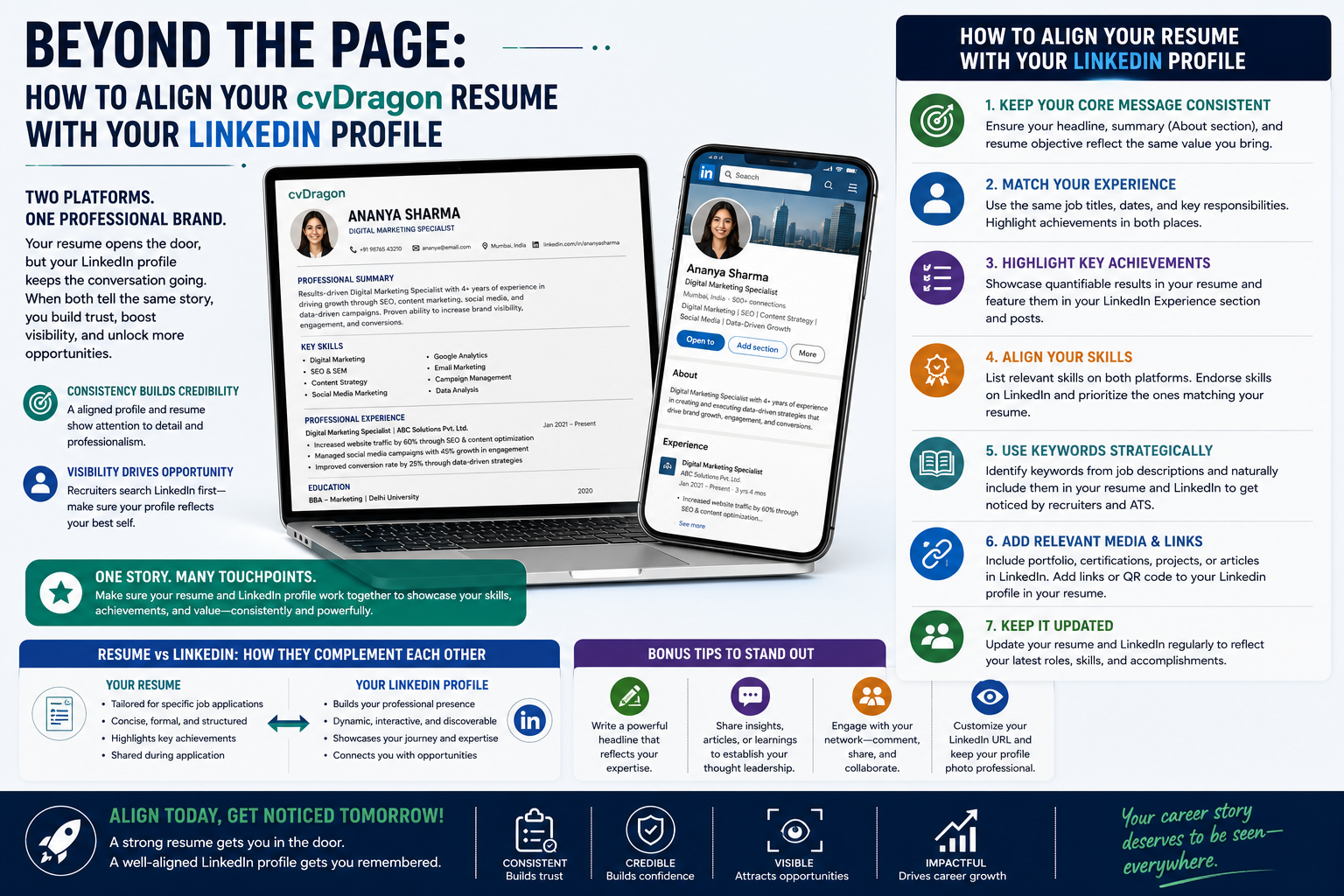
In today’s digital-first job market, your resume is no longer the only document recruiters use to evaluate your professional profile. Your LinkedIn profile has become an important extension of your career identity, allowing employers, recruiters, and professional connections to learn more about your experience, skills, achievements, and career goals. This makes consistency between your resume and LinkedIn profile more important than ever.
Imagine a recruiter receiving your CVDragon resume and then visiting your LinkedIn profile. If your resume says you have five years of experience but your LinkedIn profile shows seven, or your job titles, employment dates, skills, and achievements don’t match, the inconsistency may create doubts about your credibility. On the other hand, when both profiles present a consistent and professional career story, you create a stronger personal brand and make it easier for recruiters to understand your value.
At CVDragon, we believe your resume and LinkedIn profile should work together rather than exist as separate professional documents. Your resume can provide a focused, job-specific presentation of your qualifications, while LinkedIn offers a broader picture of your professional journey. By aligning the two strategically, you can build a stronger online presence and improve your chances of attracting the right career opportunities.
Why Your Resume and LinkedIn Profile Should Be Aligned
Your resume and LinkedIn profile serve different purposes, but they should tell the same overall story.
Your resume is typically customized for a specific job application. It highlights the skills, experience, and achievements most relevant to a particular position.
LinkedIn, on the other hand, is a broader professional profile. It helps you:
- Build your professional identity.
- Connect with industry professionals.
- Showcase your career journey.
- Share knowledge and achievements.
- Attract recruiters.
- Discover career opportunities.
While the content doesn’t need to be identical, important facts should remain consistent. This includes job titles, employment dates, education, certifications, and major career achievements.
Start with Your Professional Identity
The first step in aligning your CVDragon resume and LinkedIn profile is defining your professional identity.
Ask yourself:
- What type of professional am I?
- What industry do I work in?
- What roles am I targeting?
- What are my strongest skills?
- What value do I bring to employers?
Your resume summary and LinkedIn headline should communicate this identity clearly.
For example, if you are a digital marketing professional specializing in SEO and performance marketing, your resume and LinkedIn profile should consistently reflect those areas of expertise.
This creates a clear professional brand that recruiters can easily recognize.
Align Your Job Titles and Employment Dates
One of the most important details to keep consistent is your employment history.
Make sure the following information matches:
- Company names.
- Job titles.
- Employment dates.
- Promotions.
- Career progression.
If your official job title is very specialized or unclear to external recruiters, you may use a more understandable equivalent on your resume, but avoid misrepresenting your position.
Consistency in employment history helps establish credibility and prevents confusion.
Keep Your Career Story Consistent
Your resume and LinkedIn profile should tell a logical story about your professional development.
For example, your career journey might show:
Intern → Marketing Executive → Senior Marketing Specialist → Marketing Manager
Your LinkedIn profile can provide more context about each stage, while your resume can focus on the roles and achievements most relevant to your target position.
The key is to ensure that your career progression is accurate and easy to understand.
Use a Consistent Professional Summary and Headline
Your resume summary and LinkedIn “About” section don’t need to be word-for-word identical, but they should communicate the same professional direction.
For example, your CVDragon resume might begin with:
“Results-driven HR professional with eight years of experience in talent acquisition, employee engagement, and organizational development.”
Your LinkedIn headline could be:
HR Professional | Talent Acquisition | Employee Engagement | Organizational Development
Your LinkedIn About section can then expand on your experience, career interests, and professional achievements.
This creates consistency while allowing each platform to serve its unique purpose.
Highlight the Same Major Achievements
Your most important career accomplishments should appear across both platforms.
If your resume highlights that you:
- Increased sales by 35%.
- Reduced operational costs by 20%.
- Managed a team of 25 employees.
Consider mentioning these achievements on LinkedIn as well.
However, your LinkedIn profile can provide additional context about how you achieved those results.
The goal is not to copy and paste everything but to reinforce your strongest professional accomplishments across both platforms.
Match Your Skills
Your resume and LinkedIn profile should reflect a consistent set of core skills.
For example, if your CVDragon resume emphasizes:
- Project Management.
- Data Analysis.
- Leadership.
- Strategic Planning.
Your LinkedIn profile should include these skills as well.
LinkedIn allows users to add multiple skills and receive endorsements from connections. Prioritize skills that are relevant to the career opportunities you want to pursue.
This also improves your visibility when recruiters search for candidates using specific keywords.
Align Your Education and Certifications
Education and certifications should be accurate and consistent across your resume and LinkedIn profile.
Check:
- Degree names.
- Institution names.
- Graduation dates.
- Certification titles.
- Issuing organizations.
- Completion dates.
If you have recently earned a certification, update both platforms promptly.
Professional certifications can significantly strengthen your profile, particularly when applying for specialized roles.
Use Keywords Strategically
Recruiters often search LinkedIn using keywords related to specific skills and job titles. Applicant Tracking Systems also scan resumes for relevant keywords.
Identify keywords from the job descriptions of positions you want to target.
These might include:
- Digital Transformation.
- Data Analytics.
- Project Management.
- Cloud Computing.
- Cybersecurity.
- Business Development.
- Talent Acquisition.
Naturally incorporate relevant keywords into your resume and LinkedIn profile.
Avoid keyword stuffing. Instead, use terms in meaningful descriptions of your experience and achievements.
Keep Your LinkedIn Profile More Detailed
Your resume should be concise and focused, while LinkedIn can provide a more comprehensive view of your career.
For example, your resume might include three key achievements from a previous role, while your LinkedIn profile can include additional projects, responsibilities, and professional contributions.
Think of your resume as a targeted career document and LinkedIn as your broader professional portfolio.
This approach allows both platforms to complement each other without becoming identical copies.
Add Your CVDragon Resume Experience to LinkedIn
When creating a resume with CVDragon, review each section and identify information that can strengthen your LinkedIn profile.
Consider adding:
- Relevant projects.
- Certifications.
- Skills.
- Awards.
- Leadership experiences.
- Volunteer work.
- Portfolio links.
This ensures that your LinkedIn presence reflects the professional strengths presented in your resume.
Use a Professional Photo
Your LinkedIn profile should include a professional and appropriate profile photo. While a photo is generally unnecessary on a modern resume in many professional markets, LinkedIn is designed as a professional networking platform where a profile image helps people recognize you.
Choose a photo that is:
- Clear.
- Professional.
- Recent.
- Appropriate for your industry.
Your profile image should reinforce the professional identity presented by your CVDragon resume.
Include a Professional Portfolio When Relevant
For certain careers, a portfolio can provide valuable evidence of your skills.
Consider including portfolio links for roles in:
- Graphic design.
- Writing.
- Software development.
- Digital marketing.
- Photography.
- UI/UX design.
- Content creation.
Your resume can include a direct portfolio link, while LinkedIn can provide additional context about your work.
Update Both Profiles Regularly
Your professional profile should never remain static.
Update your resume and LinkedIn profile when you:
- Change jobs.
- Receive a promotion.
- Complete a certification.
- Finish a major project.
- Develop a new skill.
- Receive an award.
- Change your career goals.
Keeping both profiles updated ensures that recruiters always see accurate information.
Avoid Copying Your Resume Word-for-Word
Although consistency is important, copying your entire resume directly into LinkedIn isn’t always the best strategy.
Your LinkedIn profile should feel more conversational and provide additional context.
For example:
Resume:
“Managed a team of 15 employees and increased productivity by 25%.”
LinkedIn:
“I led a team of 15 professionals through a process improvement initiative that increased productivity by 25%. The experience taught me the importance of clear communication, employee engagement, and data-driven decision-making.”
Both versions communicate the same achievement, but LinkedIn provides a more personal perspective.
Check for Inconsistencies Before Applying
Before submitting your CVDragon resume, take a few minutes to review your LinkedIn profile.
Check:
- Job titles.
- Employment dates.
- Company names.
- Education.
- Certifications.
- Skills.
- Major achievements.
Correct any inconsistencies before recruiters notice them.
This simple step can strengthen your credibility and create a more professional impression.
Build a Consistent Personal Brand
Your resume and LinkedIn profile should communicate a consistent professional brand.
This includes:
- Similar professional positioning.
- Consistent career direction.
- Matching key skills.
- Accurate career history.
- Consistent achievements.
A strong personal brand helps recruiters understand who you are professionally and what type of opportunity you are seeking.
Conclusion
Your CVDragon resume and LinkedIn profile are two powerful tools that can work together to strengthen your career opportunities. While your resume should be tailored and focused on the specific position you are applying for, your LinkedIn profile can provide a broader view of your professional journey, skills, achievements, and career interests.
Aligning important information across both platforms builds credibility, strengthens your personal brand, improves recruiter visibility, and creates a more consistent professional presence. Remember to keep your job history, education, certifications, skills, and major accomplishments accurate and consistent while allowing each platform to serve its unique purpose.
At CVDragon, we believe that building a successful career involves more than creating a great resume. Your professional identity should be consistent wherever employers find you. By connecting your CVDragon resume with a strong LinkedIn profile, you can move beyond the page, showcase your professional value, and create a digital presence that supports your long-term career growth.
Leave a Reply