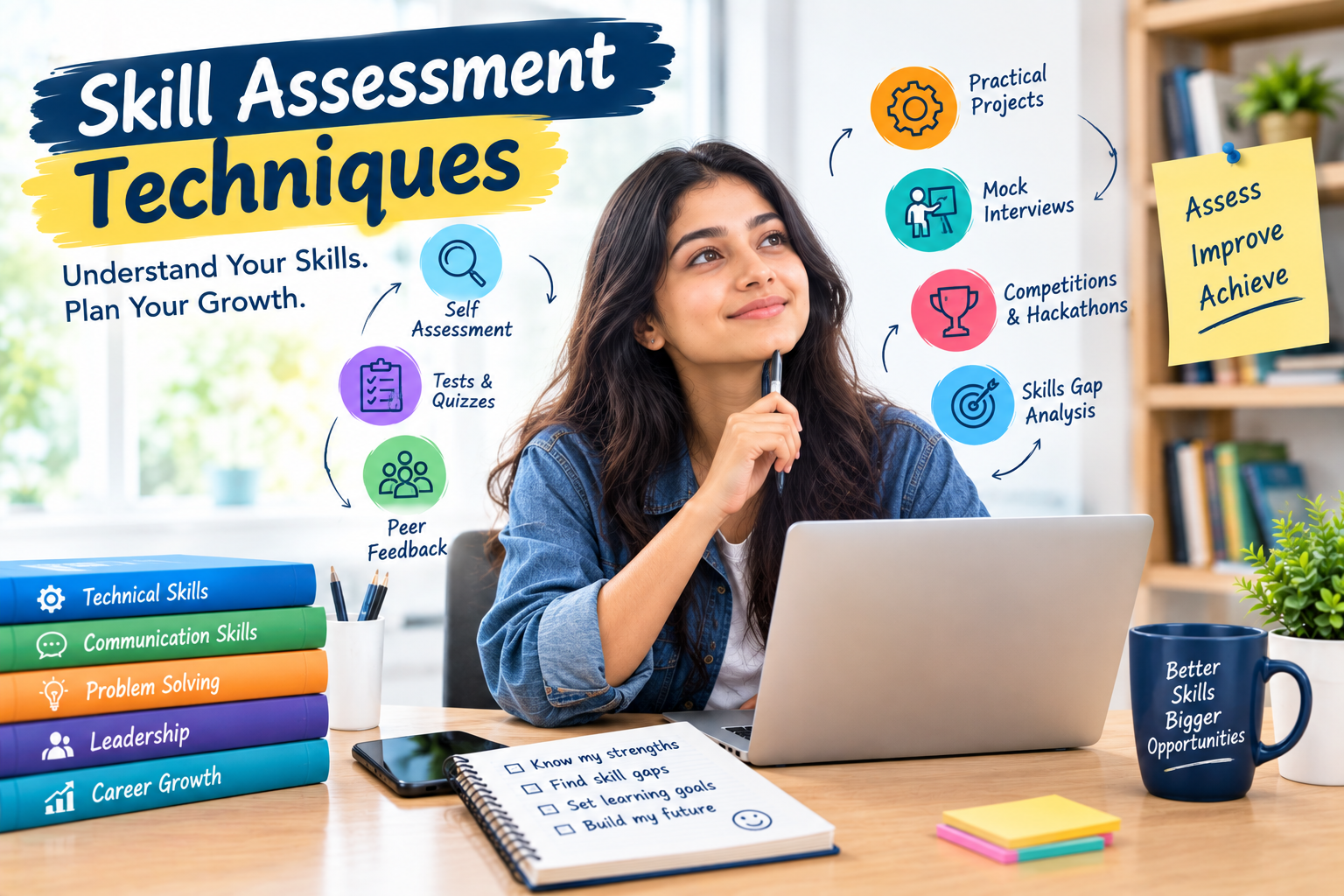
Students often hear that developing the right skills is important for academic and career success. However, before improving a skill, it is useful to understand where you currently stand. A student may believe they are good at communication, teamwork, coding, problem-solving, or time management, but without evaluating these abilities, it can be difficult to identify strengths and areas that need improvement. Skill assessment techniques can help students understand their current capabilities and create a more focused learning plan.
Skill assessment is the process of evaluating a person’s knowledge, abilities, competencies, and practical performance. It can involve tests, projects, self-assessments, interviews, simulations, feedback, or practical tasks. For students, skill assessment is not simply about receiving a score. It is an opportunity to understand what they can already do, discover skill gaps, and determine what they should learn next.
At cvDragon, we believe that students can build stronger career foundations when they understand their skills and continuously work on improving them. A clear assessment can help students make better decisions about courses, projects, internships, competitions, career paths, and resume development.
What Is Skill Assessment?
Skill assessment is a structured process used to evaluate how effectively someone can perform a particular task or demonstrate a specific competency. The assessment may focus on technical skills, soft skills, academic knowledge, or practical abilities.
For example, a computer science student might complete a coding assessment, while a marketing student could develop a sample campaign. A student preparing for employment might participate in a mock interview to assess communication and presentation skills.
Skill assessment can therefore be both theoretical and practical. The most useful approach often combines different techniques to create a broader understanding of a student’s capabilities.
Why Skill Assessment Matters for Students
Students develop skills at different speeds. Two students studying the same subject may have very different strengths and weaknesses.
One student might have strong technical knowledge but need to improve communication. Another may be an excellent presenter but require more practice with data analysis.
Skill assessments can help students identify these differences.
They can help students:
- Identify their strengths.
- Discover skill gaps.
- Measure progress.
- Select relevant learning resources.
- Prepare for internships.
- Improve interview readiness.
- Choose suitable projects.
- Align skills with career goals.
- Build stronger resumes.
Instead of learning everything at once, students can focus their efforts on areas that require the most attention.
Start With Self-Assessment
Self-assessment is one of the simplest skill assessment techniques.
Students can create a list of important skills and honestly evaluate their current level.
For example:
| Skill | Current Level | Evidence |
|---|---|---|
| Communication | Developing | Class presentations |
| Excel | Intermediate | Academic project |
| Leadership | Developing | College event |
| Python | Beginner | Online course |
| Teamwork | Strong | Case competition |
The important part is not the label itself but the evidence behind it.
Students should ask themselves, “What have I actually done that demonstrates this skill?”
This question can make self-assessment more realistic.
Use Practical Skill Tests
Practical assessments can show whether students can apply their knowledge.
Instead of asking only theoretical questions, a practical assessment might require students to complete a task.
Examples include:
- Writing a program.
- Analyzing a dataset.
- Creating a presentation.
- Designing a marketing campaign.
- Preparing a financial report.
- Writing an article.
- Solving a business problem.
- Creating a prototype.
Practical assessments are particularly useful because they demonstrate application rather than simple memorization.
Take Knowledge-Based Assessments
Knowledge tests can still play an important role in skill development.
Multiple-choice tests, quizzes, technical assessments, and subject-specific examinations can help students determine whether they understand important concepts.
For example, a student learning digital marketing could take an assessment covering SEO, content marketing, analytics, and customer targeting.
However, knowledge alone does not always demonstrate practical ability. Students should ideally combine knowledge assessments with hands-on practice.
Participate in Mock Interviews
Mock interviews are useful for assessing professional communication and interview readiness.
Students can ask a teacher, mentor, career counselor, or peer to conduct a practice interview.
The assessment can focus on:
- Clarity of answers.
- Confidence.
- Body language.
- Listening.
- Professional communication.
- Ability to explain projects.
- Understanding of career goals.
Students can record practice sessions where appropriate and review them afterward to identify areas for improvement.
Use Project-Based Assessment
Projects provide a more comprehensive way to evaluate skills because they require students to combine multiple abilities.
For example, a business project might require research, data analysis, teamwork, presentation, and problem-solving.
A technology project may involve coding, testing, documentation, troubleshooting, and communication.
Students can assess themselves after completing a project by asking:
What did I accomplish?
Which skills did I use?
What problems did I encounter?
What would I do differently next time?
This type of reflection can turn a project into a valuable skill assessment experience.
Assess Skills Through Competitions
Competitions can provide another practical assessment environment.
Students can participate in:
- Hackathons.
- Case competitions.
- Business challenges.
- Debates.
- Coding contests.
- Design competitions.
- Research competitions.
- Entrepreneurship challenges.
Competitions often require students to work under time constraints and perform alongside other participants.
The outcome can provide useful information about areas such as problem-solving, teamwork, creativity, communication, and decision-making.
Winning is not the only measure of development. Students can also evaluate what they learned and which skills need further improvement.
Use Peer Assessment
Sometimes classmates can notice strengths or weaknesses that students do not recognize themselves.
Peer assessment allows students to receive feedback from people who have observed their work.
For example, after a group presentation, team members can provide feedback on:
- Communication.
- Contribution.
- Collaboration.
- Presentation structure.
- Reliability.
- Problem-solving.
Peer feedback should be specific and constructive rather than simply positive or negative.
Seek Mentor and Teacher Feedback
Teachers, mentors, and professionals can provide another perspective on skill development.
A student might think their presentation skills are strong, while a mentor may suggest that the content is good but the delivery could be more concise.
Similarly, a student may believe their technical skills are advanced but discover through mentor feedback that they need more experience with real-world applications.
Students should actively seek feedback rather than waiting for someone to provide it.
Useful questions include:
- Which skill should I improve first?
- What am I doing well?
- What is holding me back?
- What practical activity would help me improve?
- What skills are important for my target career?
Use Simulation-Based Assessment
Simulation can assess how students respond to realistic situations.
For example, students can participate in simulated:
- Business decisions.
- Customer interactions.
- Project management scenarios.
- Technical troubleshooting.
- Interviews.
- Negotiations.
Simulation can reveal how students apply knowledge when they need to make decisions rather than simply answer questions.
This makes it particularly useful for developing practical and workplace-oriented skills.
Use 360-Degree Feedback
A broader assessment can be created by collecting feedback from multiple sources.
Students may receive feedback from:
- Teachers.
- Classmates.
- Mentors.
- Project teammates.
- Internship supervisors.
- Coaches.
This provides different perspectives on the student’s performance.
For example, a student may receive strong technical feedback from a teacher but learn from teammates that they need to communicate project updates more consistently.
Different perspectives can help create a more complete picture of skill development.
Create a Skills Gap Analysis
After completing assessments, students should compare their current abilities with the skills required for their desired career.
For example, a student interested in data analytics might identify the following:
Current strengths: Excel, basic statistics, presentation.
Skills to develop: SQL, Python, data visualization.
Next steps: Complete a SQL course, build a data project, and practice visualization tools.
This turns assessment into action.
A skills gap analysis should not make students feel discouraged. Its purpose is to show them where learning opportunities exist.
Track Skill Development Over Time
Skill assessment should not happen only once.
Students can repeat assessments periodically to measure progress.
For example:
January: Beginner Python skills.
April: Completed basic Python projects.
July: Built a data analysis project.
October: Applied Python during an internship.
Tracking progress can help students see development that may otherwise be difficult to notice.
It can also increase motivation by providing evidence that consistent practice is producing results.
Assess Soft Skills Through Real Activities
Soft skills can be more difficult to measure than technical skills, but they can still be assessed through practical activities.
For example:
Communication: Present a project.
Teamwork: Complete a group assignment.
Leadership: Coordinate an event.
Problem-solving: Participate in a case challenge.
Time management: Complete a project within a fixed deadline.
The goal is to observe actual behavior rather than simply claiming proficiency.
Avoid Relying Only on Scores
A score can be useful, but it does not always tell the complete story.
Two students could receive the same score while having different strengths. One may understand the concepts but struggle with practical application, while another may perform well practically but need stronger theoretical knowledge.
Students should therefore consider assessment results alongside feedback, practical performance, and experience.
The most useful question is not simply “What score did I receive?” but “What does this result tell me about my next learning step?”
Connect Skill Assessment With Career Planning
Skill assessment becomes more valuable when connected with career goals.
A student interested in software development should assess programming, problem-solving, debugging, teamwork, and technical communication.
Someone interested in marketing might assess research, content creation, communication, analytics, creativity, and campaign planning.
This career-focused approach helps students avoid spending too much time developing skills that are unrelated to their current goals.
Use Assessment Results to Improve Your Resume
Skill assessments can also help students improve their resumes.
Instead of listing every skill they have encountered, students can focus on abilities supported by actual evidence.
For example, a student who completes several data projects can confidently highlight data analysis as a relevant skill. A student who participates in case competitions and team projects can provide evidence of problem-solving and collaboration.
At cvDragon, we encourage students to connect their skills with real experiences whenever possible. A resume becomes stronger when skills are supported by projects, internships, competitions, certifications, and achievements.
Build a Personal Skill Development Plan
After completing assessments, students can create a simple development plan.
A useful structure is:
Skill: What do I need to improve?
Current Level: Where am I today?
Target: Where do I want to reach?
Action: What will I do to improve?
Evidence: How will I demonstrate progress?
For example:
Skill: Public speaking
Current Level: Developing
Target: Confident presentation
Action: Complete two presentations each month
Evidence: Recorded presentations and feedback
This makes skill development measurable and practical.
Common Mistakes in Skill Assessment
Students should avoid several common mistakes when assessing their abilities.
These include:
- Overestimating skills without evidence.
- Underestimating abilities because of comparison with others.
- Focusing only on test scores.
- Ignoring feedback.
- Assessing skills only once.
- Listing skills without practical experience.
- Trying to improve too many skills simultaneously.
An effective assessment should be honest, evidence-based, and connected to specific development goals.
Conclusion
Skill assessment techniques can help students understand where they currently stand and where they need to improve. Through self-assessments, practical tests, projects, mock interviews, competitions, simulations, peer feedback, mentor guidance, and skills gap analysis, students can gain a clearer picture of their abilities.
At cvDragon, we believe skill development becomes more effective when students know what they are trying to improve and why it matters. Assessment provides the starting point, while consistent practice creates progress.
Students should remember that a skill assessment is not a final judgment about their abilities. It is a snapshot of their current development. A beginner today can become proficient through regular practice, feedback, and practical experience.
The most useful approach is to follow a continuous cycle:
Assess → Identify Gaps → Learn → Practice → Receive Feedback → Reassess
By making this process part of their academic and career journey, students can make more informed learning decisions, prepare for professional opportunities, and build stronger evidence of their capabilities. Over time, skill assessment can become more than a way to measure performance—it can become a tool for purposeful career development.
Leave a Reply