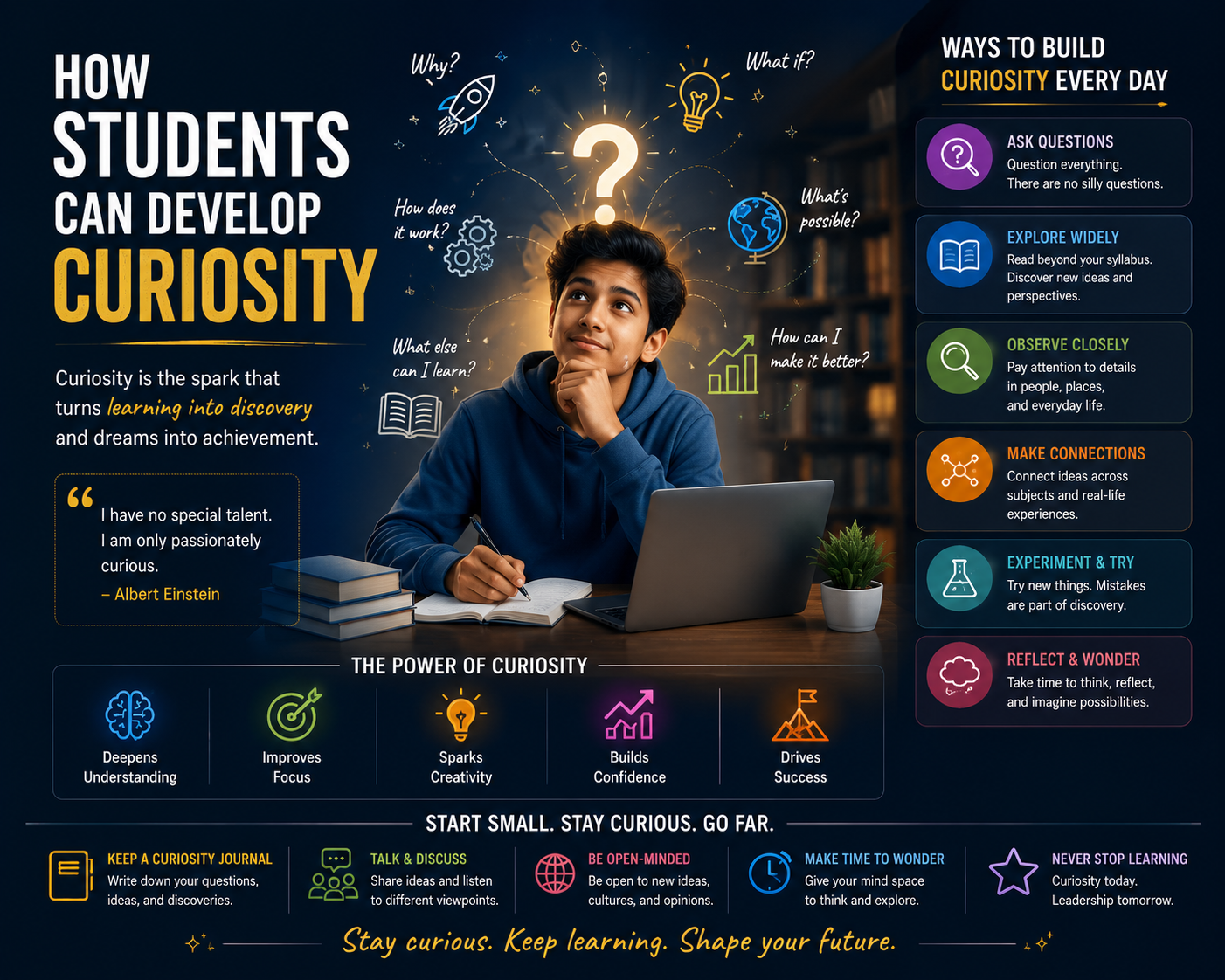
Curiosity is one of the most powerful forces behind learning. It drives students to ask questions, explore new ideas, and seek deeper understanding. Many of the world’s greatest discoveries, innovations, and achievements began with a simple question: “Why?” or “How?”
However, many students gradually lose their natural curiosity due to pressure, routine learning methods, and a strong focus on grades. They begin studying only to complete assignments or pass exams rather than to understand and explore.
At CvDragon, we believe curiosity is not a fixed personality trait—it is a skill and mindset that students can actively develop. Curious learners often become better thinkers, stronger problem-solvers, and lifelong learners.
Why Curiosity Matters
Curiosity transforms learning from a task into an experience.
Students who are curious often:
- Learn more deeply
- Retain information longer
- Ask better questions
- Think creatively
- Solve problems effectively
- Enjoy learning more
When students become genuinely interested in a topic, studying often feels less like work.
Curiosity creates motivation from within.
Understand That Curiosity Begins with Questions
Curiosity usually starts with questioning.
Instead of accepting information immediately, students can ask:
- Why does this happen?
- How does this work?
- What causes this result?
- What would happen if things changed?
Questions activate thinking.
Learning becomes more active and meaningful when students search for answers rather than simply receive them.
Develop a Habit of Asking “Why”
Many students memorize facts without understanding reasons behind them.
For example:
Instead of learning:
“Plants need sunlight.”
Ask:
“Why do plants need sunlight?”
“How does sunlight help them grow?”
Asking deeper questions builds stronger understanding.
Often one question leads to several more.
Read Beyond Academic Materials
Students sometimes limit learning to textbooks.
Curiosity grows when students explore different topics.
Read:
- Articles
- Biographies
- Science stories
- Business case studies
- Technology trends
- History topics
Exposure to diverse ideas often sparks new interests.
Learning outside the classroom broadens thinking.
Follow Your Interests
Students do not need to be curious about everything.
Curiosity often starts with personal interests.
Examples:
- Technology
- Psychology
- Marketing
- Space science
- Business
- Art
Exploring subjects you naturally enjoy creates momentum.
Interest often becomes a gateway to deeper learning.
Learn Through Exploration
Instead of only reading information, explore actively.
Examples:
- Watch educational demonstrations
- Try experiments
- Build projects
- Join competitions
- Participate in discussions
Hands-on experiences make learning more engaging.
Exploration strengthens curiosity naturally.
Be Comfortable Not Knowing Everything
Some students avoid asking questions because they fear appearing uninformed.
Curious learners think differently.
They understand that not knowing something creates an opportunity to learn.
Curiosity grows when students become comfortable saying:
“I don’t understand this yet.”
Learning starts with openness.
Use Technology for Discovery
Technology can help students explore ideas beyond classrooms.
Educational platforms and tools can introduce new subjects and perspectives.
Useful learning apps include:
- TED
- Khan Academy
- YouTube
Students can discover topics they never previously considered.
Technology should support curiosity rather than distract from it.
Connect Learning to Real Life
Students often lose interest when subjects feel disconnected from everyday experiences.
Ask:
- Where is this used in real life?
- Why does this matter?
- How does this affect people?
Connecting knowledge to practical situations increases relevance.
Relevance often creates curiosity.
Surround Yourself with Curious People
Curiosity can be contagious.
Students who spend time with people who ask questions and enjoy learning often become more curious themselves.
Engage with:
- Study groups
- Mentors
- Teachers
- Learning communities
Conversations expose students to new ideas and perspectives.
Keep a Curiosity Journal
Interesting questions often disappear quickly.
Maintain a notebook where you record:
- Questions
- Interesting ideas
- Topics to explore
- New discoveries
Reviewing these notes can create future learning opportunities.
Small questions sometimes lead to big interests.
Allow Time for Reflection
Modern life moves quickly.
Students constantly switch between classes, assignments, and devices.
Curiosity often requires quiet moments.
Take time to think:
- What surprised me today?
- What confused me?
- What would I like to understand better?
Reflection encourages deeper thinking.
Avoid Learning Only for Grades
Academic success matters, but learning solely for marks can reduce curiosity.
Students may focus only on:
- Memorizing answers
- Completing tasks
- Passing exams
Curiosity grows when learning becomes about understanding rather than only performance.
Knowledge lasts longer than grades.
Common Curiosity Killers Students Should Avoid
Avoid habits that limit exploration:
- Fear of asking questions
- Constant multitasking
- Studying only for exams
- Avoiding challenges
- Expecting immediate answers
Curiosity often grows slowly through exploration and patience.
Long-Term Benefits of Curiosity
Students who develop curiosity often build:
- Better critical thinking
- Stronger creativity
- Improved communication
- Problem-solving ability
- Lifelong learning habits
Curiosity supports success not only in academics but also in careers and personal growth.
Final Thoughts
Curiosity is one of the most valuable learning skills students can develop. It turns education into exploration and transforms information into understanding.
At CvDragon, we encourage students to ask more questions, explore more ideas, and stay open to learning beyond textbooks.
Remember, curiosity does not require extraordinary intelligence. It begins with something simple: the willingness to ask questions and seek answers.
Leave a Reply