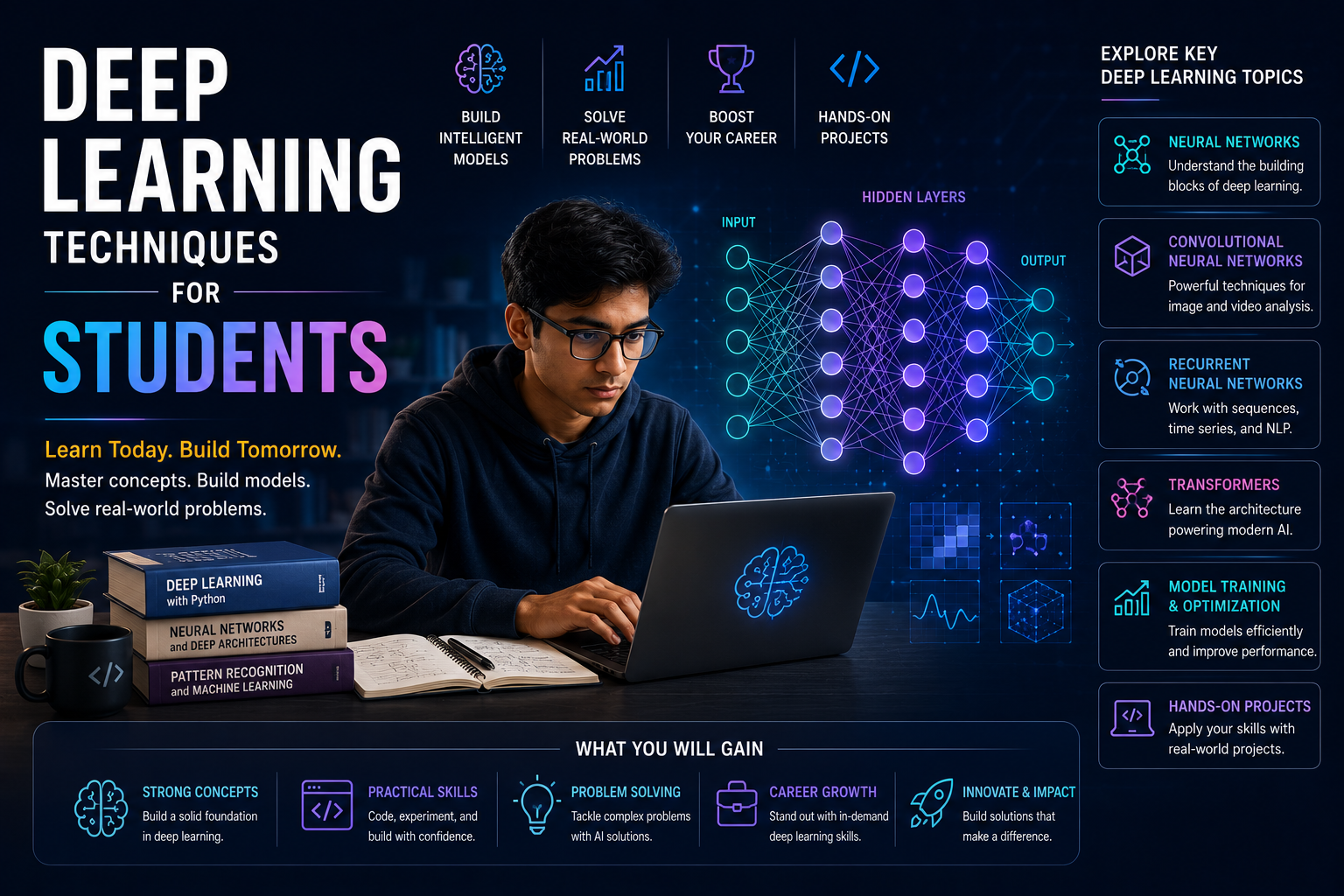
In education, many students spend hours studying but still struggle to remember information after a few days. They read chapters repeatedly, highlight pages, and memorize notes, yet long-term understanding remains difficult. The problem is often not effort—it is the learning approach.
This is where deep learning techniques become important. Deep learning in education does not mean artificial intelligence or machine learning. It refers to learning methods that help students understand concepts deeply, connect ideas, and retain knowledge for a longer time.
At CvDragon, we believe effective learning is not about studying harder; it is about studying smarter. Deep learning techniques can help students move beyond memorization and develop real understanding.
What Is Deep Learning in Education?
Deep learning is a learning approach where students focus on understanding meaning rather than simply memorizing facts.
Students practicing deep learning:
- Ask questions
- Connect ideas
- Analyze information
- Apply knowledge
- Understand concepts deeply
Instead of remembering information temporarily, they build long-term understanding.
Why Deep Learning Matters
Surface learning often leads to:
- Forgetting information quickly
- Difficulty applying knowledge
- Weak conceptual understanding
- Stress during exams
Deep learning helps students:
- Retain information longer
- Improve problem-solving ability
- Build critical thinking skills
- Increase academic confidence
- Apply learning in real situations
The goal becomes understanding rather than memorization.
Technique 1: Use Active Recall
Many students reread notes repeatedly.
However, rereading often creates familiarity rather than true learning.
Active recall involves retrieving information from memory without looking at notes.
Examples:
- Answer questions from memory
- Explain concepts aloud
- Use flashcards
- Write summaries without checking notes
Retrieval strengthens memory pathways.
Students remember information better when they actively pull it from memory.
Technique 2: Learn Through Teaching
One of the strongest learning methods is teaching others.
When students teach, they must:
- Organize ideas
- Simplify information
- Identify confusion
- Explain concepts clearly
Teaching reveals weaknesses in understanding.
If a topic is difficult to explain, more revision may be needed.
The popular Feynman Technique, developed by Richard Feynman, follows this principle.
Technique 3: Connect New Knowledge to Existing Knowledge
The brain learns more effectively when information connects to what students already know.
Ask:
- How does this relate to previous topics?
- Where have I seen this idea before?
- What examples connect to real life?
Connections create stronger understanding.
Learning becomes meaningful rather than isolated.
Technique 4: Ask Better Questions
Deep learners ask questions beyond basic memorization.
Examples:
Instead of:
“What is photosynthesis?”
Ask:
“Why is photosynthesis important?”
“How would life change without it?”
Questions encourage analysis and deeper thinking.
Curiosity improves learning quality.
Technique 5: Use Spaced Repetition
Students often study intensively before exams and forget information afterward.
Spaced repetition solves this problem.
Review material over increasing intervals:
- Day 1
- Day 3
- Day 7
- Day 14
This strengthens long-term retention.
Repeated exposure over time helps prevent forgetting.
Technique 6: Practice Interleaving
Many students study one topic continuously for hours.
Interleaving means mixing different subjects or concepts during study sessions.
Example:
Instead of:
Math → 3 hours only
Try:
Math → Science → Language → Return to Math
Switching topics trains the brain to retrieve information more actively.
Learning becomes more flexible.
Technique 7: Focus on Understanding Before Memorizing
Students often rush into memorization.
However, understanding should come first.
Ask:
- Why does this happen?
- How does it work?
- What causes this result?
Strong understanding makes memorization easier.
Memorizing without understanding creates fragile knowledge.
Technique 8: Use Visual Learning Techniques
Visual organization can improve understanding.
Examples:
- Mind maps
- Flowcharts
- Diagrams
- Concept maps
Visual tools help students organize relationships between ideas.
Complex information becomes easier to process.
Technique 9: Solve Problems Actively
Learning remains incomplete without application.
Students should:
- Solve exercises
- Practice problems
- Apply concepts
- Analyze case studies
Application strengthens understanding.
Knowledge becomes useful rather than theoretical.
Technique 10: Reflect on Learning
Reflection helps students evaluate understanding.
Ask:
- What did I learn today?
- What confused me?
- What needs more practice?
Reflection strengthens awareness and learning quality.
Short learning journals can help.
Build a Deep Learning Environment
Environment influences learning quality.
Students should:
- Reduce distractions
- Study with focus
- Set clear goals
- Create structured routines
Deep work often supports deep learning.
Attention matters.
Common Mistakes Students Should Avoid
Avoid:
Passive Rereading
Reading repeatedly without testing understanding.
Memorizing Without Meaning
Learning facts without context.
Multitasking
Switching attention constantly.
Studying Without Practice
Knowledge requires application.
Cramming Before Exams
Last-minute studying often weakens retention.
Deep learning requires consistency.
Technology Can Support Deep Learning
Digital tools can help students strengthen learning habits.
Useful platforms include:
- Notion
- Anki
- Quizlet
These tools support active recall, organization, and long-term revision.
Final Thoughts
Deep learning techniques help students move beyond memorization toward meaningful understanding. Instead of focusing only on short-term exam performance, students develop stronger thinking skills and long-term retention.
At CvDragon, we encourage students to study with curiosity, reflection, and active engagement. Learning becomes more effective when students understand deeply rather than memorize temporarily.
Remember, successful learning is not measured by how much you study—it is measured by how well you understand and apply what you learn.
Leave a Reply