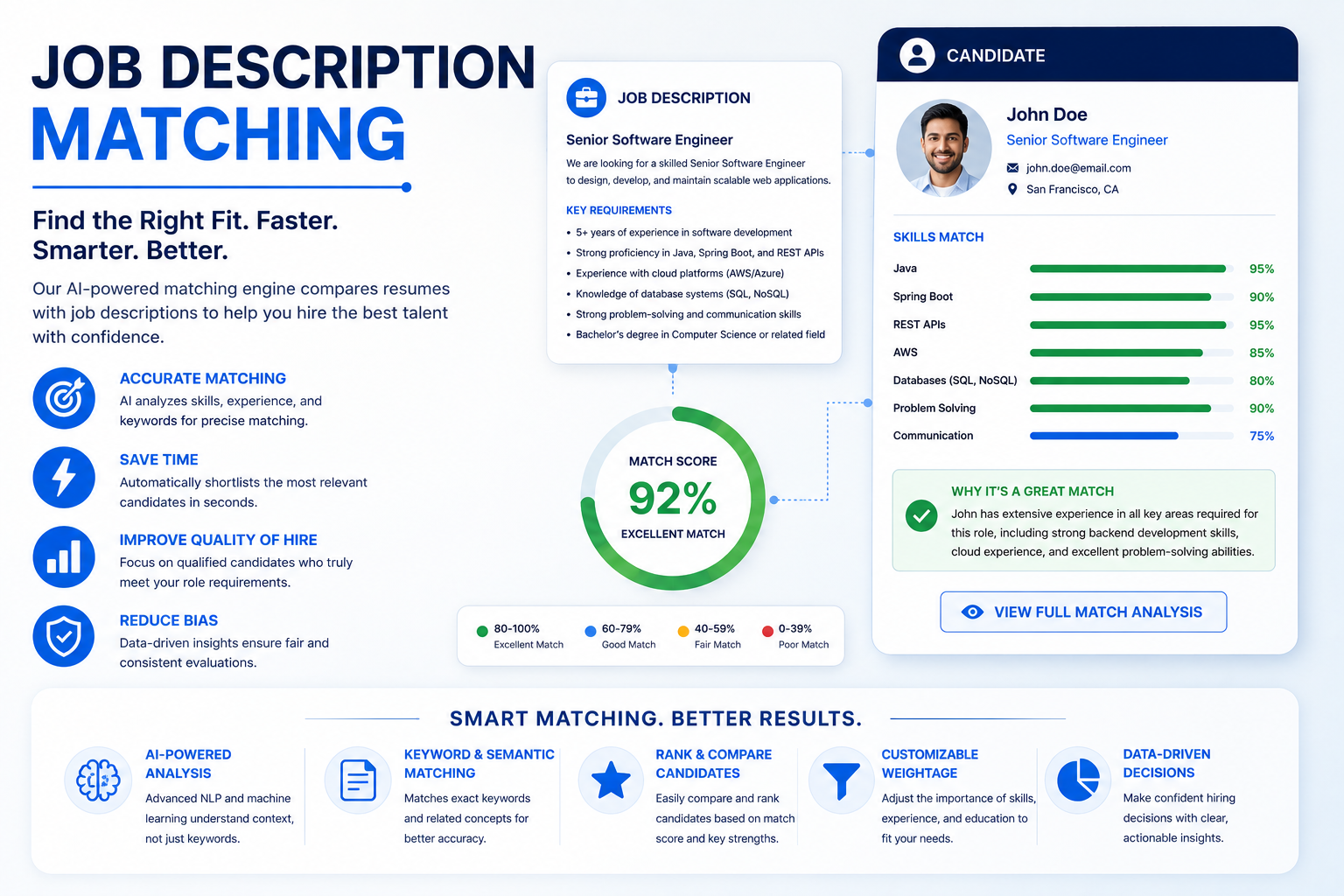
One of the biggest reasons resumes get rejected today is poor alignment with the job description. Many candidates apply with a generic resume and assume their qualifications alone are enough. However, modern recruitment systems and recruiters look for one important factor: job description matching.
A resume that closely matches the job description has a much higher chance of passing Applicant Tracking Systems (ATS) and getting shortlisted by recruiters. At CvDragon, we help job seekers understand how to tailor their resumes strategically for every role.
This guide explains what job description matching is, why it matters, and how students and professionals can do it effectively.
What Is Job Description Matching?
Job description matching is the process of aligning your resume with the specific requirements, skills, and keywords mentioned in a job posting.
It involves customizing your resume so that it reflects:
- Required skills
- Relevant experience
- Job-related keywords
- Industry terminology
- Responsibilities mentioned in the posting
The goal is to show recruiters and ATS systems that you are a strong fit for the role.
Why Job Description Matching Matters
Most companies use ATS platforms such as Workday and Greenhouse to filter applications.
These systems compare resumes with job descriptions and rank candidates based on relevance.
A well-matched resume helps:
- Improve ATS scores
- Increase shortlisting chances
- Show role relevance
- Highlight suitable qualifications
- Improve recruiter attention
Without customization, even qualified candidates may get ignored.
How Recruiters Use Job Descriptions
Recruiters use job descriptions as a checklist.
They compare your resume against:
- Required skills
- Experience level
- Technical knowledge
- Tools and software
- Educational qualifications
- Responsibilities handled
The closer your profile matches the description, the better your chances.
Step 1: Read the Job Description Carefully
Most candidates scan job descriptions too quickly.
Instead, analyze them properly.
Pay attention to:
- Required skills
- Responsibilities
- Qualifications
- Keywords
- Preferred tools
- Industry terms
Highlight repeated terms and important requirements.
These are usually the highest-priority keywords.
Step 2: Identify Important Keywords
Keywords are one of the most important parts of job description matching.
Examples:
Marketing Role
- SEO
- Content Strategy
- Social Media Marketing
- Google Analytics
HR Role
- Recruitment
- Employee Engagement
- Payroll
Finance Role
- Financial Reporting
- Budgeting
- Auditing
These keywords should appear naturally in your resume if you have those skills.
Step 3: Match Your Skills Strategically
Compare your existing skills with the job requirements.
If the role requires:
- Project Management
- Data Analysis
- Communication
Ensure these are clearly included in your:
- Skills section
- Work experience
- Projects
- Summary
Only include skills you genuinely possess.
Step 4: Customize Your Resume Summary
Your professional summary should reflect the target role.
Generic summary:
“Hardworking individual looking for opportunities.”
Better summary:
“Marketing graduate with skills in SEO, content strategy, and digital campaign management.”
Tailored summaries improve recruiter engagement quickly.
Step 5: Adjust Your Work Experience
Your work experience should highlight relevant responsibilities and achievements.
Example:
Instead of:
“Handled company tasks”
Write:
“Managed SEO campaigns and improved website traffic by 25%.”
Use bullet points and measurable results whenever possible.
Step 6: Use Relevant Job Titles
ATS systems often compare job titles with the target role.
Example:
If applying for a “Digital Marketing Executive” role, related titles like:
- Marketing Intern
- SEO Associate
- Content Marketing Executive
can improve relevance.
Avoid creative or unclear job titles.
Step 7: Include Relevant Certifications
Certifications help strengthen alignment with the job description.
Examples:
- Google Analytics
- Advanced Excel
- HR Analytics
- Project Management Certification
Relevant certifications improve credibility.
Step 8: Focus on ATS-Friendly Formatting
Even strong keyword matching can fail if formatting is poor.
Use:
✔ Standard headings
✔ Single-column layout
✔ Bullet points
✔ Simple fonts
Avoid:
✘ Graphics
✘ Tables
✘ Text boxes
✘ Complex designs
ATS systems work best with clean formatting.
Step 9: Avoid Keyword Stuffing
Adding excessive keywords unnaturally can reduce readability.
Bad example:
“SEO expert with SEO skills in SEO strategy and SEO optimization.”
Instead, use keywords naturally within meaningful sentences.
Balance ATS optimization with human readability.
Step 10: Customize Every Application
One of the biggest mistakes candidates make is sending the same resume everywhere.
Different roles require different emphasis.
For example:
- One marketing role may focus on SEO
- Another may focus on social media strategy
Tailoring your resume improves relevance significantly.
Common Job Description Matching Mistakes
Avoid these common errors:
- Ignoring keywords
- Using generic resumes
- Adding irrelevant skills
- Not customizing summaries
- Overstuffing keywords
- Using poor formatting
Small mistakes can reduce your ATS ranking and recruiter interest.
Job Description Matching for Freshers
Freshers can still optimize resumes effectively.
Focus on:
- Skills
- Projects
- Internships
- Certifications
- Academic achievements
Even without full-time experience, relevant alignment matters.
Final Thoughts
Job description matching is one of the most effective ways to improve your chances of getting shortlisted. It helps both ATS systems and recruiters recognize your suitability for a role quickly.
At CvDragon, we recommend carefully analyzing every job description and tailoring your resume accordingly. A customized resume shows professionalism, attention to detail, and genuine interest in the role.
Remember, successful resumes are not generic—they are targeted, relevant, and aligned with employer needs.
Leave a Reply