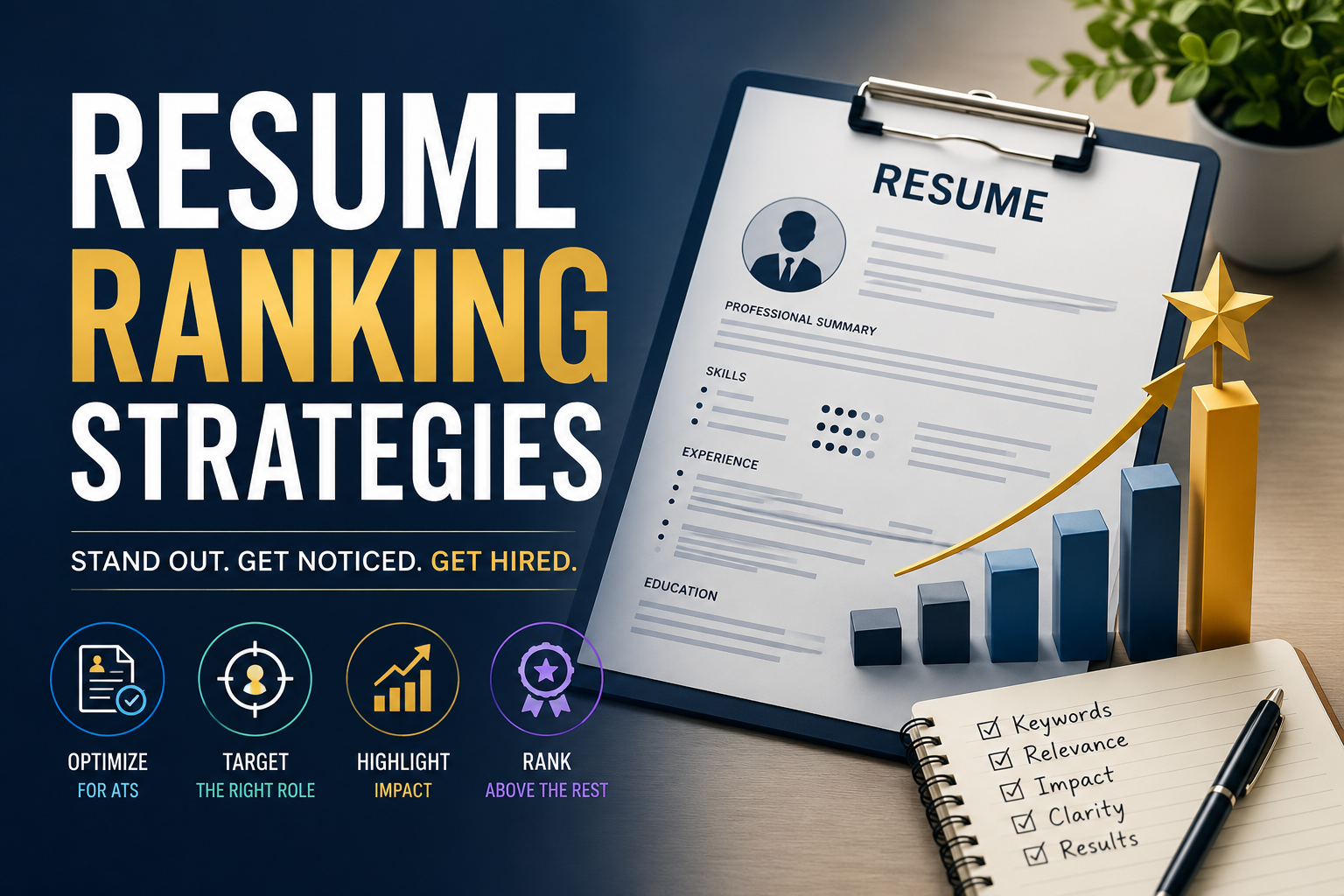
In today’s hiring landscape, getting your resume noticed is no longer just about qualifications. Before a recruiter reads your application, your resume often competes against hundreds of others inside an Applicant Tracking System (ATS). These systems sort, score, and rank resumes based on how well they align with a job posting.
This means a strong candidate can still get overlooked if their resume is not optimized correctly. Understanding resume ranking strategies can significantly improve your chances of moving higher in recruiter searches and ATS results.
At CvDragon, we help job seekers create resumes that rank better, attract recruiter attention, and improve interview opportunities.
What Is Resume Ranking?
Resume ranking refers to how ATS software organizes and prioritizes applications based on relevance.
Systems often analyze:
- Keywords
- Skills
- Job titles
- Experience
- Education
- Certifications
- Resume structure
Resumes with stronger alignment to the job description usually appear higher in recruiter search results.
Higher ranking increases visibility.
Why Resume Ranking Matters
Recruiters often receive hundreds of applications for a single role.
Instead of reviewing every application manually, ATS platforms like Workday and Greenhouse help prioritize candidates.
A higher-ranked resume can:
- Increase recruiter visibility
- Improve shortlisting chances
- Reduce filtering risks
- Reach recruiters faster
Strong qualifications alone are not always enough.
Strategy 1: Study the Job Description Carefully
The job description is your roadmap.
Read it carefully and identify:
- Required skills
- Responsibilities
- Keywords
- Tools
- Qualifications
Pay close attention to repeated words.
Repeated terms are often high-priority ranking signals.
Strategy 2: Use Relevant Keywords Naturally
Keywords remain one of the most important ranking factors.
Examples:
Marketing
- SEO
- Content Strategy
- Lead Generation
HR
- Recruitment
- Employee Relations
- Payroll
Finance
- Financial Analysis
- Auditing
- Budgeting
Place keywords naturally in:
- Summary
- Skills section
- Experience
- Projects
Avoid keyword stuffing.
Strategy 3: Customize Your Resume for Every Job
One resume should not be sent to every employer.
Different companies prioritize different skills.
For example:
Job A may require:
- Social Media Marketing
- Content Writing
Job B may require:
- SEO
- Analytics
Customization improves relevance and ranking.
Strategy 4: Write a Strong Professional Summary
Recruiters often read the summary first.
A strong summary should include:
- Target role
- Years of experience
- Key skills
- Professional strengths
Example:
“Marketing professional with expertise in SEO, content strategy, and campaign management.”
This improves both ATS matching and recruiter attention.
Strategy 5: Focus on Achievement-Based Experience
ATS and recruiters value measurable impact.
Weak statement:
“Responsible for social media management.”
Stronger statement:
“Increased social media engagement by 35% within four months.”
Numbers create stronger relevance and credibility.
Strategy 6: Use Standard Job Titles
ATS systems often compare previous roles with target positions.
Use recognizable titles such as:
✔ Marketing Executive
✔ HR Associate
✔ Data Analyst
Avoid:
✘ Growth Ninja
✘ Brand Rockstar
Clear titles improve matching.
Strategy 7: Build a Strong Skills Section
A dedicated skills section helps ATS identify qualifications quickly.
Example:
Skills
- SEO
- MS Excel
- Communication
- Project Management
- Data Analysis
Include a mix of technical and soft skills.
Strategy 8: Keep Formatting ATS-Friendly
Poor formatting can reduce ranking because ATS may struggle to read the resume.
Use:
✔ Single-column design
✔ Standard headings
✔ Bullet points
✔ Professional fonts
Avoid:
✘ Tables
✘ Graphics
✘ Text boxes
✘ Complex designs
Simple formatting improves parsing accuracy.
Strategy 9: Include Relevant Certifications
Certifications help strengthen ranking.
Examples:
- Google Analytics Certification
- Advanced Excel
- Project Management
- HR Analytics
Certifications show initiative and relevant expertise.
Strategy 10: Add Relevant Projects
Projects demonstrate practical experience.
Especially for students and freshers, projects can improve ranking significantly.
Examples:
- Consumer behavior analysis
- Website SEO project
- Data visualization project
Practical work helps bridge experience gaps.
Strategy 11: Match Industry Language
Every industry has its own terminology.
Examples:
Marketing:
- Lead generation
- Conversion optimization
Finance:
- Financial reporting
- Risk assessment
Using industry-specific language improves ATS relevance.
Strategy 12: Maintain Resume Readability
Even if ATS ranks your resume highly, recruiters still review it.
Make sure your resume is:
- Easy to scan
- Well-structured
- Cleanly formatted
- Concise
Optimization should not hurt readability.
Common Resume Ranking Mistakes
Avoid these common errors:
- Sending generic resumes
- Missing keywords
- Using poor formatting
- Writing vague achievements
- Overusing keywords
- Adding irrelevant information
These mistakes reduce both ATS and recruiter performance.
Resume Ranking for Freshers
Students and fresh graduates can improve ranking through:
- Skills
- Internships
- Certifications
- Projects
- Academic achievements
You do not need years of experience to rank well.
Relevance matters more.
Final Thoughts
Resume ranking strategies are about alignment, clarity, and relevance. Strong resumes rank better when they closely match employer requirements while remaining easy to read.
At CvDragon, we recommend focusing on smart customization, keyword placement, ATS-friendly formatting, and measurable achievements.
Remember, a high-ranking resume does not happen by accident—it is built intentionally. Optimize carefully, present your value clearly, and improve your chances of reaching the interview stage.
Leave a Reply