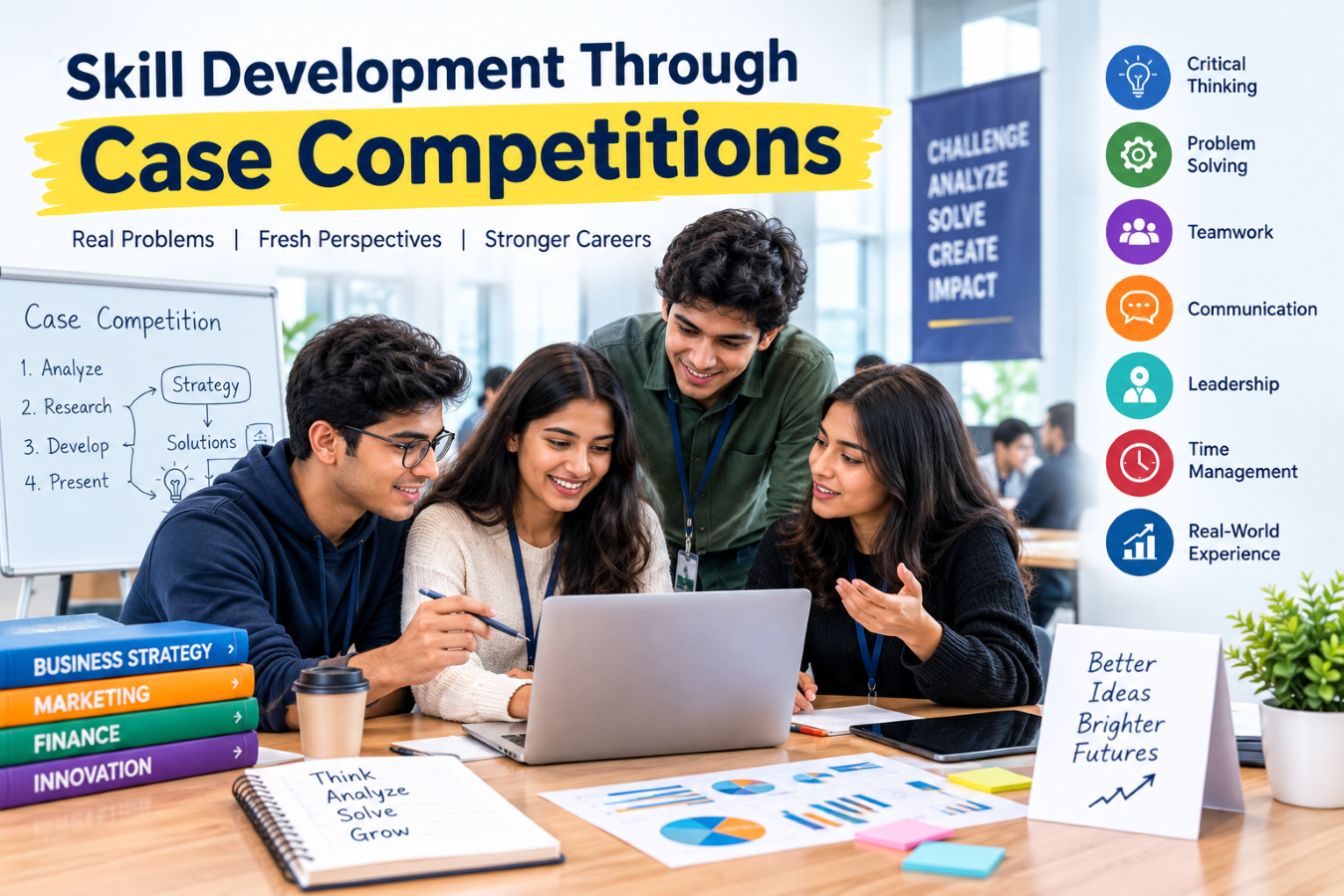
Students today are expected to develop more than academic knowledge to prepare for a competitive professional environment. Understanding concepts from textbooks is important, but employers also value the ability to analyze problems, think critically, communicate ideas, work in teams, and make practical decisions. Case competitions provide students with an excellent opportunity to develop these skills while working on realistic business and organizational challenges.
A case competition usually presents participants with a business problem, industry situation, or organizational challenge. Students analyze the information provided, identify key issues, develop possible solutions, and present their recommendations to a panel of judges. The experience combines research, strategy, teamwork, creativity, communication, and time management in one practical activity.
At cvDragon, we believe that students can strengthen their career readiness by actively participating in experiences that allow them to apply what they learn. Case competitions provide a structured environment where students can move beyond theoretical learning and experience how professionals approach complex problems.
What Is a Case Competition?
A case competition is a competitive event in which individuals or teams are given a real-world or realistic business problem to solve within a specific timeframe. Cases may focus on marketing, finance, human resources, operations, technology, strategy, entrepreneurship, sustainability, or other areas.
Participants typically receive information about a company, market, product, or organizational challenge. They must study the case, identify the central problem, analyze relevant data, develop recommendations, and present their solution.
The final presentation is often followed by questions from judges. This means students must not only develop a solution but also explain and defend their reasoning.
Why Case Competitions Matter for Students
Case competitions provide a practical learning experience that can complement classroom education. Instead of answering questions with predetermined solutions, students often need to determine what the actual problem is and decide how it should be addressed.
This process encourages students to think independently and consider multiple perspectives.
Through case competitions, students can develop skills such as:
- Critical thinking.
- Analytical reasoning.
- Research.
- Problem-solving.
- Teamwork.
- Communication.
- Presentation.
- Decision-making.
- Time management.
- Leadership.
These skills can be useful across different academic disciplines and career paths.
Develop Critical Thinking Skills
Critical thinking is one of the most important skills students can develop through case competitions.
A case may contain a large amount of information, but not every detail is equally important. Students need to identify relevant facts, recognize patterns, question assumptions, and determine which issues require attention.
For example, a company may be experiencing declining sales. Instead of immediately suggesting a new marketing campaign, students may need to investigate whether the real issue involves pricing, customer preferences, competition, product quality, distribution, or another factor.
This encourages students to look beyond the obvious and understand the underlying problem.
Strengthen Analytical and Research Skills
Case competitions often require students to conduct research before developing their recommendations.
Students may need to examine:
- Industry trends.
- Competitor strategies.
- Customer behavior.
- Financial information.
- Market opportunities.
- Business models.
- Technology developments.
They learn how to gather relevant information, compare sources, organize findings, and use evidence to support their conclusions.
This research experience can be useful for academic projects as well as future professional responsibilities.
Learn How to Solve Complex Problems
Real-world business problems rarely have one simple solution. Case competitions introduce students to this complexity.
A single challenge may involve multiple factors that influence each other. Students must understand the situation, identify priorities, develop alternatives, and select an approach that is practical.
A useful problem-solving process can include:
Identify → Analyze → Generate → Evaluate → Recommend → Present
Following a structured process can help students approach complicated situations more confidently.
Improve Decision-Making Skills
Once students understand a case, they must decide what the organization should do.
This can involve comparing different strategies and considering their potential advantages, limitations, costs, risks, and expected outcomes.
Students learn that decision-making is not always about finding a perfect answer. It is often about choosing a practical option based on the information available.
This experience can help students become more comfortable making reasoned decisions when there is uncertainty.
Develop Teamwork and Collaboration
Many case competitions are completed in teams. Students with different strengths must work together to produce one final solution.
One team member may be good at research, another at data analysis, another at presentation design, and another at public speaking.
Successful collaboration requires students to:
- Divide responsibilities.
- Communicate regularly.
- Respect different viewpoints.
- Resolve disagreements.
- Manage deadlines.
- Support one another.
These experiences can help students understand how individual contributions come together to achieve a common objective.
Build Leadership Skills
Case competitions can provide opportunities for students to practice leadership.
A team member may take responsibility for coordinating research, managing deadlines, organizing meetings, or guiding the final presentation.
Leadership in this context is not simply about giving instructions. It involves taking responsibility, listening to others, making decisions, and helping the team remain focused on its objective.
Students can develop these abilities gradually by taking different responsibilities across multiple competitions.
Improve Presentation and Public Speaking
Developing a strong solution is only one part of a case competition. Students must also communicate their recommendations effectively.
Presenting before judges can help students practice:
- Public speaking.
- Storytelling.
- Slide design.
- Business communication.
- Persuasive communication.
- Answering questions.
- Defending recommendations.
Students also learn that professional presentations should be structured and focused. Instead of overwhelming an audience with information, they need to explain the problem, present their analysis, recommend a solution, and explain why it makes sense.
Learn to Work Under Time Constraints
Case competitions often operate under strict deadlines. Teams may have only a few hours or days to understand a problem and prepare a final recommendation.
This creates a realistic time-management challenge.
Students need to decide:
- What should be researched first?
- Which information is most important?
- How much time should be spent on analysis?
- When should the presentation be prepared?
- How much time is needed for practice?
Learning to prioritize under pressure can become an important professional skill.
Encourage Creativity and Strategic Thinking
Case competitions are not always about identifying an existing solution. Participants may need to develop creative approaches to address a challenge.
For example, a company facing declining customer engagement might need more than a conventional advertising campaign. Students could explore new customer experiences, digital platforms, partnerships, loyalty strategies, or product improvements.
This encourages students to combine analytical thinking with creativity.
Strategic thinking also requires looking beyond immediate actions and considering long-term consequences.
Learn From Feedback
Judges and mentors may provide feedback after a case competition. This feedback can be extremely valuable for students.
They may learn that their analysis was strong but their presentation lacked clarity, or that their recommendation was creative but difficult to implement.
Instead of focusing only on the final result, students should ask:
- What did we do well?
- What could we improve?
- Which assumptions were incorrect?
- How could our recommendation become more practical?
- What should we change in our next competition?
This approach transforms feedback into a learning opportunity.
Develop Resilience Through Competition
Not every team will win a case competition. Students may spend days preparing a solution and still not receive an award.
This experience can teach an important lesson about resilience.
Students can learn to handle disappointment, evaluate their performance, accept constructive feedback, and continue improving.
A competition that does not result in a prize can still provide valuable knowledge, experience, and confidence.
Explore Different Career Fields
Case competitions can also help students discover their professional interests.
A student may participate in a marketing case and discover an interest in consumer behavior. Another may enjoy analyzing financial challenges, while someone else may become interested in strategy, technology, operations, or entrepreneurship.
This practical exposure can help students make more informed decisions about future careers.
Instead of choosing a career path based only on what they have read or heard, students can experience different types of problems and identify the areas they genuinely enjoy.
Build Portfolio Projects
Case competition work can become useful portfolio material.
Students can document:
- The problem they analyzed.
- Their research process.
- Their proposed solution.
- Data or frameworks used.
- Their presentation.
- Their individual responsibilities.
- Feedback received.
- Outcomes or recognition.
Students should avoid sharing confidential competition information when the organizers restrict its use. For public cases, however, a well-documented project can demonstrate practical problem-solving abilities.
A portfolio can help employers see how students apply knowledge rather than simply what subjects they have studied.
Strengthen Your Resume With Case Competition Experience
Case competitions can add meaningful content to a student resume when described properly.
Instead of simply writing:
“Participated in a case competition.”
students can explain their role and contribution.
For example:
“Analyzed a market expansion case as part of a four-member team, conducted competitor research, developed strategic recommendations, and presented the solution to a judging panel.”
If the team received an award or recognition, students can include that achievement as well.
At cvDragon, we encourage students to focus on actions, skills, and outcomes when presenting experiences on their resumes.
Build Professional Networks
Case competitions can bring students into contact with peers, mentors, faculty members, industry professionals, and judges.
These interactions can create opportunities to learn about industries and career paths. Students can ask thoughtful questions, maintain professional connections, and learn from people with different experiences.
Networking should not be treated simply as a way to ask for opportunities. Building genuine professional relationships around shared interests can be more valuable over time.
How Students Can Prepare for a Case Competition
Preparation can make the learning experience more effective.
Students can begin by understanding the competition format and studying basic frameworks relevant to the case. They can also practice analyzing sample business problems and presenting recommendations within a limited time.
Before the competition, teams should establish responsibilities and agree on a communication process.
During preparation, students can focus on:
- Understanding the problem.
- Researching the industry.
- Analyzing available data.
- Identifying assumptions.
- Developing multiple solutions.
- Evaluating alternatives.
- Creating a clear presentation.
- Practicing questions and answers.
Preparation should support flexibility rather than force the team to follow a predetermined answer.
Common Mistakes to Avoid
Students can sometimes focus too heavily on presentation design while overlooking the quality of their analysis.
Other common mistakes include:
- Trying to solve every issue in the case.
- Making recommendations without sufficient evidence.
- Ignoring implementation challenges.
- Using too much unnecessary information.
- Poorly dividing team responsibilities.
- Waiting until the last minute to practice.
- Becoming defensive when questioned by judges.
A strong case solution should be logical, evidence-based, practical, and clearly communicated.
Turning Case Competitions Into Long-Term Skill Development
The value of case competitions increases when students apply what they learn to future experiences.
After each competition, students can identify two or three skills they want to improve.
For example:
Weak data analysis → Practice working with datasets.
Nervous presentation → Join public speaking activities.
Poor time management → Use structured planning techniques.
Limited industry knowledge → Read industry reports and business news.
This creates a continuous development cycle:
Participate → Reflect → Identify Gaps → Practice → Participate Again
Over time, repeated participation can help students build a broader set of career-ready skills.
Conclusion
Skill development through case competitions gives students an opportunity to experience practical problem-solving in a structured environment. By analyzing realistic challenges, conducting research, working with teammates, developing recommendations, and presenting their ideas, students can develop skills that extend beyond traditional classroom learning.
At cvDragon, we believe students should actively build experiences that demonstrate what they can do, not just what they have studied. Case competitions can contribute to that journey by strengthening critical thinking, research, communication, teamwork, leadership, decision-making, creativity, and resilience.
The goal of participating in a case competition should not be limited to winning. The experience itself can provide valuable lessons about solving problems, working with others, managing pressure, and communicating ideas.
Students who approach case competitions with curiosity and a willingness to learn can turn each challenge into an opportunity for growth. With consistent participation, reflection, and improvement, these experiences can become valuable additions to their portfolios and resumes while helping them develop a clearer understanding of their career interests.
In a professional world where employers value practical thinking and adaptability, case competitions can give students an opportunity to start developing those abilities early. The case may end when the presentation is over, but the skills gained from solving it can continue to benefit students throughout their academic and professional journeys.
Leave a Reply