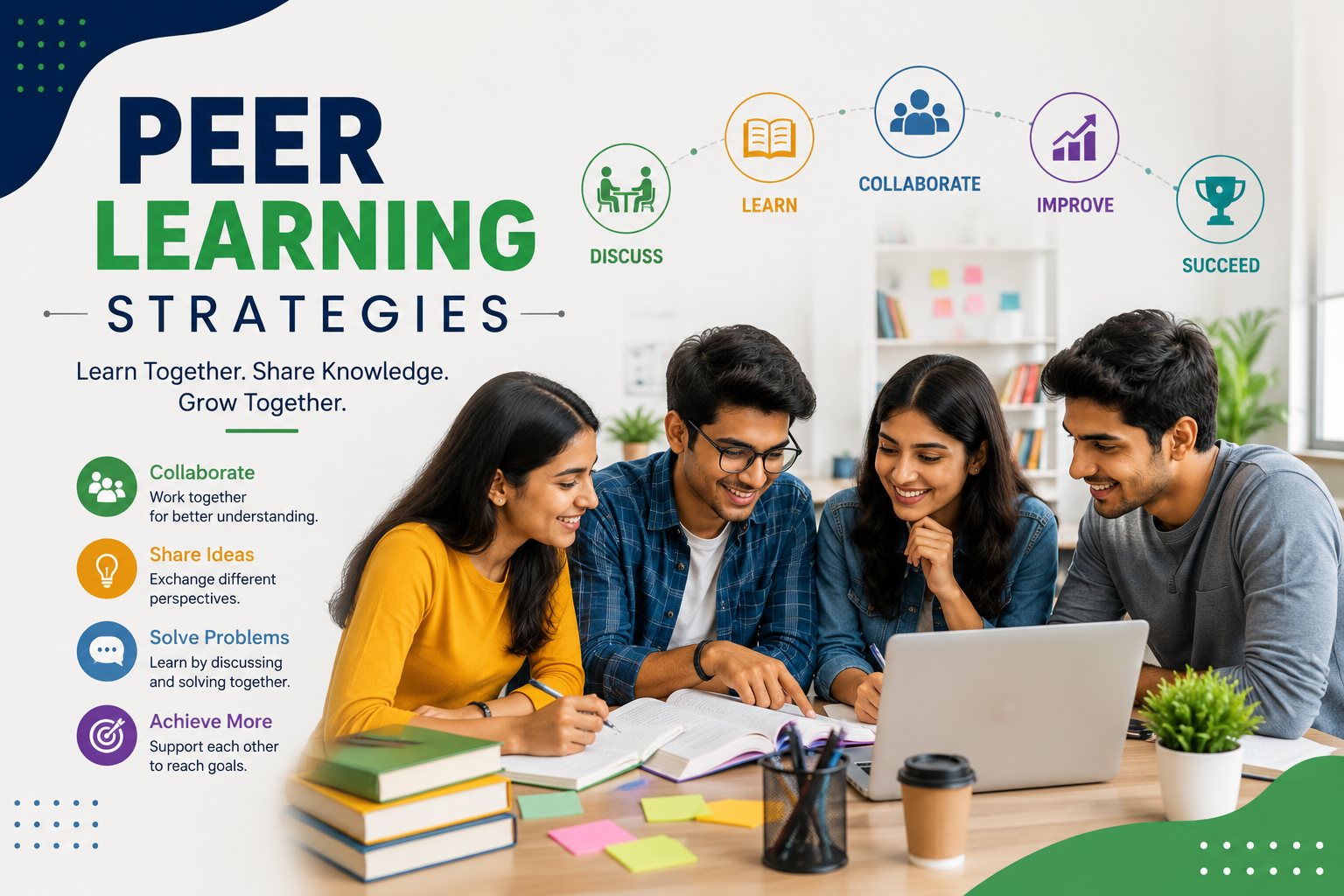
Learning becomes more effective when students do not have to figure everything out alone. Sometimes, a classmate’s explanation can make a difficult concept easier to understand, while discussing a problem with a peer can reveal an approach that a textbook never considered. This is where peer learning strategies can make a real difference.
Peer learning involves students learning with and from one another through discussion, explanation, practice, feedback, and shared problem-solving. It can happen inside a classroom, during study sessions, through student clubs, or even while preparing for interviews and internships.
For students, graduates, and freshers, peer learning is valuable because it develops more than academic knowledge. It also builds communication, teamwork, confidence, critical thinking, and other skills that contribute to employability and workplace readiness.
What Is Peer Learning?
Peer learning is a learning approach in which students support each other’s learning instead of relying entirely on a teacher or instructor.
The process can take different forms. Students might explain concepts to each other, review assignments, solve problems together, conduct mock interviews, or discuss different approaches to a project.
For example, imagine a student struggling to understand Excel formulas. A classmate who is comfortable with Excel could demonstrate how a formula works using a practical example. While explaining the process, the classmate may also strengthen their own understanding.
This makes peer learning a two-way process. One student learns the concept, while the other develops the ability to explain and communicate knowledge effectively.
Why Is Peer Learning Important for Students?
Peer learning can complement traditional classroom learning by creating more opportunities for students to participate actively.
It Makes Learning More Interactive
Instead of only listening to an explanation, students get opportunities to ask questions, discuss ideas, and practise what they have learned.
Active participation can help students identify which areas they understand well and which topics need more attention.
It Encourages Students to Ask Questions
Some students hesitate to ask questions in a classroom because they are worried about giving the wrong answer or interrupting the session.
Discussing the topic with classmates can feel more comfortable. Students can ask questions, compare their understanding, and clarify confusion without feeling that every question needs to be perfect.
It Develops Communication Skills
Explaining a concept to another student requires clear communication.
Students learn to adjust their explanation depending on the listener. This ability becomes useful later when communicating with teammates, managers, customers, or clients.
It Builds Confidence
Regularly sharing ideas with peers can gradually make students more comfortable speaking and participating.
That confidence can later help during presentations, group discussions, interviews, and workplace meetings.
Effective Peer Learning Strategies Students Can Use
Peer learning does not require a complicated system. The right strategy depends on the subject, group size, and learning objective.
1. Peer Teaching
One of the simplest strategies is to take turns teaching each other.
Each student can choose a topic they understand and explain it to the group using examples, diagrams, or questions.
For instance, while preparing for an examination, one student could explain a mathematics formula, another could cover a science concept, and another could discuss an important theoretical topic.
Tip: If you cannot explain something simply, it may be a sign that you need to understand it more deeply yourself.
2. Think-Pair-Share
This strategy works particularly well for discussions.
First, students think about a question individually. Next, they discuss their answer with a partner. Finally, they share their ideas with the larger group.
This gives quieter students an opportunity to organise their thoughts before speaking publicly.
3. Group Problem-Solving
Students can work together on problems that require reasoning rather than memorisation.
For example, computer science students might solve a programming problem together, while business students might analyse a hypothetical business situation.
Each person can suggest an approach before the group compares the possible solutions.
4. Peer Review
Students can review each other’s work and provide constructive feedback.
This could include:
- Reviewing an assignment
- Checking a presentation
- Improving written communication
- Reviewing a project report
- Giving feedback on a CV
- Practising interview answers
Peer review teaches students to look at work from another person’s perspective.
5. Study Circles
A study circle is a small group that meets regularly with a specific learning goal.
Instead of simply sitting together and studying independently, members can assign topics, discuss difficult concepts, quiz each other, and track their progress.
Keeping the group small can make it easier for everyone to participate.
6. Mock Interviews With Peers
Peer learning can also support career preparation.
Students can take turns acting as interviewer and candidate. One student asks common interview questions while another answers them.
Afterward, the interviewer can provide feedback on:
- Clarity of answers
- Confidence
- Body language
- Relevance of examples
- Communication style
- Areas that could be improved
This gives students a safe environment to practise before facing an actual interview.
How to Make Peer Learning More Effective
Simply studying together does not automatically create effective peer learning. Students need to make sure that everyone participates and that the group has a clear purpose.
Set a Specific Learning Goal
Before starting a session, decide what the group wants to accomplish.
Instead of saying, “Let’s study for two hours,” try:
“By the end of this session, we should be able to explain these three concepts and solve five practice questions.”
A clear objective makes the session easier to manage.
Give Everyone a Role
One person does not have to lead every session.
Students can rotate responsibilities such as:
- Discussion leader
- Note-taker
- Timekeeper
- Question creator
- Presenter
- Feedback provider
This encourages participation and gives students opportunities to practise different skills.
Ask Questions Instead of Giving Immediate Answers
When a classmate is struggling, it can be tempting to simply provide the answer.
A better approach may be to ask guiding questions that help the student reach the answer themselves.
This encourages critical thinking and makes the learning process more meaningful.
Create a Comfortable Environment
Peer learning works best when students feel comfortable admitting that they do not understand something.
Mistakes should be treated as part of learning rather than something embarrassing. A supportive group encourages students to ask questions and experiment with new ideas.
Common Challenges in Peer Learning
Although peer learning has many advantages, students can also face difficulties.
One Person Does Most of the Talking
If one student dominates the discussion, others may not get enough opportunity to participate.
Solution: Rotate leadership roles and deliberately invite quieter members to share their views.
Incorrect Information Can Spread
Peers can sometimes misunderstand a concept and unintentionally pass that misunderstanding to others.
Solution: Use reliable learning materials to verify important information. Peer learning should complement formal resources, not replace them completely.
The Group Gets Distracted
Friends may start discussing unrelated topics, checking social media, or spending too much time chatting.
Solution: Set a time limit and define specific tasks for every session.
Different Learning Speeds
Some students may understand a topic quickly while others need more time.
Solution: Encourage students to explain concepts in different ways and allow enough time for questions and practice.
How Peer Learning Builds Career-Ready Skills
One of the biggest advantages of peer learning is that the skills developed through it extend beyond academics.
Students who regularly participate in peer learning can practise:
Communication: Explaining ideas clearly and listening actively.
Teamwork: Working toward a shared learning objective.
Leadership: Taking responsibility for organising discussions or helping others.
Problem-solving: Comparing different approaches to a challenge.
Critical thinking: Evaluating ideas instead of accepting the first answer.
Feedback: Giving and receiving constructive suggestions.
These are useful skills in internships and professional environments.
For example, a student who regularly leads study discussions may have a genuine example of leadership to discuss during an interview. Someone who helped classmates complete a project can demonstrate teamwork and communication.
How to Showcase Peer Learning Experiences on Your CV
Students should avoid simply writing “Good at peer learning” on their CV. Instead, describe the activity and the contribution made.
For example:
Less effective:
“Participated in group study sessions.”
Stronger:
“Organised weekly peer-learning sessions for a five-member study group, facilitating topic discussions and practice sessions ahead of semester examinations.”
Another example could be:
“Conducted peer-led mock interview sessions with fellow students, providing structured feedback on communication, confidence, and response quality.”
These statements provide evidence of skills instead of simply listing them.
Students can also mention relevant peer-learning experiences under sections such as Projects, Leadership Experience, Extracurricular Activities, Volunteering, or Achievements, depending on the nature of the activity.
Using Peer Learning for Career Preparation
Peer learning can become particularly useful as students approach internships and their first jobs.
A group of students can create a weekly career-preparation session where they:
- Practise common interview questions
- Review each other’s CVs
- Discuss internship opportunities
- Conduct mock group discussions
- Practise professional introductions
- Share useful learning resources
- Discuss industry-related topics
- Give feedback on presentations
For students without formal work experience, activities like these can also provide opportunities to develop and demonstrate transferable skills.
Conclusion
Peer learning is not simply about studying with friends. When approached intentionally, it becomes a practical way to understand difficult concepts, exchange ideas, practise communication, and develop confidence.
The most effective peer learning strategies encourage students to teach, question, listen, practise, review, and give feedback. These activities can strengthen academic learning while also developing skills that matter in internships, interviews, and professional environments.
Students do not need to wait for a formal training programme to start. Find a few motivated peers, choose a clear learning goal, divide responsibilities, and start sharing knowledge.
When students learn from one another, every participant has the opportunity to become both a learner and a contributor—and that mindset can continue long after college.
Leave a Reply