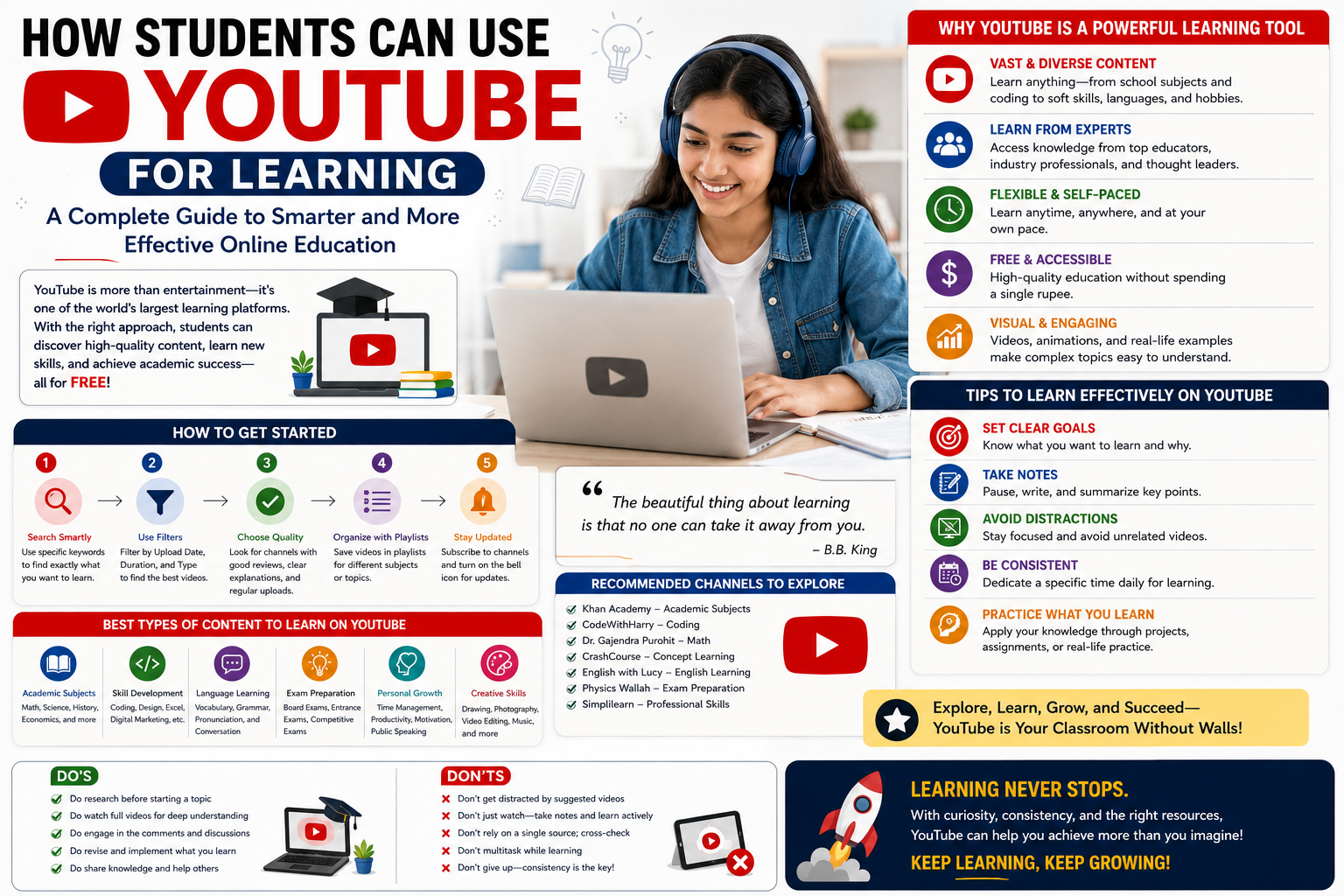
YouTube is often associated with entertainment, music, and social media content, but it has also become one of the world’s most accessible learning platforms. Students can use YouTube to understand difficult academic concepts, learn practical skills, explore new subjects, prepare for exams, develop career skills, and discover new areas of interest. With millions of educational videos available for free, the platform offers students an opportunity to supplement traditional education and learn at their own pace.
At CVDragon, we believe that effective learning is not limited to textbooks or classrooms. Students who know how to use digital resources responsibly can expand their knowledge, develop valuable skills, and become more confident learners. However, using YouTube effectively requires more than simply watching random videos. Students need to develop a structured approach that helps them find reliable content, avoid distractions, take meaningful notes, and apply what they learn.
Why YouTube Can Be a Powerful Learning Tool
Traditional classroom education provides structure, but students do not always learn at the same speed. Some may understand a topic immediately, while others may need additional explanations and examples.
YouTube gives students the flexibility to:
- Learn at their own pace.
- Pause and replay difficult explanations.
- Watch visual demonstrations.
- Explore different teaching styles.
- Learn practical skills.
- Access expert perspectives.
- Study topics beyond their academic curriculum.
For students who struggle with a particular concept, watching multiple explanations from different educators can make complex subjects easier to understand.
Use YouTube to Understand Difficult Academic Concepts
One of the simplest ways students can use YouTube is to supplement classroom learning.
If a student finds a topic difficult, they can search for educational videos that explain the concept in simpler language. Visual demonstrations, animations, diagrams, and real-world examples can often make complicated ideas easier to understand.
For example, students can use educational videos to explore:
- Mathematics problems.
- Science experiments.
- Historical events.
- Economic concepts.
- Programming fundamentals.
- Accounting principles.
- Language skills.
The goal should not be to replace textbooks or teachers but to use YouTube as an additional resource for better understanding.
Create a Learning Playlist
YouTube can become more useful when students organize educational content into playlists.
Instead of watching unrelated videos, students can create separate playlists for different learning goals, such as:
- College subjects.
- Programming.
- Communication skills.
- Interview preparation.
- Digital marketing.
- Data analytics.
- Career development.
A structured playlist creates a personalized learning library that students can return to whenever needed.
Learn Practical and Career-Oriented Skills
Academic knowledge is important, but students also need practical skills to prepare for employment.
YouTube provides access to tutorials and demonstrations covering a wide range of professional skills.
Students can learn:
- Coding and software development.
- Graphic design.
- Video editing.
- Digital marketing.
- Excel and data analysis.
- Public speaking.
- Presentation skills.
- Entrepreneurship.
- Personal branding.
- Resume development.
Learning these skills early can help students build stronger portfolios and become more prepared for internships and entry-level jobs.
Learn from Industry Professionals
Many professionals, educators, entrepreneurs, and subject experts share their knowledge through YouTube channels.
Students can follow creators who work in their areas of interest and learn about:
- Industry trends.
- Career paths.
- Professional challenges.
- Emerging technologies.
- Workplace expectations.
- Skill requirements.
For example, a student interested in software development can follow experienced developers to learn about programming languages, development tools, and real-world projects.
This exposure can help students understand what skills they need to develop before entering the professional world.
Use YouTube for Exam Preparation
YouTube can be a useful supplementary resource during exam preparation.
Students can search for:
- Topic explanations.
- Revision videos.
- Concept summaries.
- Problem-solving tutorials.
- Practice questions.
- Exam strategies.
However, students should verify information against their official textbooks, course materials, and teacher guidance. Not every educational video is accurate or aligned with a specific curriculum.
YouTube should support exam preparation rather than become the only source of study material.
Learn Through Visual Demonstrations
Some subjects are easier to understand when students can see concepts being demonstrated.
YouTube is particularly useful for visual learning because students can watch:
- Science experiments.
- Engineering demonstrations.
- Software tutorials.
- Design processes.
- Mathematical problem-solving.
- Historical documentaries.
- Laboratory techniques.
Visual learning can make abstract concepts more concrete and easier to remember.
Practice Active Learning While Watching
Simply watching videos does not guarantee learning. Students should actively engage with the content.
While watching educational videos, students can:
- Take notes.
- Pause to summarize key ideas.
- Write down unfamiliar terms.
- Create questions.
- Try solving problems independently.
- Explain the concept in their own words.
A useful technique is to pause the video before the explanation is revealed and try to predict the answer. This turns passive viewing into active learning.
Take Notes and Build a Personal Knowledge Base
Students should avoid relying entirely on video memory. Taking notes helps organize and retain information.
They can record:
- Important concepts.
- Definitions.
- Examples.
- Formulas.
- Useful resources.
- Questions for further research.
Digital note-taking tools can make it easier to organize information by subject or skill.
Over time, students can build a personal knowledge library that supports their academic and professional development.
Learn New Languages
YouTube can also support language learning.
Students can find videos for:
- Vocabulary.
- Grammar.
- Pronunciation.
- Conversation practice.
- Listening skills.
- Cultural understanding.
Watching interviews, news programs, or educational content in the language being learned can help students become more comfortable with real-world communication.
Combining video learning with active speaking and writing practice can make language development more effective.
Develop Communication and Public Speaking Skills
Communication is one of the most valuable skills students can develop, regardless of their career choice.
YouTube offers tutorials on:
- Public speaking.
- Presentation skills.
- Interview preparation.
- Professional communication.
- Storytelling.
- Body language.
Students can observe how experienced speakers structure their presentations and communicate ideas.
They can then practice by recording themselves and reviewing their performance.
Explore Career Options
Many students are unsure about what career path they want to pursue. YouTube can help them explore different professions before making important decisions.
Students can watch content about:
- Day-in-the-life experiences.
- Career journeys.
- Industry introductions.
- Professional interviews.
- Skill requirements.
- Workplace experiences.
This can provide useful perspectives, although students should remember that individual experiences do not represent every career or workplace.
Using multiple sources for career research helps students develop a more balanced understanding.
Build Projects Based on What You Learn
One of the best ways to turn YouTube learning into real skill development is by creating projects.
For example:
A programming student can build a simple application.
A design student can create a portfolio project.
A digital marketing student can develop a mock marketing campaign.
A data analytics student can analyze a public dataset.
A video editing student can create a short video.
Projects demonstrate that students can apply knowledge rather than simply consume content. They can also become valuable additions to a resume and portfolio.
Follow Reliable Educational Channels
Not all YouTube content is equally reliable. Students should evaluate the quality of educational videos before accepting information as accurate.
Look for:
- Qualified instructors.
- Reputable educational institutions.
- Industry professionals.
- Well-researched explanations.
- References and supporting sources.
- Clear and transparent information.
Students should be particularly careful when learning about sensitive or high-stakes topics and should cross-check important information with trusted sources.
Avoid the YouTube Distraction Trap
One of the biggest challenges of learning on YouTube is distraction. A student may start watching an educational video and quickly move to unrelated entertainment content.
To avoid this:
- Set a specific learning goal.
- Use a dedicated study playlist.
- Turn off unnecessary notifications.
- Set a time limit.
- Avoid unrelated recommendations.
- Take breaks at planned intervals.
The objective is to use YouTube intentionally rather than allowing the algorithm to control your attention.
Create a Structured Learning Schedule
Students can make YouTube learning more effective by including it in a regular study routine.
For example:
Monday: Watch one programming tutorial.
Tuesday: Practice the concepts learned.
Wednesday: Complete a small project.
Thursday: Review previous lessons.
Friday: Learn a new concept.
This approach creates consistency and prevents students from consuming large amounts of content without actually developing skills.
Don’t Become a Passive Content Consumer
One of the biggest mistakes students make is watching endless tutorials without applying what they learn.
The real value of YouTube comes from the cycle:
Watch → Understand → Practice → Create → Review
After watching a tutorial, students should immediately try to apply the knowledge.
For example, after watching a coding tutorial, write code. After learning a design technique, create a design. After watching a communication lesson, practice speaking.
Application transforms information into skill.
Use YouTube Alongside Other Learning Resources
YouTube is a valuable learning tool, but it should not be the only resource students use.
Combine YouTube with:
- Textbooks.
- Online courses.
- Academic resources.
- Professional certifications.
- Practice exercises.
- Mentorship.
- Internships.
- Online communities.
Different resources provide different learning experiences. A balanced approach can help students develop deeper knowledge and stronger practical abilities.
Turn YouTube Learning into Resume Value
The skills students develop through YouTube can become valuable when combined with practical application.
For example, if a student learns Python through YouTube and then builds three projects, the projects can be included in a resume or portfolio.
Similarly, students can highlight:
- Completed projects.
- New technical skills.
- Portfolio work.
- Personal initiatives.
- Content creation.
- Practical achievements.
The important point is to demonstrate what was achieved through learning rather than simply stating that YouTube videos were watched.
Create Your Own Educational Content
Advanced learners can take their knowledge one step further by creating educational content themselves.
Students can create:
- Tutorial videos.
- Project demonstrations.
- Educational presentations.
- Study guides.
- Skill-based content.
Teaching others can strengthen understanding and improve communication skills. It can also help students develop a professional digital presence.
Conclusion
YouTube can be a powerful learning platform for students when used with purpose and discipline. From understanding difficult academic concepts and preparing for exams to learning professional skills and exploring career options, the platform provides access to an enormous range of educational resources.
At CVDragon, we encourage students to use YouTube as part of a broader learning strategy. The most successful learners do not simply watch videos—they actively take notes, practice new concepts, build projects, seek feedback, and apply their knowledge in real-world situations.
The key is to move from watching to doing. A tutorial can introduce a skill, but practice develops it. A video can explain an idea, but applying it creates genuine understanding. By using YouTube intentionally and combining it with academic learning, practical projects, certifications, and professional communities, students can build valuable skills that strengthen their resumes and prepare them for future career opportunities.
In a world where continuous learning is becoming increasingly important, students who learn how to use digital platforms effectively can take greater control of their education and professional development. With the right approach, YouTube can become more than an entertainment platform—it can become a personal classroom available whenever and wherever you need it.
Leave a Reply