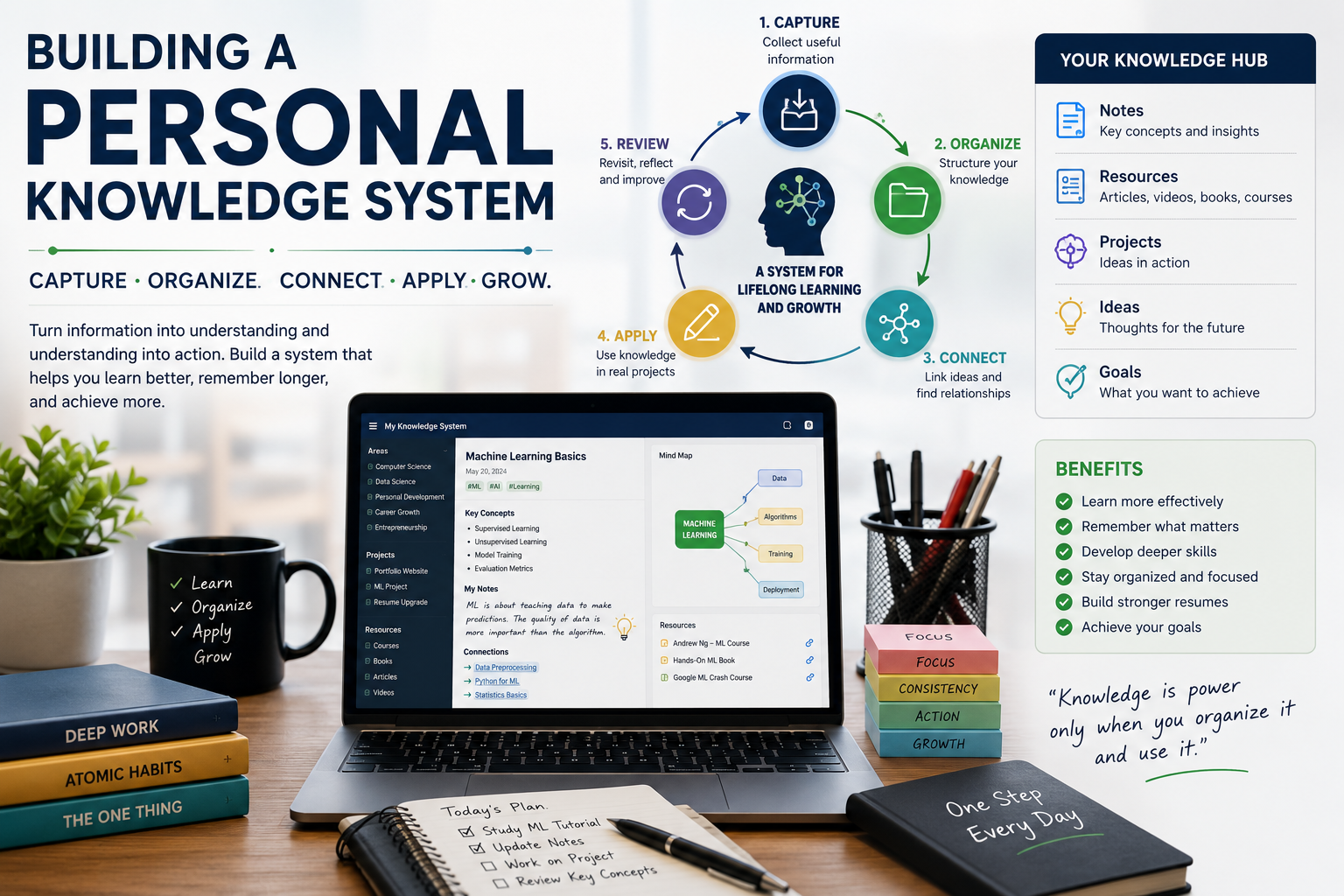
In today’s fast-changing world, learning is no longer limited to classrooms, textbooks, or formal courses. Students have access to an enormous amount of information through online courses, videos, articles, podcasts, digital communities, webinars, and professional platforms. While this access creates exciting opportunities, it also creates a new challenge: how do you organize everything you learn so that it remains useful?
Many students consume a lot of educational content but struggle to remember it later. They may save dozens of articles, bookmark hundreds of videos, take notes in different applications, or collect certificates without having a clear system for connecting their knowledge. Over time, information becomes scattered and difficult to retrieve.
This is where a personal knowledge system can make a significant difference.
A personal knowledge system is a structured method for capturing, organizing, connecting, reviewing, and applying information. It helps students transform random pieces of information into a useful collection of knowledge that can support academic performance, skill development, career preparation, and personal growth.
For students building their careers, creating a personal knowledge system can also complement their resume-building journey. Platforms such as cvDragon can help students present their skills and achievements, while a well-organized knowledge system helps them continuously develop the skills and experiences they eventually want to showcase.
What Is a Personal Knowledge System?
A personal knowledge system is a collection of tools, habits, and processes that help you manage information and knowledge in a way that works for you.
It is more than simply taking notes.
A strong knowledge system helps you:
- Capture useful information
- Organize your notes
- Connect related ideas
- Find information quickly
- Review important concepts
- Apply what you have learned
- Identify knowledge gaps
- Build new skills over time
For example, imagine that a student wants to learn digital marketing. They may watch a YouTube video about SEO, complete an online course about social media marketing, read an article about content strategy, and attend a webinar about analytics.
Without a system, these resources may remain separate pieces of information.
With a personal knowledge system, the student can connect these concepts and gradually build a larger understanding of digital marketing. They can record key ideas, add examples, practice the skills, and eventually use their knowledge in a real project.
The goal is not to collect the most information. The goal is to build knowledge that you can remember, understand, and use.
Why Students Need a Personal Knowledge System
Students today are surrounded by information. The challenge is no longer finding information—it is managing it effectively.
A personal knowledge system can help students overcome several common problems.
Information Overload
The internet provides endless learning resources. Without a system, students may jump from one topic to another without developing deep knowledge.
A personal knowledge system creates structure and helps students focus on information that is genuinely relevant to their goals.
Forgetting What You Learn
Students often study for exams, complete assignments, and move on to the next topic. Without regular review and practical application, much of that knowledge can be forgotten.
A knowledge system gives students a place to store important concepts and revisit them when necessary.
Scattered Notes
Many students use different notebooks, apps, documents, and messaging platforms to store information. This makes it difficult to find anything later.
A centralized system can make knowledge easier to access.
Lack of Connection Between Ideas
Knowledge becomes more powerful when concepts are connected.
For example, a student studying business might connect marketing, consumer psychology, data analytics, and finance. These connections can lead to better understanding and more creative thinking.
Step 1: Define What You Want to Learn
Before building a knowledge system, identify your learning goals.
Ask yourself:
- What skills do I want to develop?
- What subjects do I want to understand better?
- What career am I preparing for?
- What knowledge will help me achieve my goals?
- What problems do I want to learn how to solve?
Your system should support your objectives.
For example, a computer science student may focus on:
- Programming
- Data structures
- Artificial intelligence
- Cloud computing
- Cybersecurity
- Software development
A business student may focus on:
- Marketing
- Finance
- Business strategy
- Entrepreneurship
- Leadership
- Data analytics
Defining your learning priorities prevents your knowledge system from becoming a digital storage space filled with information you never use.
Step 2: Choose One Main Place for Your Knowledge
One of the simplest ways to create a personal knowledge system is to choose a central location for your notes.
You can use:
- A digital note-taking application
- A document management system
- A personal wiki
- A physical notebook
- A combination of digital and physical tools
The specific tool is less important than consistency.
You do not need the most advanced application. A simple system that you actually use is better than a sophisticated system that feels too complicated.
Choose a platform that allows you to:
- Create organized notes
- Search for information
- Add links
- Categorize topics
- Update information
- Access your knowledge easily
Step 3: Create a Simple Organizational Structure
Avoid creating too many categories at the beginning.
A simple structure might include:
1. Areas
These are broad subjects you care about.
Examples:
- Career
- Education
- Technology
- Personal Development
2. Projects
These are specific activities you are currently working on.
Examples:
- Build a portfolio website
- Complete a programming project
- Prepare for an internship
- Create a marketing campaign
3. Resources
These include books, articles, videos, courses, and other materials you want to explore.
4. Notes
These are your own thoughts, explanations, observations, and insights.
This structure makes it easier to separate information from active work.
Step 4: Capture Information Efficiently
Whenever you learn something useful, capture it.
However, avoid copying everything.
Instead, record:
- The main idea
- Important facts
- Your interpretation
- Practical examples
- Questions you still have
- Connections to other topics
For example, instead of copying an entire article about time management, write a short note explaining the key principle and how you might apply it to your daily routine.
The best notes are often written in your own words.
Writing information in your own language forces you to process the concept rather than simply storing it.
Step 5: Use the “Progressive Summarization” Approach
A useful strategy for managing information is progressive summarization.
The basic idea is to gradually make important information easier to understand.
You might begin by saving an article or resource. Later, you highlight the most useful sections. After that, you write a short summary in your own words.
Over time, the most valuable information becomes easier to review.
This approach prevents you from spending excessive time organizing every piece of information immediately.
Step 6: Connect Ideas Together
One of the most powerful aspects of a personal knowledge system is the ability to connect ideas.
Suppose you have notes about:
- Artificial intelligence
- Data analytics
- Business strategy
- Customer behavior
You might discover that these topics are connected through AI-powered customer analytics.
By linking related concepts, you can develop a broader understanding of complex subjects.
Ask questions such as:
- What does this concept remind me of?
- Where else can I apply this idea?
- How does this topic relate to something I already know?
- What is similar or different?
- Can I explain this concept using another example?
These questions turn your knowledge system into a network of ideas rather than a collection of isolated notes.
Step 7: Create an “Idea Bank”
Students often have ideas but forget them because they do not record them.
Create a dedicated space for:
- Project ideas
- Business ideas
- Content ideas
- Research questions
- Career opportunities
- Problems you want to solve
- Skills you want to learn
You do not need to develop every idea immediately.
The purpose is to create a place where ideas can be stored until you are ready to explore them.
An idea that seems unimportant today may become valuable in the future.
Step 8: Turn Knowledge Into Projects
Knowledge becomes more valuable when you apply it.
If you learn:
- Web development, build a website.
- Data analytics, analyze a dataset.
- Graphic design, create a portfolio.
- Digital marketing, develop a campaign.
- Public speaking, record a presentation.
- Business strategy, analyze a real company.
Projects help you move from knowing to doing.
They also create tangible evidence of your skills. This can be especially useful when building a resume or preparing for internships and job applications.
A student who says, “I know Python,” may have limited evidence of that skill.
A student who can say, “I used Python to build a data analysis project and documented the results,” can demonstrate practical application.
Step 9: Review Your Knowledge Regularly
A personal knowledge system is only useful if you revisit it.
Set aside time to review your notes.
You might review:
- Important concepts weekly
- Current projects every few days
- Learning goals monthly
- Career progress every few months
During your review, ask:
- What did I learn?
- What did I actually use?
- What do I still not understand?
- Which skills are improving?
- What should I learn next?
Regular reviews help you identify gaps and keep your learning focused.
Step 10: Create Your Own Learning Dashboard
As your knowledge system grows, you can create a simple dashboard to track your progress.
You might include:
| Category | Current Focus | Progress |
|---|---|---|
| Technical Skills | Python | Intermediate |
| Communication | Public Speaking | Improving |
| Career | Resume Development | Completed |
| Projects | Portfolio Website | In Progress |
| Certifications | Data Analytics | Planned |
The dashboard does not need to be complicated. Its purpose is to provide a quick overview of where you are and where you want to go.
Personal Knowledge Systems and Resume Building
One of the biggest advantages of building a personal knowledge system is that it can support your career development.
Students often struggle to remember everything they have accomplished. After several semesters, they may forget the projects they completed, workshops they attended, skills they practiced, or responsibilities they took on.
A knowledge system can act as a career record.
You can maintain sections for:
- Academic achievements
- Projects
- Internships
- Certifications
- Technical skills
- Soft skills
- Volunteer experiences
- Leadership roles
- Competitions
- Workshops
- Extracurricular activities
When it is time to update your resume, you can review this information and identify the most relevant experiences.
Using a resume platform such as cvDragon, students can then organize and present their qualifications more effectively.
The knowledge system and resume serve different purposes:
Your knowledge system helps you grow and remember.
Your resume helps you communicate your value to employers.
Together, they can create a stronger career development process.
Common Mistakes to Avoid
Building a personal knowledge system is useful, but there are several mistakes students should avoid.
Overcomplicating the System
Do not spend more time designing your system than learning.
Start simple and improve it gradually.
Collecting Without Processing
Saving hundreds of articles does not mean you have learned anything.
Focus on understanding and applying information.
Excessive Categorization
Too many folders and tags can make your system difficult to maintain.
Use categories only when they genuinely improve organization.
Never Reviewing Notes
A knowledge system that you never revisit becomes a digital archive.
Schedule regular reviews.
Focusing Only on Consumption
Watching videos and reading articles are useful, but active practice is essential.
Try to balance learning with doing.
Trying to Remember Everything
Your system does not need to contain every detail you encounter.
Capture information that is useful, meaningful, or relevant to your goals.
A Simple Personal Knowledge System for Students
Students who are just getting started can use a simple five-part framework:
1. Capture
Save useful information and ideas.
2. Understand
Rewrite important concepts in your own words.
3. Connect
Link new knowledge to what you already know.
4. Apply
Use your knowledge through projects and practice.
5. Review
Return to your notes and update your understanding.
This process can gradually become a natural part of your learning routine.
The Long-Term Benefits of a Personal Knowledge System
A personal knowledge system is not just a productivity technique. It can become a long-term investment in your education and career.
Over time, it can help you:
- Learn more effectively
- Remember important concepts
- Develop deeper expertise
- Identify skill gaps
- Generate new ideas
- Build practical projects
- Prepare stronger resumes
- Track career progress
- Make better decisions
The system becomes increasingly valuable as your knowledge grows.
A first-year student may use it to organize coursework and explore career options. Later, the same system can support internships, projects, job applications, professional development, and lifelong learning.
Conclusion
Building a personal knowledge system gives students a practical way to manage the enormous amount of information they encounter every day. Instead of allowing useful ideas to disappear into scattered notes, bookmarks, and saved videos, students can create a structured environment where knowledge is captured, connected, reviewed, and applied.
The most effective system is not necessarily the most sophisticated one. It is the system that you can maintain consistently and that helps you turn information into understanding and understanding into action.
For students, this approach can also strengthen career preparation. By keeping track of skills, projects, achievements, and learning experiences, students can build a clearer picture of their professional growth and use that information when preparing their resumes and portfolios.
With a platform like cvDragon helping students present their qualifications and a personal knowledge system helping them continuously develop those qualifications, students can create a more organized approach to lifelong learning and career growth.
In the end, the goal is simple: don’t just collect knowledge—build a system that helps you use it.
Leave a Reply