Introduction
Every day, individuals face decisions and challenges—some simple, others highly complex. Whether it involves business strategy, career planning, academic research, or personal decision-making, solving problems effectively requires more than intelligence alone. It requires structured thinking.
This is where mental models become powerful tools.
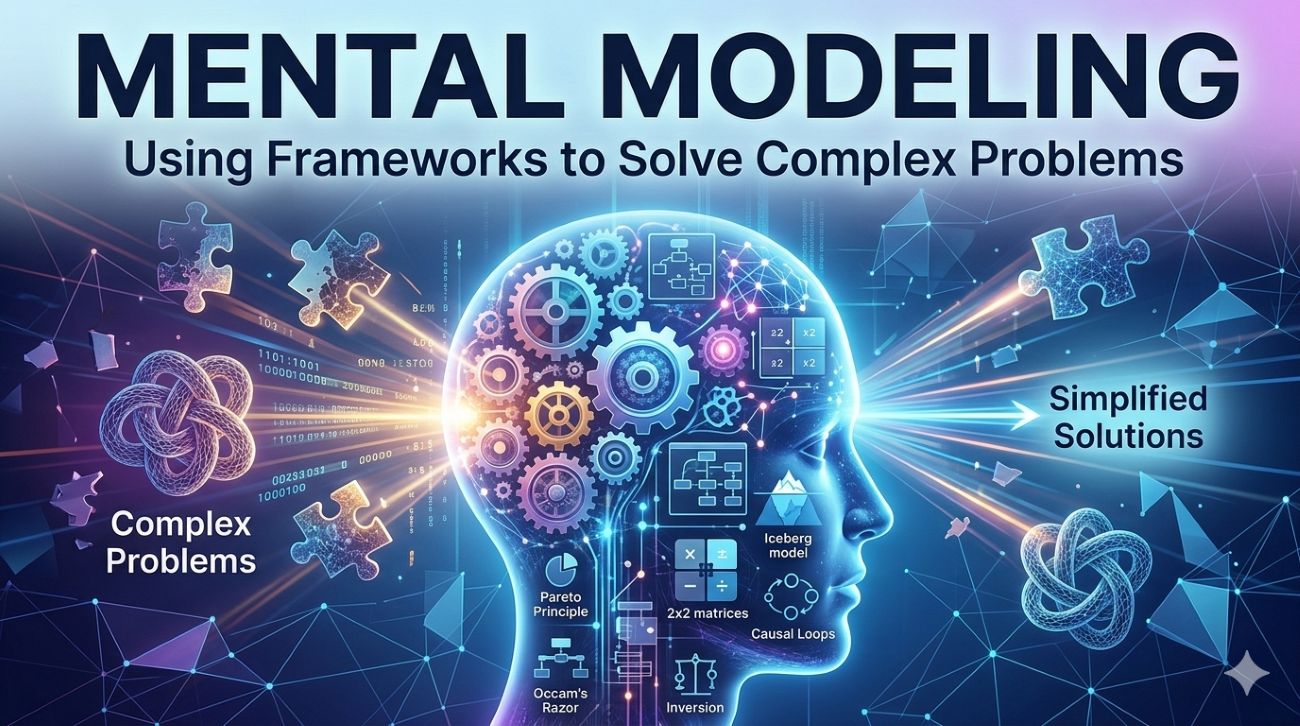
Mental modeling is the practice of using thinking frameworks to understand situations, analyze problems, and make better decisions. Instead of reacting emotionally or randomly, mental models help individuals approach challenges logically and strategically.
At CVDragon, we believe mental modeling is a critical skill for professionals, students, leaders, and decision-makers. Those who master structured thinking gain clarity, reduce mistakes, and solve problems more efficiently.
This article explores mental models, their importance, and how frameworks can help solve complex problems.
What are Mental Models?
Mental models are simplified frameworks or thinking tools that help people understand how things work.
They act as cognitive shortcuts that allow you to:
- Analyze situations clearly
- Predict outcomes
- Make informed decisions
- Solve problems effectively
Mental models help organize thoughts.
They turn complexity into clarity.
Why Mental Modeling is Important
1. Simplifies Complex Problems
Complex problems often feel overwhelming.
Mental models break problems into manageable parts.
This makes decision-making easier.
2. Improves Decision-Making
Structured thinking reduces impulsive decisions.
Mental models help evaluate options logically.
Better thinking leads to better outcomes.
3. Reduces Cognitive Bias
Humans often make decisions based on assumptions or emotions.
Mental models encourage objective thinking.
They minimize errors.
4. Enhances Strategic Thinking
Professionals and leaders use frameworks to plan effectively.
Mental models improve long-term thinking.
5. Encourages Problem-Solving Confidence
When you have tools to analyze challenges, confidence increases.
You approach problems calmly.
How Mental Models Work
Mental models provide perspectives.
Instead of viewing a problem from one angle, they allow multiple viewpoints.
For example:
A business challenge can be analyzed using cost, risk, efficiency, or customer impact models.
Different frameworks reveal better solutions.
Popular Mental Models for Problem Solving
Here are some powerful mental models widely used by successful professionals.
1. First Principles Thinking
This model involves breaking problems down into basic truths.
Instead of relying on assumptions, ask:
- What do we know for certain?
- What are the fundamental facts?
Then rebuild solutions from scratch.
This encourages innovation.
2. The 80/20 Rule (Pareto Principle)
This model suggests that:
80% of results come from 20% of efforts.
It helps prioritize tasks.
Focus on high-impact activities.
Avoid wasting time on low-value work.
3. Cause and Effect Thinking
Every action has consequences.
Understanding cause and effect helps predict outcomes.
Ask:
- What caused this problem?
- What will happen next?
This improves planning.
4. SWOT Analysis
SWOT stands for:
- Strengths
- Weaknesses
- Opportunities
- Threats
This framework helps analyze situations strategically.
It is widely used in business and career planning.
5. Systems Thinking
Problems often exist within systems.
Systems thinking examines how parts interact.
Instead of fixing symptoms, it addresses root causes.
This leads to sustainable solutions.
6. Decision Tree Model
This model maps possible decisions and outcomes.
It helps compare risks and benefits.
Useful for complex choices.
Applying Mental Models in Real Life
Mental models are practical tools.
Career Decisions
Use SWOT analysis to evaluate opportunities.
Assess strengths and risks.
Academic Problem Solving
Use cause-and-effect analysis.
Understand root problems.
Business Strategy
Apply the 80/20 rule.
Focus on impactful actions.
Personal Life Decisions
Use decision trees to compare options.
Choose wisely.
Steps to Use Mental Models Effectively
1. Define the Problem Clearly
Understand the issue first.
Clear problems lead to clear solutions.
2. Choose the Right Framework
Different problems need different models.
Select appropriately.
3. Analyze from Multiple Angles
Use more than one model.
Multiple perspectives improve decisions.
4. Evaluate Outcomes
Predict consequences.
Consider risks.
5. Take Action and Learn
Apply decisions.
Learn from results.
Improve continuously.
Benefits of Mental Modeling
Individuals who use mental models experience:
- Better problem-solving skills
- Improved decision-making
- Increased productivity
- Reduced stress
- Strategic thinking ability
Mental clarity leads to success.
Common Mistakes to Avoid
Avoid these errors:
Using Only One Model
Single perspectives limit thinking.
Use multiple frameworks.
Overthinking
Models guide thinking.
Do not delay action excessively.
Ignoring Real-World Data
Frameworks must align with reality.
Use facts.
Mental Models in Leadership and Management
Leaders frequently face uncertainty.
Mental models help leaders:
- Analyze risks
- Make strategic decisions
- Manage teams effectively
Strong leaders rely on structured thinking.
Mental Modeling for Students and Professionals
Students benefit by improving learning and analysis.
Professionals benefit through better workplace decisions.
Mental modeling strengthens critical thinking.
It builds career advantage.
Developing a Mental Modeling Habit
You can develop this skill gradually.
Learn Different Frameworks
Expand your thinking tools.
Practice Regularly
Apply models daily.
Reflect on Decisions
Evaluate results.
Improve thinking.
Stay Curious
Continuous learning improves reasoning.
Mental Models and Future Success
The modern world is complex.
Information overload creates confusion.
Mental models provide clarity.
They help individuals navigate uncertainty.
Those who think better perform better.
Conclusion
Mental modeling is a powerful approach to solving complex problems using structured frameworks. It simplifies decision-making, improves strategic thinking, and enhances problem-solving ability.
By applying mental models such as first principles thinking, the 80/20 rule, and systems thinking, individuals can approach challenges logically and confidently.
At CVDragon, we believe success begins with clear thinking. Mental models provide the tools needed to analyze problems, make informed decisions, and achieve meaningful outcomes.
Because success is not just about working harder—
It is about thinking smarter.
Leave a Reply