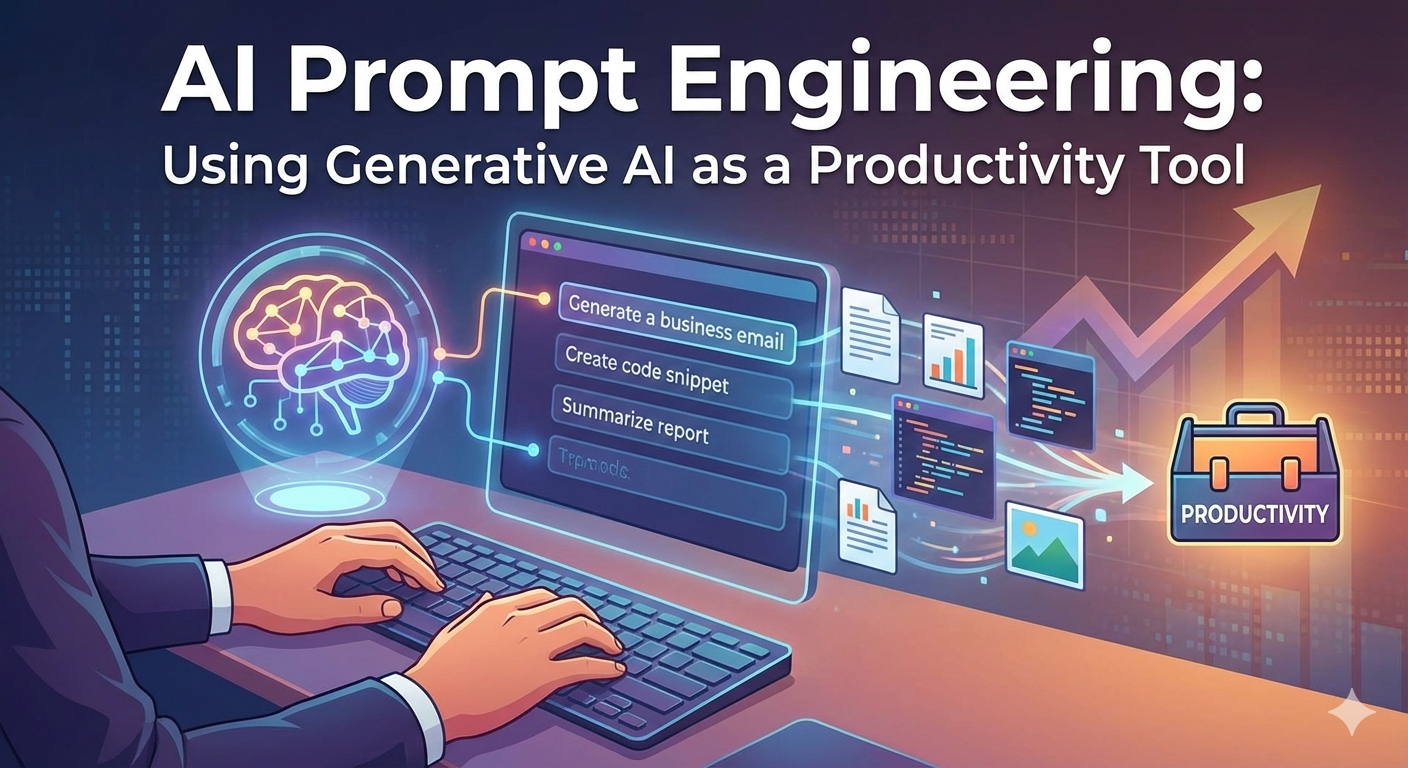
Artificial Intelligence is no longer a futuristic concept—it is already reshaping how we learn, work, and grow professionally. From drafting emails and resumes to generating ideas, analyzing data, and automating repetitive tasks, Generative AI has become a powerful productivity companion. However, the real value of AI does not come from the tool itself, but from how effectively we communicate with it.
This is where AI Prompt Engineering comes into play.
At cvDragon, we work closely with students, freshers, and professionals who want to improve productivity, build strong career profiles, and stay relevant in a rapidly evolving job market. One key insight we’ve observed is this: people who know how to write effective prompts get far better results from AI than those who don’t.
This article explores what AI prompt engineering is, why it matters, how generative AI boosts productivity, and how students and professionals can use it responsibly and effectively.
What Is AI Prompt Engineering?
AI prompt engineering is the skill of designing clear, specific, and well-structured instructions (prompts) to guide generative AI tools—such as ChatGPT, Gemini, or Copilot—to produce accurate, useful, and high-quality outputs.
A prompt is simply the input you give to an AI system. The quality of the output depends heavily on:
-
Clarity of the prompt
-
Context provided
-
Level of detail
-
Tone and constraints
In simple terms:
Better prompts = better results.
Why Prompt Engineering Matters in the Age of Generative AI
Generative AI is capable of producing content at incredible speed, but it is not a mind reader. Without proper guidance, AI responses can be vague, generic, or misaligned with your goals.
Prompt engineering helps users:
-
Save time
-
Reduce rework
-
Improve accuracy
-
Increase productivity
-
Use AI more strategically
At cvDragon, we see prompt engineering as a core future skill, just like communication or problem-solving.
Generative AI as a Productivity Tool
When used correctly, generative AI can significantly enhance productivity across academic and professional tasks.
Key Areas Where AI Improves Productivity
-
Content creation (blogs, emails, reports)
-
Resume and cover letter drafting
-
Idea generation and brainstorming
-
Research summarization
-
Learning new skills
-
Interview preparation
-
Task planning and time management
However, the effectiveness of AI in all these areas depends on how well prompts are written.
The Science Behind Effective Prompts
AI models are trained on large datasets and respond based on patterns. Clear prompts help narrow down these patterns and guide the AI toward the desired outcome.
Effective prompts usually include:
-
Context – What is the situation?
-
Role – Who should the AI act as?
-
Task – What needs to be done?
-
Constraints – Length, tone, format
-
Audience – Who is this for?
Example:
Instead of saying “Write a resume”, a better prompt would be:
“Act as a professional resume writer. Create an ATS-friendly resume for a final-year business student applying for a marketing internship. Use concise bullet points and highlight skills and projects.”
How AI Prompt Engineering Boosts Productivity
1. Saves Time on Repetitive Tasks
Prompt engineering allows users to automate repetitive cognitive tasks such as:
-
Drafting emails
-
Summarizing articles
-
Formatting content
This frees up time for high-value work like decision-making and creativity.
2. Improves Quality of Output
Clear prompts reduce ambiguity. With proper instructions, AI delivers:
-
More relevant responses
-
Better structure
-
Higher accuracy
This minimizes the need for repeated edits.
3. Enhances Learning and Skill Development
Students can use AI prompts to:
-
Explain concepts in simple language
-
Create study plans
-
Generate practice questions
-
Simulate mock interviews
AI becomes a personal tutor when prompted correctly.
4. Supports Career Readiness
At cvDragon, we encourage students to use AI responsibly for:
-
Resume improvement
-
LinkedIn summaries
-
Interview question practice
-
Career exploration
Prompt engineering helps transform raw information into career-ready content.
Types of Prompts for Maximum Productivity
1. Instructional Prompts
Used to complete a specific task.
Example: “Summarize this article in 200 words for a college audience.”
2. Role-Based Prompts
Assign a role to the AI.
Example: “Act as a career counselor and suggest job roles for a commerce graduate.”
3. Step-by-Step Prompts
Useful for complex tasks.
Example: “Explain this concept step by step with examples.”
4. Creative Prompts
Used for brainstorming and ideation.
Example: “Generate 10 blog ideas on productivity for students.”
5. Refinement Prompts
Improve existing content.
Example: “Rewrite this paragraph in a more professional tone.”
Best Practices for Writing Effective AI Prompts
1. Be Specific
Vague prompts lead to generic outputs.
2. Provide Context
Background information improves relevance.
3. Set Clear Constraints
Mention word count, format, or tone.
4. Iterate and Improve
Prompt engineering is a skill—refine prompts based on outputs.
5. Combine Human Judgment with AI Output
AI assists productivity, but final decisions should always involve human thinking.
Responsible Use of Generative AI
While AI is a powerful productivity tool, it must be used ethically and responsibly.
Students and professionals should:
-
Avoid plagiarism
-
Verify facts
-
Use AI as support, not a shortcut
-
Maintain originality and critical thinking
At cvDragon, we emphasize that AI should enhance human capability, not replace it.
AI Prompt Engineering as a Future Skill
As workplaces adopt AI tools, prompt engineering is emerging as a valuable professional skill.
Employers increasingly value candidates who can:
-
Use AI efficiently
-
Ask the right questions
-
Improve workflows with technology
-
Adapt to digital tools
Prompt engineering is quickly becoming a career advantage.
How cvDragon Supports AI-Driven Productivity
At cvDragon, we help individuals:
-
Translate skills into impactful resumes
-
Present AI-assisted projects ethically
-
Build future-ready career profiles
-
Understand how productivity tools align with employability
We believe AI is not just a tool—it’s a skill amplifier when used correctly.
Conclusion
AI prompt engineering is more than a technical skill—it is a new form of communication between humans and machines. When used thoughtfully, generative AI becomes a powerful productivity partner that saves time, enhances learning, and supports career growth.
At cvDragon, we encourage students and professionals to embrace AI not as a replacement for effort, but as a tool that amplifies clarity, focus, and impact. In the future of work, those who know how to work with AI—by asking the right questions—will lead the way.
Leave a Reply