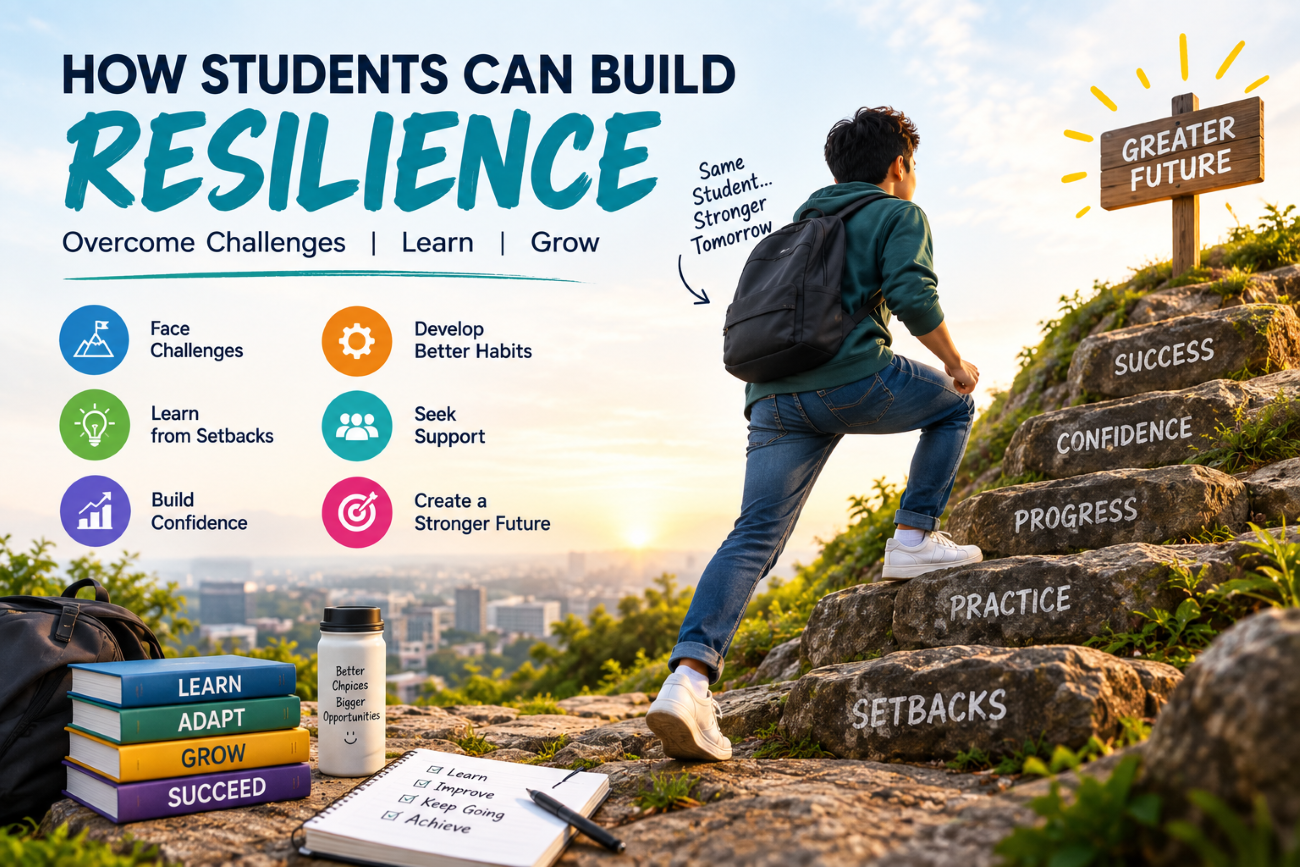
Student life is filled with opportunities, expectations, and challenges. From academic pressure and competitive examinations to internship rejections, project failures, changing career goals, and personal setbacks, students regularly face situations that test their ability to adapt. While knowledge and technical skills are important, another quality plays a major role in long-term success: resilience.
Resilience is the ability to recover from setbacks, adapt to difficult situations, and continue moving forward. It does not mean that students never feel disappointed, stressed, or discouraged. Instead, it means learning how to process challenges, understand what can be improved, and take the next step.
At CVDragon, we believe that resilience is an important part of student growth and career readiness. Students who learn to handle setbacks constructively can develop greater confidence, adaptability, and problem-solving abilities. These qualities can support them not only during their academic journey but also throughout their professional lives.
What Is Resilience?
Resilience is often described as the ability to bounce back after difficulties. For students, resilience can mean continuing to work toward a goal after receiving a low grade, learning from a rejected internship application, improving after a failed project, or adapting when plans do not work as expected.
Being resilient does not mean ignoring problems or pretending that everything is easy. It means acknowledging challenges and responding to them in a constructive way.
For example, if a student performs poorly in an examination, a resilient response might involve reviewing mistakes, identifying weak topics, changing study strategies, and preparing differently for the next opportunity.
The focus shifts from “I failed” to “What can I learn, and what can I do next?”
Understand That Setbacks Are Part of Growth
Many students feel that failure means they are not capable or talented enough. However, setbacks are a normal part of learning and development.
Learning something new often involves making mistakes. Building a project may require multiple attempts. Preparing for an interview may involve facing rejection before gaining confidence. Developing a new skill can take time and practice.
Students can build resilience by accepting that progress is rarely a straight line. Challenges do not automatically mean that a goal is impossible. Sometimes they simply reveal areas where a different approach, more practice, or additional learning is needed.
Develop a Growth-Oriented Mindset
The way students think about challenges can influence how they respond to them.
A fixed mindset may lead someone to believe that abilities cannot change. A student might think, “I am just not good at this.” This kind of thinking can make setbacks feel permanent.
A growth-oriented mindset focuses on development. Instead of saying, “I cannot do this,” students can say, “I cannot do this yet.”
This small change encourages students to view skills as something that can improve through practice, feedback, and experience.
Students can develop this mindset by:
- Viewing mistakes as learning opportunities.
- Focusing on improvement rather than perfection.
- Trying different strategies.
- Asking for feedback.
- Recognizing progress, even when it is small.
Learn How to Respond to Failure
Failure can be emotionally difficult, especially when students have invested significant time and effort into something. The first reaction may be disappointment, frustration, or self-doubt.
Instead of immediately making negative conclusions, students should take time to reflect.
Ask questions such as:
- What happened?
- What factors contributed to the outcome?
- What did I do well?
- What could I improve?
- What will I do differently next time?
This process transforms failure from a final judgment into useful feedback.
A poor result does not have to define the next attempt. What matters is how students use the experience to improve.
Set Realistic and Manageable Goals
Large goals can sometimes feel overwhelming. A student who wants to master a new subject, build a portfolio, prepare for competitive exams, and apply for internships at the same time may struggle without a clear plan.
Breaking large goals into smaller steps makes progress easier to manage.
For example, instead of saying, “I need to become an expert programmer,” a student could set smaller goals:
- Learn one programming concept.
- Practice it through exercises.
- Build a small project.
- Review mistakes.
- Move to the next skill.
Completing smaller goals builds confidence and creates momentum.
Build Strong Problem-Solving Skills
Resilient students do not always have immediate answers to their problems. However, they learn how to explore possible solutions.
When facing a challenge, students can:
- Define the problem clearly.
- Identify possible solutions.
- Consider the advantages and limitations of each option.
- Take action.
- Review the results.
- Adjust the approach if necessary.
This process helps students become more comfortable with uncertainty and develops confidence in their ability to handle future challenges.
Create Healthy Learning Habits
Resilience is easier to maintain when students have consistent routines.
Unorganized study habits, procrastination, and last-minute preparation can increase pressure and make setbacks feel more difficult. A structured routine can provide stability during challenging periods.
Students can focus on:
- Creating realistic study schedules.
- Breaking assignments into smaller tasks.
- Reviewing work regularly.
- Avoiding unnecessary multitasking.
- Taking planned breaks.
- Maintaining consistency.
Small daily habits can create a stronger foundation for handling larger challenges.
Learn to Adapt When Plans Change
Not every plan will work exactly as expected. A student may not get their preferred internship, may need to change a project idea, or may discover that a chosen career path is not the right fit.
Adaptability is an important part of resilience.
Instead of focusing only on what did not happen, students can ask:
- What alternatives are available?
- What can I learn from this situation?
- Is there another path toward the same goal?
- Have my interests or priorities changed?
Being adaptable does not mean abandoning goals easily. It means being flexible enough to adjust strategies when circumstances change.
Ask for Help and Seek Feedback
Resilience does not mean handling every challenge alone.
Students can seek guidance from:
- Teachers and professors.
- Mentors.
- Classmates.
- Career counselors.
- Professional communities.
- Family and trusted friends.
Sometimes another person’s perspective can reveal solutions that are difficult to see independently.
Constructive feedback can also help students identify areas for improvement. Rather than becoming defensive, students can ask questions and focus on how the feedback can support future growth.
Build Confidence Through Small Wins
Confidence often grows through action.
Students do not need to wait for a major achievement before recognizing progress. Completing a difficult assignment, improving a presentation, learning a new skill, or finishing a personal project can all demonstrate growth.
Keeping track of small achievements can remind students of how far they have progressed.
For example, students can maintain a simple record of:
- Skills learned.
- Projects completed.
- Feedback received.
- Challenges overcome.
- Improvements made.
Over time, this record can become evidence of personal and professional development.
Avoid Comparing Your Journey Constantly
Comparing progress with others can sometimes create unnecessary pressure.
Students have different backgrounds, opportunities, interests, and learning speeds. Someone else’s achievement does not mean that another student’s progress is less valuable.
Instead of constantly asking, “Why am I behind?” students can focus on questions such as:
- What have I improved recently?
- What skill should I develop next?
- What can I learn from this experience?
Healthy comparison can provide inspiration, but constant comparison can distract students from their own goals.
Develop Skills Outside Your Comfort Zone
Growth often requires students to try things they are not immediately comfortable with.
Students can gradually challenge themselves by:
- Giving presentations.
- Participating in competitions.
- Joining student communities.
- Applying for internships.
- Building personal projects.
- Taking leadership responsibilities.
- Learning unfamiliar skills.
Not every experience will lead to immediate success, but every attempt can provide useful experience.
The more students practice facing manageable challenges, the more confident they may become when larger challenges appear.
Use Failure to Improve Career Readiness
Career development often involves rejection and uncertainty.
A student may apply to several internships before receiving an offer. An interview may not go as planned. A portfolio project may require significant revision.
These experiences can be used as learning opportunities.
For example:
Internship rejection → Improve the resume, portfolio, or application strategy.
Interview difficulty → Practice communication and interview responses.
Project failure → Improve planning, technical skills, or collaboration.
Missed deadline → Develop stronger time-management systems.
By connecting setbacks with specific actions, students can turn difficult experiences into professional growth.
Build a Supportive Network
A strong support system can help students maintain perspective during challenging periods.
Supportive people can provide encouragement, feedback, advice, and accountability. Students can also benefit from being part of communities where people share similar learning and career goals.
Professional and student networks can create opportunities for collaboration and knowledge sharing. Seeing how others handle challenges can also provide useful perspectives.
At the same time, students should aim to build relationships that encourage constructive growth rather than constant comparison or negativity.
Practice Reflection Regularly
Reflection helps students understand their experiences and identify patterns.
At the end of a week, project, or major task, students can ask:
- What did I accomplish?
- What challenges did I face?
- How did I respond?
- What did I learn?
- What will I improve next time?
This habit strengthens self-awareness and makes learning more intentional.
A simple reflection process can help students recognize that even difficult experiences often contain valuable lessons.
Resilience and Long-Term Career Success
Resilience is not useful only during student life. Professional careers also involve challenges, changing technologies, difficult projects, feedback, competition, and unexpected changes.
Employers value professionals who can adapt, learn, and continue improving.
Students who develop resilience early may be better prepared to:
- Handle constructive criticism.
- Learn new technologies.
- Adapt to changing responsibilities.
- Recover from project setbacks.
- Manage uncertainty.
- Continue developing their skills.
Technical knowledge can help students begin their careers, but resilience can support their ability to grow throughout them.
How CVDragon Supports Student Growth
At CVDragon, we believe that career preparation is not only about creating a strong resume. It is also about helping students recognize their skills, achievements, learning experiences, and potential for growth.
Students can strengthen their career profiles by continuously developing new abilities, building practical projects, learning from feedback, and documenting meaningful achievements.
Every challenge overcome can contribute to a stronger understanding of personal strengths and development areas. Over time, these experiences can help students build confidence and present their growth more effectively through their resumes and professional profiles.
Conclusion
Building resilience is a continuous process. Students do not become resilient by avoiding failure or never experiencing challenges. They develop resilience by facing difficulties, learning from experiences, adapting their approach, and continuing to move forward.
Setbacks may feel discouraging in the moment, but they can also provide valuable lessons. A poor result can reveal a better study strategy. A rejected application can encourage improvements in career preparation. A failed project can teach planning, communication, and problem-solving.
At CVDragon, we encourage students to view resilience as a skill that can be developed over time. By building healthy habits, seeking feedback, setting realistic goals, adapting to change, and learning from setbacks, students can become stronger and more confident learners.
The goal is not to create a life without challenges. The goal is to develop the ability to face challenges with greater awareness, adaptability, and determination. Every obstacle can become an opportunity to learn, and every lesson can become another step toward personal and professional growth.
Leave a Reply