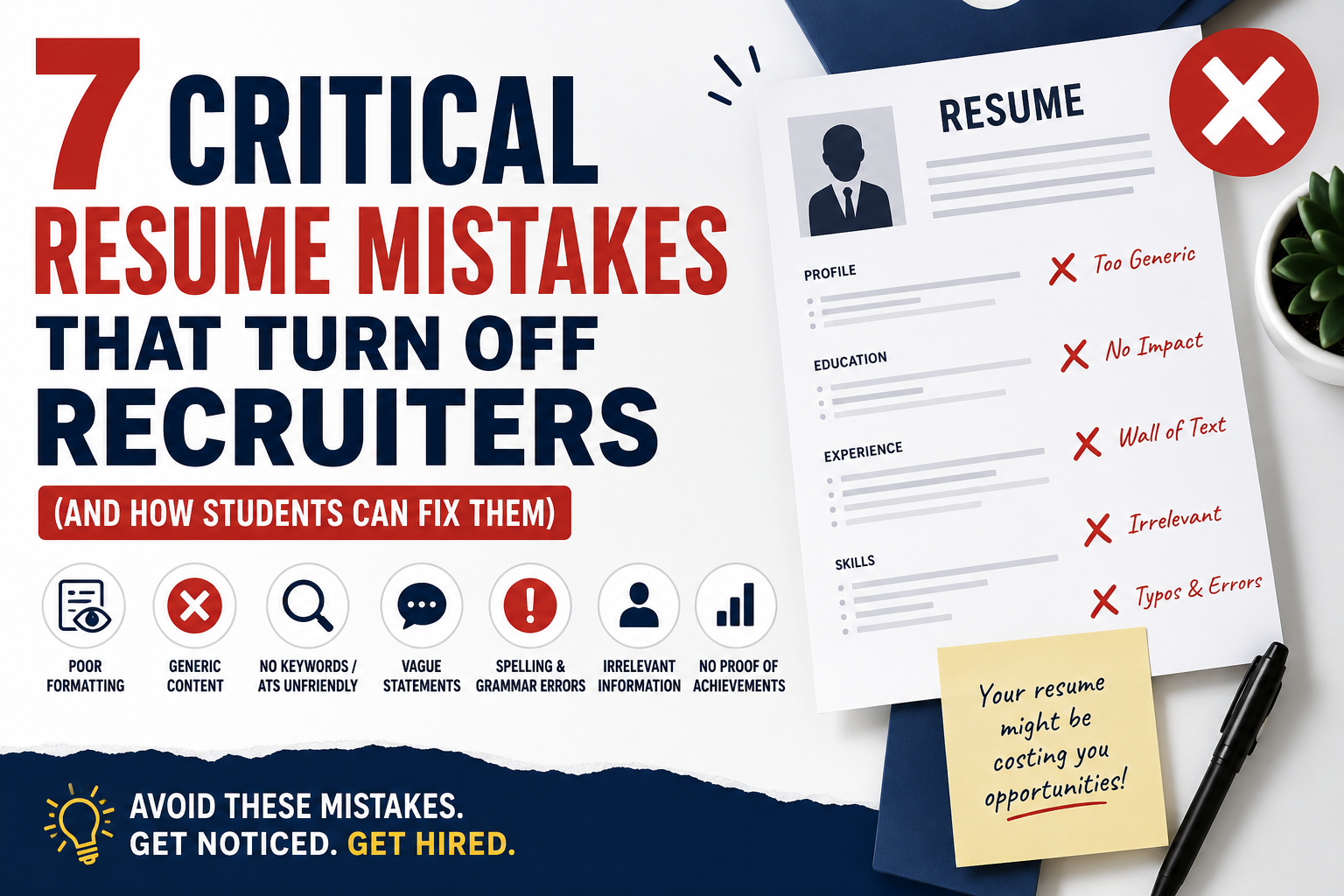
Your resume is your personal marketing document. It introduces your skills, education, achievements, and potential to employers before you ever get the chance to speak with them. For students and fresh graduates, a well-crafted resume can open doors to internships, campus placements, and entry-level jobs. However, even talented candidates are often overlooked because of avoidable resume mistakes.
Recruiters typically spend just a few seconds scanning each resume during the initial screening process. If your resume is cluttered, difficult to read, or filled with generic content, it may never make it to the interview stage. The good news is that most resume mistakes are easy to fix once you know what recruiters are looking for.
At cvDragon, we help students create professional, ATS-friendly resumes that highlight their strengths and maximize their chances of getting shortlisted. In this guide, we’ll explore seven critical resume mistakes that turn off recruiters—and, more importantly, how you can fix them.
Mistake 1: Using the Same Resume for Every Job
One of the most common mistakes students make is sending the exact same resume to every employer. While it may save time, a generic resume rarely stands out because every company is looking for a slightly different combination of skills and qualifications.
Recruiters want to see that you’ve taken the time to understand the role and align your experience with the job description.
How to Fix It
Customize your resume for each application by:
- Updating your professional summary.
- Including keywords from the job description.
- Highlighting the most relevant projects.
- Rearranging your skills based on the role.
- Prioritizing certifications that match the position.
A tailored resume significantly increases your chances of passing Applicant Tracking Systems (ATS) and catching the recruiter’s attention.
Mistake 2: Writing Responsibilities Instead of Achievements
Many student resumes contain bullet points like:
- Responsible for organizing events
- Worked on a website
- Assisted with marketing
- Helped manage social media
These statements describe tasks but fail to show the value you created.
Recruiters are far more interested in results than responsibilities.
How to Fix It
Use action verbs and measurable achievements whenever possible.
Instead of:
“Responsible for organizing a technical workshop.”
Write:
“Organized a technical workshop attended by 250+ students by coordinating speakers, managing registrations, and promoting the event across campus.”
Whenever possible, include numbers, percentages, or measurable outcomes to strengthen your resume.
Mistake 3: Ignoring ATS-Friendly Formatting
Many companies use Applicant Tracking Systems to organize and search resumes. Complex layouts, graphics, tables, and decorative designs can make it difficult for ATS software to read your information accurately.
A visually attractive resume isn’t helpful if the software cannot interpret it.
How to Fix It
Create a clean and professional layout by:
- Using a single-column format.
- Choosing standard fonts like Arial, Calibri, or Times New Roman.
- Using clear section headings such as Education, Skills, Projects, and Certifications.
- Avoiding graphics, icons, text boxes, and excessive colors.
- Saving your resume in the format requested by the employer.
Simple formatting improves readability for both ATS software and recruiters.
Mistake 4: Listing Skills Without Proof
Many resumes include a long list of skills but provide no evidence that the candidate can actually use them.
For example:
- Leadership
- Communication
- Python
- Teamwork
- Problem Solving
Without supporting examples, these skills may appear generic.
How to Fix It
Demonstrate your skills through projects, internships, competitions, volunteer work, or leadership experiences.
For example:
“Developed a Python-based inventory management application that reduced manual data entry during an academic project.”
Or:
“Led a team of six students during a national hackathon to design a mobile healthcare solution.”
Showing how you’ve applied your skills makes them more believable and impactful.
Mistake 5: Including Irrelevant or Outdated Information
Students sometimes fill their resumes with information that doesn’t add value, such as:
- Primary school achievements
- Irrelevant hobbies
- Unrelated certifications
- Excessive personal details
- Old awards that no longer reflect current abilities
This takes attention away from your strongest qualifications.
How to Fix It
Focus on information that supports the position you’re applying for.
Include:
- Relevant academic projects
- Recent certifications
- Technical skills
- Leadership roles
- Volunteer experience
- College achievements
- Internships
- Industry-related competitions
Every section should strengthen your application.
Mistake 6: Poor Grammar, Spelling, and Formatting
Even small mistakes can create a negative impression. Recruiters often view grammatical errors and inconsistent formatting as signs of carelessness or a lack of attention to detail.
Common issues include:
- Misspelled words
- Inconsistent bullet points
- Uneven spacing
- Mixed fonts
- Incorrect dates
- Broken hyperlinks
These errors can make an otherwise strong resume look unprofessional.
How to Fix It
Before submitting your resume:
- Proofread it multiple times.
- Use spelling and grammar tools.
- Ask a mentor, professor, or friend to review it.
- Verify all contact information.
- Test LinkedIn and portfolio links.
- Check that dates and formatting are consistent.
A polished resume reflects professionalism and attention to detail.
Mistake 7: Writing a Weak Professional Summary
Many students either skip the professional summary altogether or write vague objective statements such as:
“Looking for a challenging position where I can grow.”
This tells recruiters very little about your qualifications.
How to Fix It
Write a concise professional summary that highlights your strengths, education, skills, and career goals.
For example:
“Motivated Mechanical Engineering student with strong analytical skills and hands-on experience in CAD design, academic engineering projects, and robotics competitions. Passionate about product development and eager to contribute to innovative engineering teams.”
A strong summary encourages recruiters to continue reading your resume.
Bonus Tips to Make Your Resume Stand Out
Beyond avoiding these seven mistakes, here are a few additional strategies that can improve your resume:
- Keep your resume to one page if you’re a student or recent graduate.
- Start bullet points with strong action verbs such as Developed, Designed, Led, Implemented, and Analyzed.
- Quantify achievements wherever possible.
- Include relevant certifications and online courses.
- Showcase academic projects that demonstrate practical skills.
- Add leadership roles from clubs, events, or student organizations.
- Tailor your resume for every internship or job application.
These small improvements can make a significant difference in how recruiters perceive your application.
Resume Review Checklist
Before submitting your resume, ask yourself:
- Is it customized for the specific job?
- Does it use relevant keywords from the job description?
- Are achievements highlighted instead of responsibilities?
- Is the formatting simple and ATS-friendly?
- Are skills supported with real examples?
- Is all information relevant and up to date?
- Have I checked for grammar and spelling errors?
- Does the professional summary clearly communicate my strengths?
If you can answer “yes” to all these questions, your resume is in excellent shape.
Final Thoughts
Your resume doesn’t need years of professional experience to impress recruiters—it needs clarity, relevance, and evidence of your potential. By avoiding these seven common mistakes, you can transform your resume into a powerful document that showcases your abilities, achievements, and readiness for the workplace.
Remember that recruiters are looking for candidates who demonstrate initiative, problem-solving skills, continuous learning, and a genuine interest in the role. Whether you’re applying for your first internship or preparing for campus placements, a well-structured, ATS-friendly resume can significantly improve your chances of getting noticed.
At cvDragon, we specialize in helping students create professional resumes that stand out to both Applicant Tracking Systems and hiring managers. With the right strategy, attention to detail, and a focus on achievements, your resume can become the first step toward a successful and rewarding career.
Leave a Reply