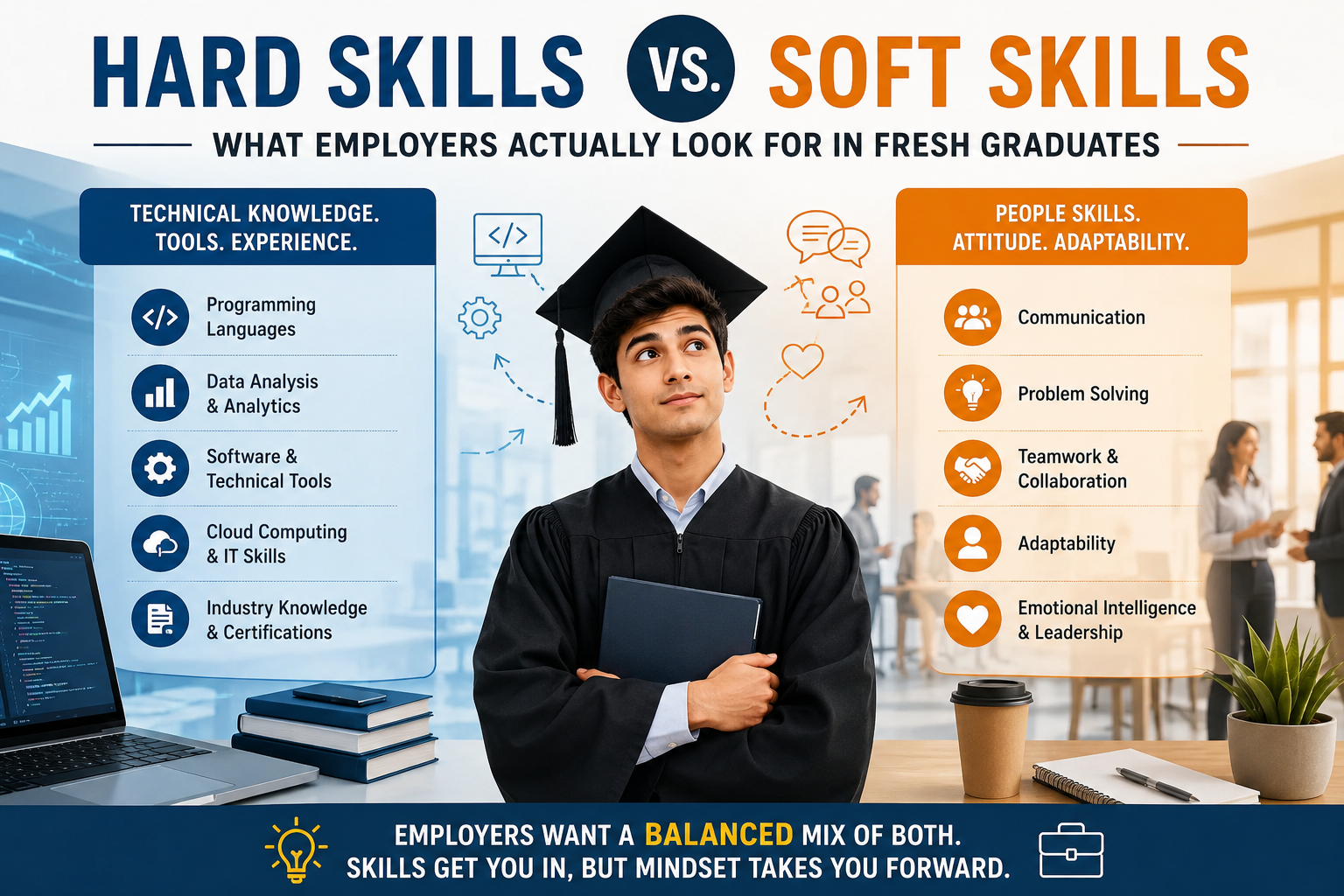
When you are preparing to graduate and enter the job market, you will constantly hear recruiters talk about two distinct categories: hard skills and soft skills.
But as a fresh graduate with limited professional experience, where should you focus your energy? Should you spend your final semester crampering in another technical certification, or should you work on how you communicate in a team?
The truth is that the modern workplace doesn’t value one over the other—it values how they connect. Here is a breakdown of what employers actually look for in fresh graduates and how to showcase both on your resume.
The Core Definitions: Hard vs. Soft Skills
To build a balanced resume, you must first understand how these two skill sets function in the eyes of a hiring manager.
Hard Skills (The “What You Do”)
Hard skills are the technical, quantifiable abilities required to perform a specific job. They are learned through formal education, certifications, training programs, and direct practice.
- Examples: Python programming, SEO optimization, financial modeling, video editing, data analysis, or foreign language proficiency.
- How employers see them: They serve as the baseline ticket to entry. If a job requires an entry-level accountant, knowing how to navigate Excel or QuickBooks is non-negotiable.
Soft Skills (The “How You Do It”)
Soft skills are your interpersonal abilities, character traits, and cognitive habits that dictate how you work independently and alongside others.
- Examples: Emotional intelligence, active listening, time management, adaptability, leadership, and conflict resolution.
- How employers see them: They determine your long-term success and cultural fit. Technical skills can be taught relatively quickly on the job, but teaching a fresh graduate how to take constructive criticism gracefully is much harder.
What Employers Actually Look For: The Reality Check
While technical competence gets your resume past the initial Applicant Tracking System (ATS) screening, your soft skills are what usually win you the job offer during the interview stage.
According to various global corporate workplace studies, employers look for a highly specific blend of both when hiring recent college graduates:
1. High Trainability (Soft) Over Advanced Expertise (Hard)
Managers do not expect a 21-year-old fresh graduate to be a master strategist. What they do expect is a growth mindset. Employers want candidates who can absorb technical training quickly, ask insightful questions, and admit when they need help.
2. Communication and Collaboration
In a world dominated by remote and hybrid work environments, clear communication is more critical than ever. Employers look for graduates who can write professional emails, synthesize complex data into a clear summary, and collaborate across diverse teams without friction.
3. Basic Digital and Technical Fluency
Even if you are entering a non-technical field like HR, marketing, or healthcare, employers expect fresh graduates to be digitally native. You should have a baseline comfort level with workplace technology, such as project management tools (Asana, Trello) or collaboration suites (Slack, Microsoft Teams).
How to Balance Both Skills on a Student Resume
A common mistake made by fresh graduates is creating a resume that leans entirely to one side—either a dry list of software tools or a vague collection of buzzwords like “hardworking team player.”
Use this checklist to structure your skills section strategically:
- Avoid the Buzzword Trap: Instead of writing “Excellent problem-solver” under your skills section, prove it in your experience bullet points. Use action-oriented phrases like: “Resolved a critical logistical bottleneck during the campus cultural fest, reducing vendor check-in times by 20%.”
- Create a Split Skills Section: Divide your skills section visually into technical tools and core competencies so it is highly scannable for recruiters.
- Anchor Soft Skills to Real Scenarios: If you want to claim “Leadership” as a soft skill, make sure your experience section highlights a time you led a group capstone project, spearheaded a club initiative, or managed a shift at a part-time retail job.
Quick Comparison: The Ideal Fresh Graduate Mix
| Essential Hard Skills for Graduates | Essential Soft Skills for Graduates |
| Data Literacy: Basic Excel/Google Sheets, understanding simple metrics. | Adaptability: Comfort with shifting project requirements and learning new tools. |
| Industry Software: Tools specific to your major (e.g., Figma for designers, Salesforce for sales). | Time Management: Ability to meet competing project deadlines without constant supervision. |
| Professional Writing: Crafting structured reports, clean emails, and concise briefs. | Critical Thinking: Attempting to solve a problem on your own before asking a manager for the answer. |
💡 CVDragon Pro Tip: Think of your hard skills as the foundation of a house and your soft skills as the framework that holds it together. When tailoring your resume for an application, look at the job description. Dedicate roughly 60% of your listed skills to the technical requirements mentioned, and use the remaining 40% to highlight the interpersonal traits the company explicitly values.
At CVDragon, we offer clean, modern resume templates that let you display your technical certifications and interpersonal strengths side-by-side perfectly. Build your professional, ATS-friendly fresh graduate resume with us today.
Leave a Reply