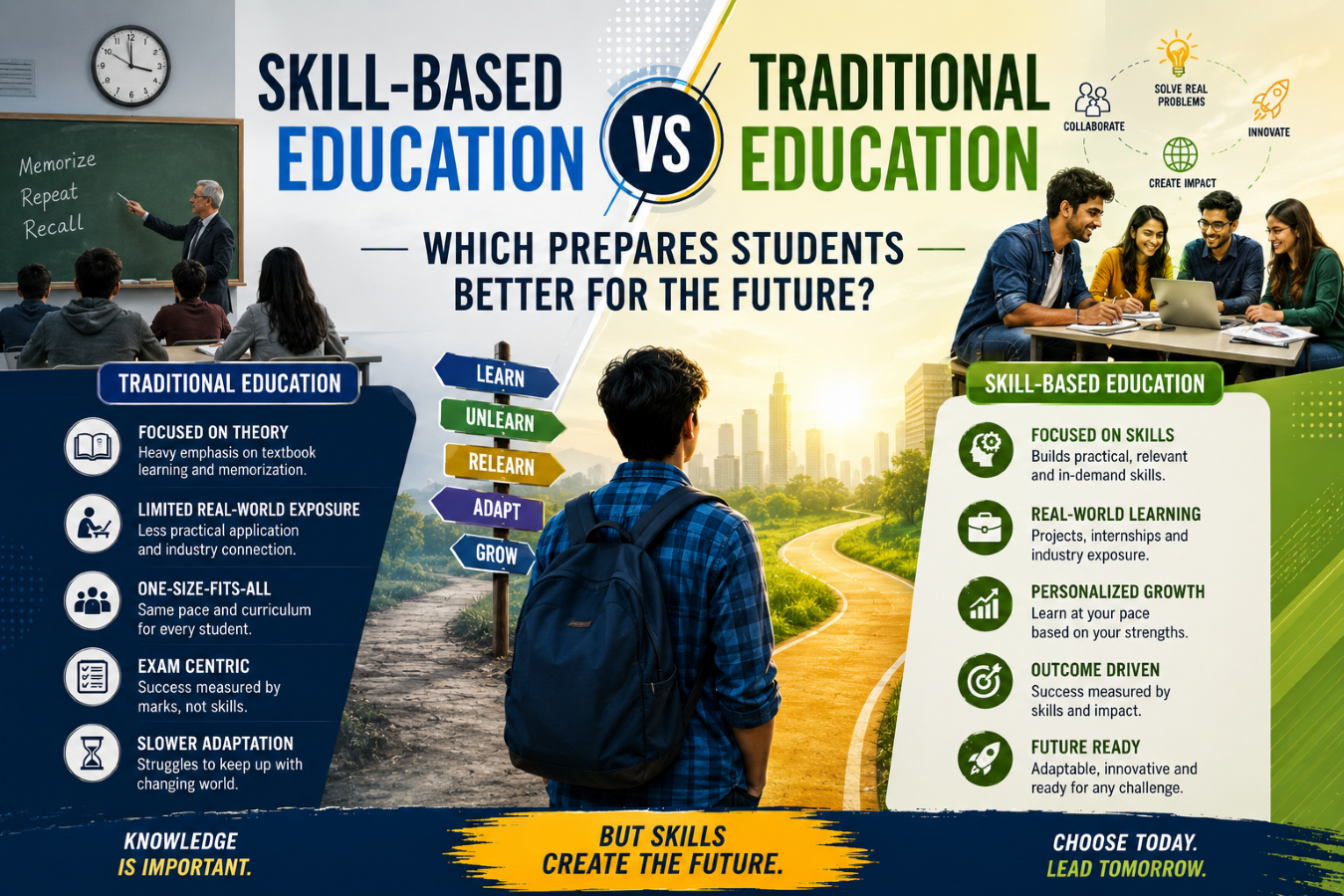
Education has always been the foundation of personal and professional growth. For decades, traditional education has been the dominant model, focusing on academic knowledge, examinations, and theoretical understanding. However, the modern job market is changing rapidly. Employers are increasingly looking for candidates who can apply knowledge, solve real-world problems, communicate effectively, and adapt to new technologies. This shift has sparked a growing debate between skill-based education and traditional education.
At CVDragon, we believe that understanding the differences between these two approaches is essential for students, parents, and educators. Both models offer valuable benefits, but their impact on career readiness and future opportunities can differ significantly.
What Is Traditional Education?
Traditional education is the conventional system followed by most schools and universities. It primarily focuses on structured curricula, classroom lectures, textbooks, examinations, and academic grades. Students learn subjects such as mathematics, science, history, literature, and commerce through theoretical instruction.
The main objective of traditional education is to build foundational knowledge and intellectual understanding. It helps students develop discipline, academic reasoning, and subject-specific expertise. For many professions such as medicine, law, and research, strong theoretical education remains extremely important.

What Is Skill-Based Education?
Skill-based education focuses on developing practical abilities that can be directly applied in real-world situations. Instead of emphasizing memorization and examinations alone, it encourages hands-on learning, projects, internships, problem-solving, communication, digital literacy, and industry-relevant training.
Examples of skill-based learning include coding, digital marketing, graphic design, data analytics, financial modeling, public speaking, project management, and entrepreneurship. The goal is to prepare students for employment, freelancing, business opportunities, and evolving workplace demands.
The Key Difference
|
Traditional Education |
Skill-Based Education |
|---|---|
|
Theory-focused |
Practice-focused |
|
Exam-oriented |
Project-oriented |
|
Fixed curriculum |
Industry-driven curriculum |
|
Grades are emphasized |
Competencies are emphasized |
|
Teacher-centered learning |
Learner-centered learning |
|
Long-term academic foundation |
Immediate employability |
Why Traditional Education Still Matters
Despite criticism, traditional education continues to play a vital role in society. It provides students with a broad understanding of subjects, develops analytical thinking, and creates a foundation for advanced learning.
Traditional education also helps students:
-
Understand fundamental concepts deeply.
-
Develop academic discipline.
-
Prepare for professional degrees.
-
Build research and theoretical knowledge.
-
Gain recognized qualifications.
For careers such as medicine, engineering, law, academia, and scientific research, rigorous theoretical education remains essential.
The Growing Importance of Skill-Based Education
The modern economy is evolving faster than ever. New technologies, automation, artificial intelligence, and digital transformation are changing the nature of work. Many employers now prioritize practical skills and real-world experience alongside academic qualifications.
Skill-based education offers several advantages:
-
Faster adaptation to industry needs.
-
Greater employability.
-
Hands-on experience.
-
Portfolio development.
-
Entrepreneurial opportunities.
-
Better workplace readiness.
Students who learn practical skills early often find it easier to secure internships, freelance projects, and entry-level jobs.
The Employability Factor
One of the biggest concerns among graduates is employability. Many students complete degrees but struggle to meet employer expectations because they lack practical experience.

Skill-based education helps bridge this gap by allowing students to apply what they learn. Employers frequently value candidates who can demonstrate real projects, internships, certifications, and problem-solving abilities.
For example, a student with a marketing degree and hands-on experience in SEO, social media campaigns, and analytics may have a stronger job profile than someone with theoretical knowledge alone.
The Role of Technology
Technology has accelerated the demand for skill-based learning. Online platforms, virtual internships, digital tools, and remote work opportunities have made practical learning more accessible than ever.
Students can now learn coding, data analysis, graphic design, video editing, digital marketing, and many other skills from anywhere in the world. This accessibility has made skill development an important part of career planning.
Challenges of Traditional Education
Traditional education faces several challenges in today’s fast-changing environment:
-
Curricula may become outdated.
-
Limited practical exposure.
-
Heavy focus on examinations.
-
Less emphasis on soft skills.
-
Slower adaptation to industry trends.
As industries evolve rapidly, educational institutions often struggle to update programs quickly enough to match market needs.
Challenges of Skill-Based Education
Skill-based education is not without limitations. Focusing only on practical skills can sometimes result in a weaker theoretical foundation.
Potential challenges include:
-
Limited conceptual depth.
-
Skills becoming outdated quickly.
-
Over-specialization at an early stage.
-
Lack of broader academic exposure.
-
Variations in training quality.
Without strong foundational knowledge, students may find it harder to adapt to complex or advanced professional roles later in their careers.
Why the Best Approach Is a Combination of Both
Rather than viewing skill-based education and traditional education as opposites, many experts believe the most effective model combines both approaches.
A balanced education should provide:
-
Strong theoretical foundations.
-
Practical industry skills.
-
Communication abilities.
-
Critical thinking.
-
Digital literacy.
-
Problem-solving experience.
-
Internship opportunities.
-
Project-based learning.
For example, an engineering student benefits from learning core engineering principles through traditional education while also gaining hands-on experience through projects, internships, and technical certifications.
How Students Can Prepare for the Future
To succeed in the modern job market, students should actively combine academic learning with skill development.
Practical steps include:
-
Taking online certification courses.
-
Building portfolio projects.
-
Participating in internships.
-
Joining competitions and hackathons.
-
Improving communication skills.
-
Learning digital tools.
-
Networking with professionals.
-
Staying updated with industry trends.
This combination creates a stronger professional profile and improves long-term career prospects.
The Future of Education
Educational systems worldwide are increasingly moving toward hybrid models that integrate academic knowledge with practical skill development. Universities are introducing internships, industry collaborations, project-based assessments, and entrepreneurship programs to improve career readiness.
Employers are also recognizing that the ideal candidate is not someone who only scores well in exams, but someone who can learn continuously, adapt quickly, and contribute effectively in real-world situations.
Conclusion
The debate between skill-based education vs traditional education is not about choosing one and rejecting the other. Both approaches offer unique strengths. Traditional education builds foundational knowledge, intellectual depth, and academic discipline, while skill-based education develops practical abilities, workplace readiness, and employability.
At CVDragon, we believe the future belongs to students who combine the best of both worlds. A strong academic foundation supported by practical skills, real-world projects, internships, and continuous learning creates a powerful advantage in today’s competitive job market. Students who embrace both knowledge and skills will be better prepared to adapt, innovate, and succeed in the careers of tomorrow.
Leave a Reply