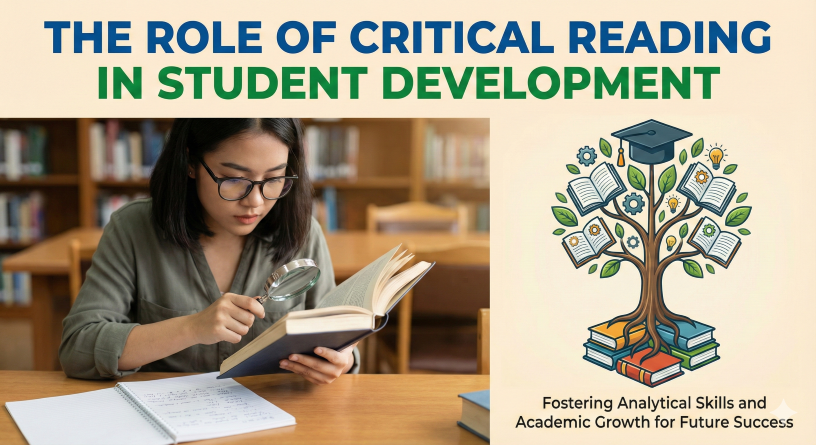
In an age overflowing with information, critical reading has become one of the most essential skills for student growth. Whether students are analyzing academic texts, engaging with digital content, or evaluating real-world information, the ability to read critically empowers them to think deeper, learn smarter, and make informed decisions.
Critical reading goes beyond simply understanding words on a page. It involves questioning ideas, examining evidence, identifying viewpoints, and evaluating the credibility of information. As a result, it plays a transformative role in academic success, personal development, and future career readiness.
In this article, we explore why critical reading matters and how it contributes to overall student development.
What Is Critical Reading?
Critical reading is the process of engaging actively with a text. It involves:
-
Analyzing content rather than accepting it at face value
-
Identifying the author’s purpose, tone, and biases
-
Evaluating the quality of evidence
-
Connecting ideas with prior knowledge
-
Reflecting on what the text means and how it applies to real life
Unlike passive reading, which focuses only on comprehension, critical reading demands curiosity, questioning, and thoughtful judgment.
Why Critical Reading Matters in Student Development
1. Enhances Analytical and Logical Thinking
Critical reading helps students break down complex information into manageable pieces. By examining arguments, identifying assumptions, and assessing evidence, students strengthen their ability to think logically.
This analytical mindset benefits them in subjects like science, mathematics, and humanities, where reasoning and interpretation are key.
2. Improves Academic Performance
Many academic tasks—research papers, essays, debates, and exams—require strong reading and interpretation skills. Students who practice critical reading are better at:
-
Understanding complex texts
-
Distinguishing facts from opinions
-
Synthesizing information
-
Answering application-based questions
This leads to higher comprehension, better grades, and more confident academic performance.
3. Boosts Communication and Writing Skills
Good writing begins with good reading. Critical readers learn how authors structure arguments, present evidence, and use language effectively. This helps students:
-
Build coherent arguments
-
Use stronger vocabulary
-
Improve grammar and sentence structure
-
Write persuasively and creatively
Strong communication skills are essential for academic success as well as future professions.
4. Encourages Independent Thinking
Critical reading fosters independence by helping students form their own opinions rather than relying on others’ viewpoints. They learn to:
-
Evaluate information critically
-
Identify misleading or biased content
-
Make informed choices
This independence is crucial in a digital world filled with advertisements, misinformation, and biased media.
5. Strengthens Problem-Solving Ability
When students examine arguments and evidence, they become better problem-solvers. Critical reading teaches them to:
-
Recognize challenges
-
Explore causes and effects
-
Consider multiple perspectives
-
Find logical solutions
These skills are essential in both academic work and real-life decision-making.
6. Develops Emotional Intelligence and Empathy
Reading critically also involves understanding perspectives and emotions found in stories, essays, and narratives. Students learn to:
-
Interpret characters’ motivations
-
Recognize emotional undertones
-
Understand diverse viewpoints
This builds empathy and emotional intelligence, which improves relationships and teamwork skills.
7. Prepares Students for Real-World Challenges
In the workplace, employees must analyze data, read reports, evaluate proposals, and make evidence-based decisions. Critical reading prepares students for such responsibilities by strengthening their ability to:
-
Assess the credibility of information
-
Interpret instructions accurately
-
Collaborate intelligently
-
Think from multiple perspectives
Professionals who read critically are better leaders, problem-solvers, and decision-makers.
How Students Can Develop Critical Reading Skills
1. Ask Questions While Reading
Encourage students to question everything:
-
What is the main idea?
-
What evidence supports this?
-
Is there bias?
-
What is the purpose of the text?
Asking questions turns reading into an active process.
2. Annotate and Highlight Key Information
Noting down ideas, marking important lines, and summarizing paragraphs helps students understand texts more deeply.
3. Compare Multiple Sources
Students should look at different viewpoints to gain a balanced understanding. This promotes open-mindedness and deeper analysis.
4. Practice Reflective Thinking
After reading, students should reflect on:
-
What they learned
-
What they agree or disagree with
-
How the information applies to real life
Reflection strengthens long-term learning.
5. Participate in Discussions
Debating or discussing the text with peers improves comprehension and exposes students to diverse perspectives.
6. Read a Variety of Materials
From academic texts to newspapers, novels, research papers, and blogs—diverse reading material sharpens comprehension and analytical abilities.
Conclusion
Critical reading is not just an academic skill—it’s a life skill that shapes how students think, learn, and interact with the world. By fostering analytical thinking, improving writing and communication, building independence, and preparing students for real-world challenges, critical reading plays a vital role in student development.
When students adopt critical reading habits, they become more informed, thoughtful, and confident individuals—ready to succeed academically and thrive in their future careers.
Leave a Reply