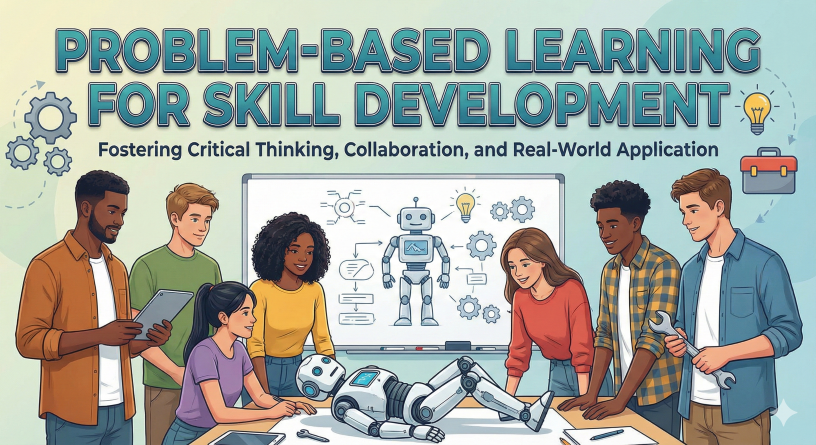
In today’s rapidly evolving job market, recruiters are no longer impressed by academic degrees alone. They look for candidates who can think critically, solve real-world problems, collaborate effectively, and adapt quickly. With technology reshaping industries, skill requirements are shifting faster than traditional education systems can keep up.
This is where Problem-Based Learning (PBL) emerges as a transformative approach to skill development. At cvDragon, where we help students and job seekers build powerful résumés and become employment-ready, we recognize that PBL is one of the most effective learning models for preparing individuals for real-world challenges.
What Is Problem-Based Learning?
Problem-Based Learning (PBL) is a student-centered educational approach where learners gain knowledge and skills by working through realistic, meaningful problems. Instead of memorizing concepts, students are encouraged to:
-
Ask questions
-
Analyze situations
-
Conduct research
-
Brainstorm solutions
-
Work collaboratively
-
Reflect on outcomes
In simple terms, PBL teaches students how to learn, not just what to learn. This shift makes learning more engaging, practical, and aligned with workplace expectations.
Why Is Problem-Based Learning Important Today?
Modern professionals face challenges that require multi-dimensional thinking. Whether it’s solving a business bottleneck, improving a customer experience, or analyzing data trends, employers expect candidates to approach problems creatively and strategically.
Traditional educational methods often focus on theoretical learning and standardized exams, leaving a gap between academic knowledge and practical skills. PBL helps bridge that gap.
Here are some reasons why PBL is gaining prominence:
1. Prepares Learners for Real-World Challenges
With PBL, learners work on authentic problems similar to those faced in workplaces. This makes learning contextual, practical, and meaningful.
2. Encourages Critical Thinking & Creativity
Instead of simply accepting information, students question, evaluate, and create solutions — the same cognitive abilities employers seek.
3. Promotes Collaboration and Communication
Group-based problem solving improves interpersonal and leadership skills, making individuals better team players.
4. Enhances Research and Analytical Abilities
Students learn how to find information, interpret it, and apply it — a must-have skill in any data-driven profession.
5. Builds Self-Confidence and Independence
Finding solutions independently gives learners a sense of accomplishment and prepares them for decision-making roles.
6. Improves Long-Term Knowledge Retention
Learning through experience ensures that concepts stay with the learner far longer than rote memorization ever could.
Core Skills Developed Through Problem-Based Learning
At cvDragon, we have closely observed that candidates who engage in PBL demonstrate an impressive range of career-ready skills, including:
✔ Critical Thinking
Students evaluate information, identify patterns, and assess the validity of solutions.
✔ Problem-Solving
They learn how to break down complex issues into manageable parts and design workable solutions.
✔ Teamwork
PBL requires collaboration, making students more comfortable with group work and shared accountability.
✔ Time Management
Projects usually come with deadlines, teaching learners how to prioritize tasks and manage schedules.
✔ Research Skills
From data collection to comparative analysis, PBL boosts a learner’s ability to research effectively.
✔ Communication and Presentation
Learners discuss ideas, justify solutions, and present findings — building strong communication skills.
✔ Adaptability
As problems evolve, students must adapt, pivot, and redesign strategies — just like in real professional environments.
✔ Leadership
Roles such as project coordinators, discussion leaders, and task managers naturally arise during PBL activities.
These skills collectively make candidates far more attractive to employers, and they form the foundation of an impactful résumé — something cvDragon helps highlight in professional formats.
How Problem-Based Learning Works: A Step-by-Step Process
A typical Problem-Based Learning framework includes the following steps:
1. Identifying a Real-World Problem
The process begins with presenting a scenario — such as a business losing customers, an environmental concern, or a technological challenge.
2. Brainstorming What Is Known and What Needs to Be Known
Students discuss the information they already possess and identify the knowledge they need to gather.
3. Research and Independent Study
Learners dive into articles, real data, reports, and expert opinions to gather insights.
4. Generating Possible Solutions
Teams analyze findings and propose multiple strategies.
5. Selecting the Best Solution
After evaluating practicality, feasibility, and impact, the most effective solution is chosen.
6. Presenting the Findings
Students communicate their process and conclusions through presentations, reports, or prototypes.
7. Reflection and Evaluation
Finally, learners reflect on the experience — what worked, what didn’t, and what they learned.
This cycle mirrors real professional problem-solving, making PBL an excellent training ground for job readiness.
Real-World Examples of Problem-Based Learning
To illustrate the impact of PBL, consider the following examples:
Business & Management
Students analyze declining sales for a company and create a marketing strategy, strengthening their analytical and strategic thinking.
Engineering
A team might be tasked with designing a low-cost water purification method, enhancing technical creativity.
IT & Computer Science
Students may develop an app to solve a community issue, learning coding, UX design, and testing along the way.
Healthcare
Medical students diagnose simulated patients by gathering symptoms, researching conditions, and proposing treatment plans.
Each scenario builds hands-on knowledge and aligns perfectly with industry expectations.
Why PBL Matters to Job Seekers — The cvDragon Perspective
At cvDragon, we help lakhs of students and professionals create powerful résumés and portfolios. We have found that employers highly value candidates who can demonstrate PBL experiences, such as:
-
Academic projects
-
Internship challenges
-
Real-world case studies
-
Research-based assignments
-
Innovation competitions
-
Capstone or final-year projects
These experiences reflect practical exposure and problem-solving abilities — qualities hiring managers prefer over theoretical achievements alone.
With cvDragon’s résumé-building tools, candidates can showcase:
-
Key projects
-
Skills developed
-
Real problems solved
-
Achievements and outcomes
This adds credibility to their profile and significantly strengthens job applications.
How Institutions Can Integrate Problem-Based Learning
Educational institutions aiming to adopt PBL can follow these approaches:
1. Use Real Industry Problems
Collaborate with companies, NGOs, and startups to bring real challenges into the classroom.
2. Encourage Interdisciplinary Projects
Problems rarely fit into one subject; neither should their solutions.
3. Train Educators in Facilitation
Teachers become mentors, guiding the learning process rather than delivering lectures.
4. Incorporate Technology Tools
Using research platforms, collaboration apps, and simulation software enhances the PBL experience.
5. Evaluate Process, Not Just Results
Assessment should focus on analysis, teamwork, creativity, and execution.
By implementing PBL, institutions can help students transition smoothly into skilled professionals.
The Future of Skill Development with PBL
As automation grows and industries transform, PBL will play an even larger role in building future-ready talent. The learning trends show a clear movement toward:
-
Experiential learning
-
Industry-academia collaborations
-
Hands-on project-based assessments
-
Lifelong learning and continuous upskilling
Problem-Based Learning aligns perfectly with these trends, preparing individuals for a world where adaptability, innovation, and critical thinking are non-negotiable.
Conclusion
Problem-Based Learning is more than an educational technique — it’s a mindset that encourages exploration, innovation, and resilience. In a competitive job market, candidates equipped with PBL experience stand out because they can not only understand problems but solve them intelligently and creatively.
At cvDragon, our mission is to help students and professionals present their true potential. By highlighting PBL-based achievements and skills in their résumés, candidates can significantly improve their employability and confidence.
If you want to showcase your PBL projects or skills effectively, cvDragon is here to help you craft a résumé that reflects your strengths and stands out from the crowd.
Leave a Reply