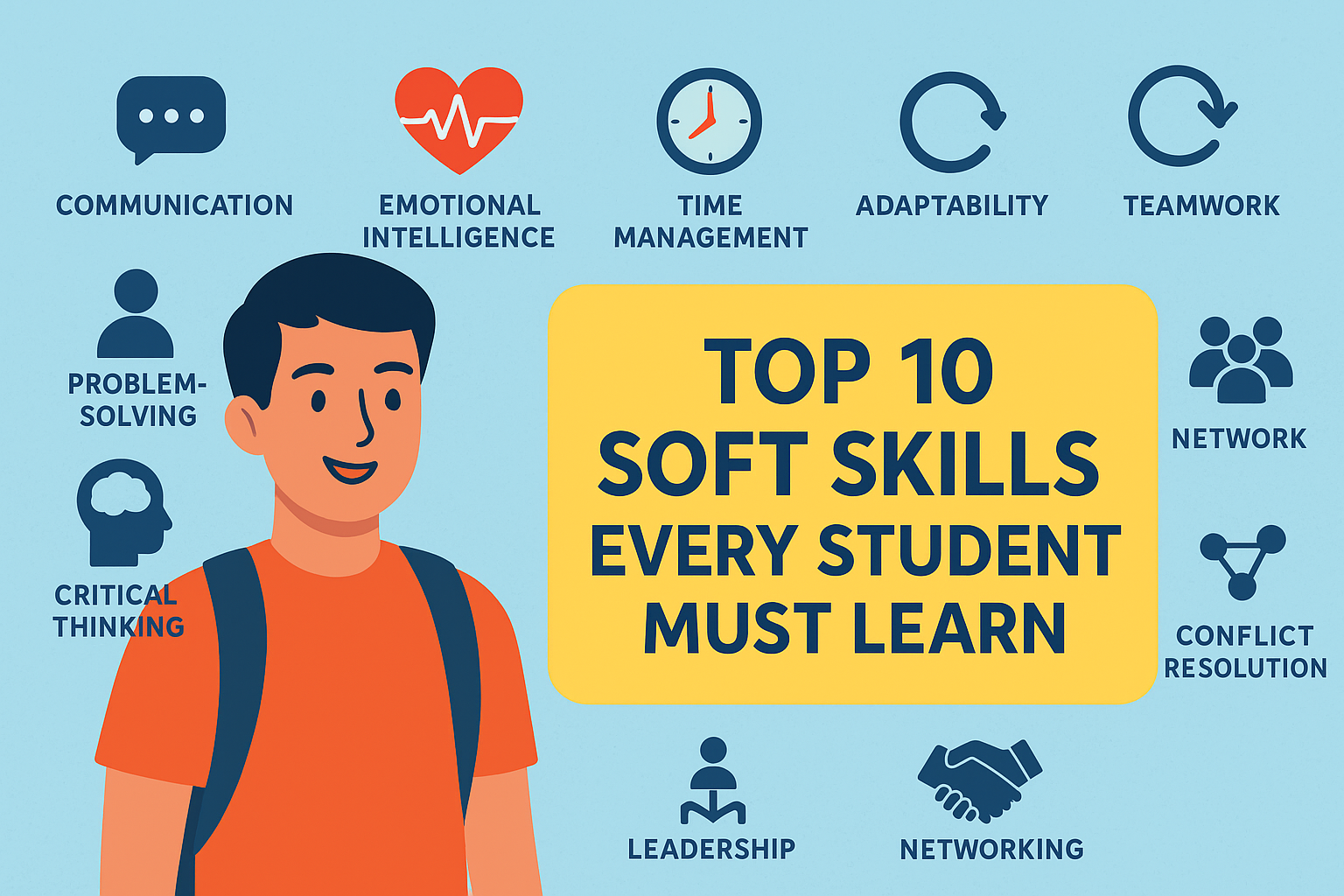
In today’s competitive world, excelling in academics is no longer the only measure of a student’s potential. While technical knowledge and academic achievements are essential, they alone cannot guarantee success in professional or personal life. Employers, educational institutions, and organizations increasingly look for individuals who possess soft skills—the interpersonal, emotional, and cognitive abilities that allow one to navigate challenges, communicate effectively, and collaborate efficiently.
Soft skills are the bridge between knowledge and action. They enable students to apply what they learn in real-world situations, manage relationships, and adapt to rapidly changing environments. For students preparing to enter higher education or the workforce, developing these skills is as crucial as mastering their core subjects.
Here, CvDragon highlights the top ten soft skills every student must learn to thrive in today’s world.
-
Communication Skills
Communication is the cornerstone of all human interaction. Students who can articulate their thoughts clearly, listen actively, and adapt their message to their audience have a significant advantage. Effective communication is not limited to speaking; it also includes writing, body language, and digital communication.
For instance, writing a concise email, presenting a project confidently, or participating in a classroom discussion all require strong communication skills. Students who master these abilities are better equipped to collaborate with peers, seek guidance from mentors, and make their voices heard in group settings.
How to Develop:
- Practice public speaking in clubs or classrooms.
- Engage in debates or group discussions.
- Write regularly, such as journals, essays, or blogs, to refine clarity and structure.
-
Emotional Intelligence
Emotional intelligence (EQ) refers to the ability to recognize, understand, and manage your emotions while empathizing with the feelings of others. High EQ allows students to navigate social interactions, handle stress, and resolve conflicts effectively.
A student with strong emotional intelligence can remain calm during exams, respond constructively to criticism, and maintain positive relationships with peers and teachers. In professional life, EQ often distinguishes great leaders and collaborators from technically competent but socially unaware individuals.
How to Develop:
- Reflect on your emotions daily and identify triggers.
- Practice empathy by listening actively to others.
- Learn stress management techniques like mindfulness or meditation.
-
Time Management
Time management is the ability to plan and control how much time to spend on specific tasks. Students often juggle multiple responsibilities: classes, assignments, extracurricular activities, and personal commitments. Without effective time management, tasks pile up, stress increases, and performance suffers.
Mastering this skill helps students set priorities, meet deadlines, and balance academics with hobbies and social life. Efficient time management also fosters self-discipline, a trait highly valued in higher education and the workplace.
How to Develop:
- Create a daily or weekly schedule.
- Use tools like planners, calendars, or productivity apps.
- Break tasks into smaller, manageable parts and avoid procrastination.
-
Adaptability
The modern world is dynamic, and the ability to adapt to change is crucial. Adaptable students can handle new environments, unexpected challenges, and shifting priorities with ease. Whether it’s a new teaching method, online learning, or group project changes, adaptability ensures resilience and continuous growth.
Adaptability also fosters creativity and problem-solving, as flexible thinkers are more likely to explore innovative solutions instead of rigidly adhering to one approach.
How to Develop:
- Step out of your comfort zone regularly.
- Take up new activities or challenges.
- Learn to embrace change instead of resisting it.
-
Problem-Solving Skills
Problem-solving is the capacity to analyze situations, identify issues, and devise practical solutions. In academic settings, students face challenges such as complex assignments or projects that require critical thinking. In life, problem-solving helps navigate personal, social, and professional obstacles.
Students who develop strong problem-solving skills demonstrate initiative, logical thinking, and creativity. Employers value these individuals because they can address challenges independently without constant supervision.
How to Develop:
- Engage in puzzles, case studies, or strategic games.
- Break problems into smaller components and analyze each part.
- Seek multiple perspectives before deciding on a solution.
-
Critical Thinking
Critical thinking involves questioning assumptions, evaluating evidence, and making reasoned decisions. Students with this skill can distinguish between fact and opinion, identify biases, and approach problems systematically.
Critical thinkers do not simply memorize information; they understand the “why” behind concepts. This skill is essential for academic research, writing, and decision-making in professional settings.
How to Develop:
- Practice analyzing articles, news, and reports critically.
- Engage in discussions that challenge your viewpoints.
- Ask open-ended questions to explore deeper meanings.
-
Teamwork and Collaboration
Most careers today involve working in teams. Students must learn to cooperate, respect differing opinions, and contribute meaningfully to group objectives. Effective teamwork requires listening, sharing responsibilities, and resolving conflicts constructively.
Collaborative skills also foster leadership and empathy, as students learn to balance individual goals with collective success. Strong team players are often more adaptable and better at networking, both of which enhance career prospects.
How to Develop:
- Participate in group projects, clubs, or sports.
- Practice active listening and provide constructive feedback.
- Learn to compromise without sacrificing core principles.
-
Leadership Skills
Leadership is not just about holding a title; it’s about inspiring, guiding, and motivating others toward shared goals. Students can develop leadership qualities through class activities, volunteer work, or community service.
A good leader takes initiative, communicates effectively, and fosters a sense of teamwork. Leadership skills are not only vital for managerial roles but also for projects, academic competitions, and social initiatives.
How to Develop:
- Volunteer for responsibilities or lead group tasks.
- Learn to motivate and encourage peers.
- Observe and learn from successful leaders.
-
Conflict Resolution
Disagreements are natural, whether in classrooms, group projects, or social settings. Conflict resolution is the ability to address disagreements constructively, find common ground, and maintain positive relationships.
Students skilled in conflict resolution are more likely to handle stress calmly, build trust with peers, and contribute to a harmonious environment. This skill is particularly important in professional life, where disputes can impact team efficiency and workplace morale.
How to Develop:
- Practice active listening to understand different perspectives.
- Focus on solutions rather than blaming others.
- Stay calm and objective during disagreements.
-
Networking Skills
Networking is the art of building and nurturing professional relationships. Students who network effectively can gain mentorship, internships, and future career opportunities. Networking is not just about meeting people; it involves maintaining genuine relationships and exchanging knowledge and support.
Strong networking skills help students learn from industry experts, explore career paths, and build a professional presence early in life. These connections often become invaluable resources throughout one’s career.
How to Develop:
- Attend seminars, workshops, and social events.
- Approach professionals with curiosity and respect.
- Maintain long-term relationships through follow-ups and meaningful interactions.
Conclusion
Soft skills are no longer optional—they are essential for academic success, personal growth, and career readiness. While technical knowledge forms the foundation, soft skills determine how effectively students apply that knowledge in real-life scenarios.
By developing communication, emotional intelligence, time management, adaptability, problem-solving, critical thinking, teamwork, leadership, conflict resolution, and networking skills, students prepare themselves for a future filled with opportunities and challenges. These skills not only enhance employability but also promote self-confidence, resilience, and lifelong learning.
For students aiming to excel academically and professionally, investing time and effort in developing soft skills is as important as mastering their subjects. CvDragon encourages students to focus on holistic growth—because success is not just about what you know, but how you apply it and interact with the world.
The journey to mastering soft skills starts today. The earlier students embrace these abilities, the stronger their foundation for a successful and fulfilling life.
Leave a Reply